
Making the Car Safe for You
Roll Cage
I am not sure which safety item is the most important, Helmet, Seat Belts or the Roll Cage. The roll cage has several purposes. One, to keep you safe in a roll over accident. Two, to keep you safe in a side impact. And lastly, if it is built properly, it stiffens up the chassis for a better handling racecar. The Enduro rules do not allow us to run a full frame roll cage from front to the back. Enduro roll cages are designed to keep the driver safe. The seat, seat belts, and roll cage are an integral safety system designed for driver safety.
The Enduro Rules only require a roll bar on hardtops. A four-point roll cage is recommended, but not required in the rules. But your are required to have a full interior roll cage, if you want to carry a passenger. Myself, I can't go racing without one. I think, that at the speeds we run, justifies the building of a least a four-point basic roll cage. I've see cars get over on there tops at all three tracks during a race. At CNS, some of our lap speeds are under 221/2 seconds. This figures out to be 60 miles per hour on a 3/8ths-mile track. That's fast enough to require as much protection as possible. I don't want to be sitting sideways in turn 3 and someone hits me at 60mph without any protection. I know we travel faster on I-25, but were not sharing paint out there.
You have about four choices when it comes to putting a roll cage in your racecar.
You can have one of the local race shops like: Wade Moon, ProTech Industries, Jeff Purvis or Whithar Racing to install a roll cage in your Enduro for about $400-500. (Check with these shops for exact pricing)
A four-point Enduro roll cage (pictured left) can be ordered from a company like Stock Car Products or CRC for about $240. This is a pre-bent ready-made roll cage for your specific body style. You can install a roll cage kit in your racecar in about a full day of work. With a little help from your buddies.
You can may be able to find a used roll cage for varying prices ($100-$300). Cut the top off your car and weld it in yourself.
One of the last choices is that you can build one yourself from scratch. You can purchase .090 gauge 1 3/4" Steel Tubing for about $25 per 20-foot stick (Hinton Steel - Denver). It will take about 4 to 5 sticks or 100 feet of tubing to build a good roll cage for your Enduro. However, you will need some special tools to complete the task. Pipe Benders start at about $100 and go up depending on the type and quality of the bender. Bending pipe is an art, expect to mess up a few pieces before you get it right. You also need some type of cutting tool, such as, a Chop Saw, 7" Grinder or Sawsall to cut roll bar tubing. You will also need something to notch your tubing, to allow it to fit together. You can purchase special tubing notchers or you may just want to use your bench grinder. And last but not least you're going to need a good welder. Expect to take a couple of full workdays, if you are going to build one yourself.
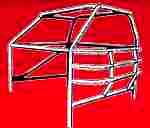
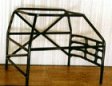
Attach your cage to the frame of your racecar. This makes for a safer car by welding the cage to the frame and as a bonus it stiffens up the chassis for better handling, When installing a kit or building one yourself it is recommended that you drill a hole the size of the tubing in the frame. Insert the roll bar tubing in the frame all the way to the bottom. Weld the rear roll bar (#1 in diagram) to both the upper and lower parts of the frame. You will want to do the same thing with the front support bars (# 6). These are the four main points in the cage.
If you plan on carrying a passenger your want to replace the X-cross bars (#4 & #5) with door bars (#9 & #10).
Make sure the Upper Halo is 1 piece of tubing for a stronger cage.
You may also want to add other bars for safety and a stronger cage. One would be an Earnhardt bar running from the middle of the Halo (#2) to the Front Cross Support (#7). Two, you may want to run a bar from front center of the Halo (#2) to the center top of the roll bar (#1). Three, you may want to run a bar from the top of the door bar (#9) to the up to the upper part of the Left Front Support (#6). Four, a bar from the point where the roll bar (#1) and the Halo (#2) meet to the rear part of the frame in the interior on both sides. Remember that roll bars are not allowed to run through the firewalls. You may also want to run X-bar on the roll bar (#1) for additional roll over support.
Do forget the roll bar padding. Once the cage and seat and seat belts are installed, get in your racecar and buckle up. Try to reach all parts of the roll cage if you can touch the roll bar then put a pad on it. Remember, if you take a really hard hit your belts will stretch and your head, arms, or legs may/can/will come in contact with the roll cage.
I am no expert on roll cages, but I think this covers the basics to have a safer racecar. Enduros are supposed to be a strip it and race it series. But, if you plan on doing this for a while, you want to do it right. Remember, you've got to go to work on Monday.
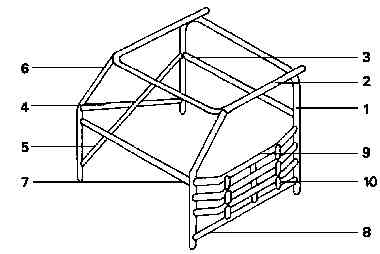
2-Upper Halo
3-Rear Roll Bar Cross Support
4-Passenger Door X-brace
5-Passenger Door X-brace
7-Front Cross Support
8-Bottom Front-Rear Support
9-Door Bars
10-Veritical Door Bars
ENDURO RULES
A roll bar is recommended, but a roll bar is not required in any post sedans or wagons.
A minimum of one sturdy headache bar behind the driver seat to the frame with braces will be mandatory on hardtops.
Roll cages with drivers side protection recommended, however, no bracing forward or rearward through the firewalls are allowed.
Passengers may be allowed if you have a full roll cage with at least 3 door bars on each side.
A four point roll cage with a minimum of four door bars to protect the driver. The same is required on passenger side for cars electing to carry a passenger.
No bars will extend through front or rear of firewalls.
All door bars and rollcage bars surrounding the drive and passenger should be padded.