What do I need to fence? (Equipment List)
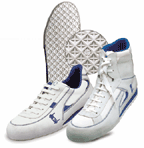 Shoes: You can fence in a pair of
ordinary, comfy sneakers with decent traction. (Some of the floors people fence on
are a little slick). Special fencing shoes are nice to have, but not required or
necessary. For the more serious recreational or competetive fencer, though,
fencing shoes do really make a difference. Adidas' are the famous and best ones,
but there are excellent (and much cheaper) variations made by many other
companies, such as PostSport. However, thin-soled wresting boots or
shoes are nearly as good as fencing shoes and sometimes less expensive.
Shoes: You can fence in a pair of
ordinary, comfy sneakers with decent traction. (Some of the floors people fence on
are a little slick). Special fencing shoes are nice to have, but not required or
necessary. For the more serious recreational or competetive fencer, though,
fencing shoes do really make a difference. Adidas' are the famous and best ones,
but there are excellent (and much cheaper) variations made by many other
companies, such as PostSport. However, thin-soled wresting boots or
shoes are nearly as good as fencing shoes and sometimes less expensive.
Pants: Make sure you wear pants
that you can really stretch and move around in. Jogging pants or track pants /
wind pants are great for fencing practice. Baseball pants are better yet (and
similar to actual fencing breeches), but if you wear those, you need to wear
long soccer or fencing socks to protect your shins. It's really hard to fence in
jeans unless they're loose-fitting. Khakis and cargoes are ok if they're loose,
too. Just don't show up in shorts.
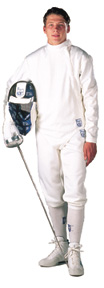 You don't need special
fencing pants to fence, but they are required for competitions at
fencing clubs or colleges with competetive teams. They're high waisted and made
of tough cotton or thick stretch synthetic. They stop at the knees, so a fencer
wears long socks over his or her shins.
You don't need special
fencing pants to fence, but they are required for competitions at
fencing clubs or colleges with competetive teams. They're high waisted and made
of tough cotton or thick stretch synthetic. They stop at the knees, so a fencer
wears long socks over his or her shins.
Shirt/Top: Regular T-shirts are ideal. You absolutely need
a special fencing jacket in order to fence safely, even for practice. But don't
panic, most clubs have got fencing jackets waiting, just for you.
Fencing jackets,
like the breeches, are made of tough, stiff cotton, or thick stretchy synthetic.
They're white, long-sleeved and zip along the side or in the back. The collar is
stiff, many layers thick, and comes up high to protect your throat. The front
bottom of the jacket is triangular and straps loosely between your legs, back up
behind you to your back. The back hem of the jacket ends at your hipbones. The
CUFC has serviceable fencing jackets available, but recommends fencers purchase
their own once they decide they have a serious and lasting interest in the
sport.
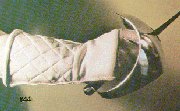 Glove: A special leather fencing glove is worn on
the hand holding the weapon. If you are right handed you would need only one
right hand glove, if left handed, one left hand glove. Fencing gloves have long
gauntlet-like wrist portions that come up over the sleeve of your fencing
jacket; the material over the fingers is thin to give you more sensitivity to
the grip of your weapon. The club has plenty of gloves available for beginners
to use, although a fencing glove is the first piece of equipment suggested you
buy for yourself if you decide fencing is the sport for you.
Glove: A special leather fencing glove is worn on
the hand holding the weapon. If you are right handed you would need only one
right hand glove, if left handed, one left hand glove. Fencing gloves have long
gauntlet-like wrist portions that come up over the sleeve of your fencing
jacket; the material over the fingers is thin to give you more sensitivity to
the grip of your weapon. The club has plenty of gloves available for beginners
to use, although a fencing glove is the first piece of equipment suggested you
buy for yourself if you decide fencing is the sport for you.
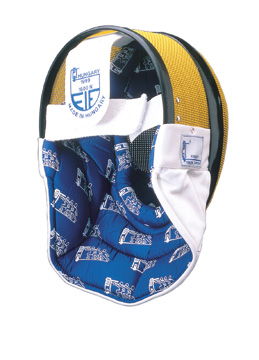 Mask: A special protective mask is
absolutely necessary for fencing. Masks come in a lot of slightly
different varieties, but virtually all protect you by means of tough metal mesh
in front of your face and thickly padded cotton over your neck, held on tightly
with a springy, padded clamp that goes behind your head. (Yes, it is actually
possible to see quite well through all that!) Fencing clubs have masks on hand to provide for beginners.
Mask: A special protective mask is
absolutely necessary for fencing. Masks come in a lot of slightly
different varieties, but virtually all protect you by means of tough metal mesh
in front of your face and thickly padded cotton over your neck, held on tightly
with a springy, padded clamp that goes behind your head. (Yes, it is actually
possible to see quite well through all that!) Fencing clubs have masks on hand to provide for beginners.
Weapon: The predominant weapon used for the education of novice fencers is the foil. (For images of fencing foils and information on the
rules and target area, click
here.) In addition, typically beginners start on the French, as opposed to pistol (orthopaedic) or Italian (very
rare) grips.
Buying: Are you a high-roller who
wants to buy his or her own stuff? But you don't know where to go? Whose
stuff is good, whose isn't, who's got the best prices, and most of all, what
should I get first?? If you can afford it, the easiest thing to start out with
is a complete beginner's kit, although if you know what you're shopping for, you might want to buy higher-quality pieces individually. Most fencing houses offer kits for sale which include
everything you need for dry or electric fencing (dry: Mask/Jacket/Foil/Glove/Bag
~$125). Typically the gear that comes in a beginner's kit isn't necessarily the
cutting edge of high-performance equipment; on the other hand, it is typically
discounted reasonably from the normal individual prices per piece when it's sold
together in such a kit. As for whom to go to, asking one of the more experienced
fencers -- or the coach -- is your best bet, but for a quick overview:
- Blue
Gauntlet: IMHO, tied for best fencing retailer around!! NJ-based fencing house enjoying a well-justified explosion of
popularity. Prices VERY resonable, for great quality gear. House-brand stuff is excellent, but also featured are the full Uhlmann line, as well as Infinity lames and Prieur blades, all very competetively priced. Good customer service, too, and fast shipping.
- Leon Paul USA: Other tie for best fencing store around! New USA offshoot of Leon Paul of London, one of the oldest and best fencing houses. They ship for free! Their equipment is univerally absolutely top-shelf quality! They ship fast! Their customer service is awesome! Their selection rocks! They're the only makers of a lot of very cool stuff, like the Golubitsky-pro foil blade, the latest generation of Leon Paul GT foil points, PFTE coated epee points, ultralight lames, ultralight foil guards, ultralight epee sockets, and the gorgeous contour fit masks.
- Triplette:
Very cheap prices for, well, very cheap equipment. Massive selection. Cheap
place to go for replacement foil blades. Heavily favors own house brand
equipment over retailing any gear produced by other manufacturers, such as
Allstar. Triplette masks are actually very nice, although they do seem to have
a tendency to dent easily. Rumor has it Triplette culls the rejects from the BF forge...
- Allstar
Fencing: Allstar is basically the premier manufacturer/retailer. Their
stuff is pretty prime, but so are the prices. Basically, they can sell you
about anything you could possibly want, and it'll cost ya plenty, but at least
you'll have top of the line gear. Sometimes they do have nice sales.
- The Fencing
Post: Fantastic prices for good-quality equipment. Customer service is totally
excellent. PostSport Uniforms are particularly comfy. Great discounts on
high-performance gear; Uhlmann is the featured high-performance line; Adidas
fencing shoes offered at great prices.
- Blade:
Not the place for top-of-the-line gear, but convenience is second to none, as
they're located in NYC. Beginner kits are decent quality and very reasonably
priced. House brand electric equipment not regarded as the best, but their dry
equipment more than sufficient for beginners. House brand uniforms are of
quite adequate quality, good prices. Allstar is featured high-performance
line.
- PBT Fencing:
Hungarian fencing house. Good high-quality stuff, moderately reasonable prices. Service is incredibly good -- shipping virtually instant via FedEx. Like Allstar and Uhlmann, they're a major manufacturer, and pretty much only sell their own brand of gear.
- Physical
Chess: Cut-rate web-based offshoot of Blade. Prices, equipment, and
service roughly comparable. House brand items reportedly virtually identical
to Blade's. Used to run some really marvellous sales on high-performance brand
items (Uhlmann the featured line), but have not observed any recently.