- First meeting of semester.
- Coach not present but expected 11/10/03
- Format for the day: Group lesson, then brief bouting among experienced fencers.
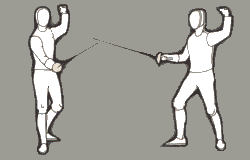
- Getting on Guard
- How to hold the French grip
- The Thrust
- The Advance
- The Retreat
- The Lunge
- Parry 4
- Parry 6
In western sport fencing, there are three weapons, each of which is a separate discipline with its own unique style. These are foil, epee, and sabre. Our coach is an experienced instructor in all three; however, the tradition is to start out beginners in foil fencing. This actually doesn't mean that foil is the easiest -- in fact sabre often comes the most naturally, and epee has the simplest rules. However, it is foil which most effectively establishes good fencing style which can easily be transferred to the other weapons.

- Second meeting of semester.
- Run by Coach Richard Gradkowski
- Format for the day: Group lesson, then brief bouting among experienced fencers.
- Enguarde, French grip
- The Thrust
- The Advance
- The Retreat
- The proper Lunge
- The Disengage-attack
- The Coupee-attack
- The importance of bending the knees when on guard
- The importance of keeping the torso upright (no leaning over)
If your blade is in contact with your opponent's (i.e., "engaged"), you can try to attack by moving your foil directly forwards, keeping your blade on the same side of your opponent's blade as before (straight thrust), or else you can perform a disengage-thrust.
You disengage by relaxing your back fingers to permit your point to drop, then tighten them again to bring it back up on the other side of your opponent's blade as before. At the same time, you are moving your foil forwards in the thrust. Make sure you keep your lateral motions very small -- your opponent's blade is not even an inch wide, so your disengage doesn't need to be any larger!
Two things may help you to remember how to do this.
- Think of the motion as a spiraling-in of your point towards the target.
- If you are having trouble keeping your disengage small and tight, think of it as a "vee" down and up rather than a circle around.
So now from an engagement, you can attack with a straight thrust or a disengage thrust. You can also attack with a coupee-thrust.
The coupee is performed by bringing the point of your foil up just enough for it to clear your opponent's tip, then snapping it sharply back down on the opposite side of your opponent's blade from before. Like with the disengage thrust, remember not to move your foil laterally any more than you have to!
A tip on how to do this:
- When you're lifting up your point to get your blade up and over your opponent's, keep a little light pressure against your opponent's blade, such that the two foil blades scrape lightly together. You'll be able to tell by feel how long they're in contact, and when you sense the contact's ended (i.e., you're clear of your opponent's blade) you can instantly start bringing your point sharply back down.
- If you are having trouble keeping your coupee tight and crisp, think of it as a little "chop" you're executing with wrist and fingers (NOT arm!!).
 |
 |

This diagram shows the areas of your own target area which the parries protect. |
 |
 | |
 |
 | |
 |
 |
- Third meeting of semester
- Run by Coach Gradkowski
- Format for the day: Footwork warmup. Group and individual instruction by Coach Gradkowski in the first four parries of the French school of defense. Group practice in the first four parries. Brief bouting period for advanced fencers.
- Enguarde position
- The lunge, esp. keeping good form
- Movement in enguarde position
- The three basic attacks:
1) The thrust
2) The disengage-thrust
3) The coupee-thrust
- Parry Prime (1)
- Parry Seconde (2)
- Parry Tierce (3)
- Parry Quarte (4)
- Be sure to completely close out the line of your opponent's attack
- Moving from one parry line to another
- You must riposte IMMEDIATELY following your parry
Your opponent has attacked you, and being the skilled fencer that you are, of course you have successfully blocked their attack with a parry. You're standing there safely, holding the blades in contact in one of the eight lines of parry. What do you do next?
If you only respond to their attacks with nothing more than the appropriate parries, sooner or later they will succeed and penetrate your guard. In addition, your objective is not only to keep from being touched -- you also want to gain touches upon them! Therefore, a parry is not complete unless it is followed by a riposte.
To execute the riposte, you release the parry and attack back at your opponent with one of the three basic attacks which we have covered (straight thrust, disengage thrust, or coupee thrust), delivering it if necessary with a lunge to close the distance (say if your opponent is in the middle of a retreat as you begin your riposte).
Ideally, there should be no delay between the parry and the riposte. The parry should be a crisp contact of the blades, moving your opponent's blade out of line. Then immediately you let go of his/her blade, and begin your own attack into his or her open target area!
Most practices of the Cooper Union Fencing Club begin with serious footwork drilling as a warmup. These drills not only serve as an excellent warmup but are also quite strenuous and are ideal for building up the powerful leg muscles and cardiovascular capacity a fencer needs.
Our footwork drills consist of 10 exercises. After each one, the fencer steps off the strip and walks back down to the end of the line. This gives you a chance to rest and catch your breath while you wait for your turn to do the next exercise.
- Advance all the way down the strip.
- Face backwards and retreat all the way down the length of the strip.
- In rapid succession:
- Advance 3 times
- Lunge
- Recover
- Repeat the above until the end of the length of the strip.
-
- Face backwards
- In rapid succession:
- Retreat 2 times
- Lunge
- Recover
- Repeat until end of strip.
-
- Advance 1 time
- Lunge
- Recover forwards
- Lunge again
- Recover normally
- Repeat until end of strip.
- This exercise is called the Redoppio, meaning "redoublement." The idea is that you lunge, and if your lunge falls short of your opponent's target, you can instantly lunge again, surprising them and gaining the touch.
- By "recover forward," what we mean is that from the normal lunge in full extension, you keep your arm out in the thrust, and keep your front foot where it is, while you draw your back foot up underneath yourself (moving your back arm up for balance), then explode back out into a second lunge, throwing the back arm back down again as you do so.
-
- Similar to exercise 3
- From enguarde, make 1 very small jump forwards (your feet keep the same enguarde position, and shift forward only a couple inches), 1 backwards, 1 forwards, and 1 backwards
- Do these jumps quickly, then immediately do 3 advances
- Lunge
- Recover
- Repeat to the end of the strip
- This exercise adds a more dynamic element to exercise number 3.
-
- Similar to exercise 4
- Get enguarde facing backwards
- Make 1 small jump backwards, 1 forwards, 1 backwards, 1 forwards
- Immediately make 2 quick retreats
- Lunge
- Recover
- Repeat to end of strip.
-
- Now add these little jumps to the redoppio exercise of number 5
- Jump forward, backward, forward backward
- Advance 1 time
- Lunge
- Recover forward
- Lunge again
- Recover normally
- Repeat to end of strip
-
- Advance to the end of the strip
- Retreat back to the middle of the strip
- Advance 1 time
- Lunge
- Recover
- Do this only 1 time
-
- Face backwards
- Retreat to end of strip
- Advance back to middle of strip
- Retreat 1 time
- Lunge
- Recover
- Do this only 1 time
- Fourth meeting of semester
- Run by Coach Gradkowski
- Format for the day: Footwork warmup. Review of the first four parries. Group and individual instruction by Coach Gradkowski in the second four parries of the French school of defense. Group practice in all eight parries. Brief bouting period for advanced fencers.
- Parry Prime (1)
- Parry Seconde (2)
- Parry Tierce (3)
- Parry Quarte (4)
- Moving from one parry line to another
- Riposte IMMEDIATELY following your parry
- Parry Quinte (5)
- Parry Sixte (6)
- Parry Septime (7)
- Parry Octave (8)
- Riposting from these parries
- Fifth meeting of semester
- Run by Coach Gradkowski
- Format for the day: Footwork warmup. Review of the eight parries and riposte from the parries. Group practice in all eight parries. All fencers suit up for the first time in full "dry" gear for introduction of the reciprocal drill. Brief bouting period for advanced fencers.
- All 8 parries of the French school of defense
- Riposting from the parry
- The counter-riposte
- Introduction of the reciprocal drill
- Sixth (and last) meeting of Fall '03 semester
- Run by Coach Gradkowski
- Format for the day: Footwork warmup. All fencers suit up for the second time in full "dry" gear for continuation of the reciprocal drill with intensive guidance from Coach Gradkowski. More reciprocal drills introduced. All fencers present have their first bouts, in a round-robin format, three touches, using electrical buzzer boxes. We conclude by sitting down for a discussion on tactics presented by Coach Gradkowski.
- The 8 parries of the French school of defense
- The importance of the immediate reposte
- The reciprocal drills covered earlier
- New reciprocal drills
- Introduction of the bout!