A CLOSE SHAVE
By Ken Phillips of the WLMDC
I went detecting with two friends at a rally near Milnthorpe in Cumbria, organised by the Kendal Metal Detecting Club. It was a little cold, but a nice day for the time of year (November) when we started detecting. As the morning progressed we had sampled three or four of the many fields available to detect on without much success, just the odd burnt-out Georgian coin and the usual grot.
By this time we had worked our way down to the bottom of the hill, the headquarters being at the top, and we decided to work two small fields adjoining each other. Things started to improve in the first one we tried, with an increase in good targets, but as it was nearly time for lunch and the drawing of the raffle we trudged our way back to base.
During our break we mulled over where to try next and settled for the two fields at the bottom of the hill again, this time taking the car to save us another climb (clever stuff or what!). Anyway we carried on where we left off, finding more Georgian and Vicky coins, two nice buckles and other items of no interest whatsoever to anyone except crazy metal detectorists’. Going into the second field, which was smaller with a dyke running along one side, things were
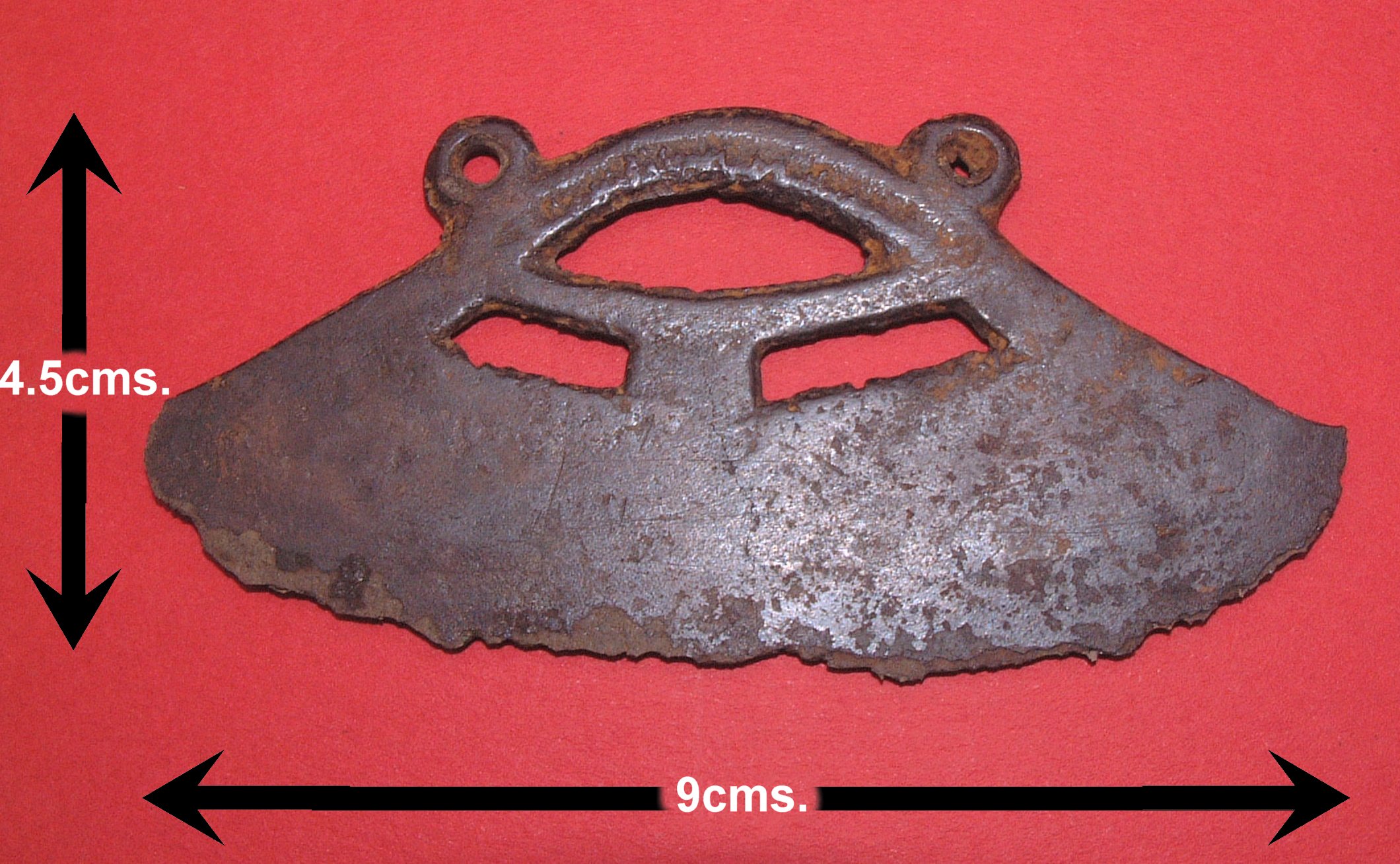 very much the same. It was now getting cold with not much detecting time left, and working my way back towards the car along the side of the dyke I found it! But WHAT was it?
Rubbing away the soil I could see it was some sort of scraping tool and called my pals over to take a look. I said that it had a ‘Roman’ look about it, but we came to the conclusion that with the finds from this site being either modern or Georgian, it was more likely to be some sort of tool for skinning rabbits or the like. That evening I scoured all my metal detecting books and trawled the internet trying to identify it, but to no avail. Convinced now it was relatively modern and considering that the edge was very corroded, I was going to throw it in my ‘not quite made the grade’ box. Something stopped me, a ‘gut feeling’ maybe, so I sent a photograph to Nick Herepath at Liverpool Museum asking for his help.
When Nick replied I was amazed, he said I had found a bronze Double Loop Razor dating from the very end of the Bronze-Age/beginning of the Iron-Age (700BC), and quite rare.
I have been a metal detectorist for over twenty years, and up until now have never found anything from the Bronze/Iron-age period, so you can imagine how pleased I am with this find.
In closing I would just like to say that this find, which had lain in the ground for over 2,700 years waiting to be discovered, very nearly ended up in the rubbish box.