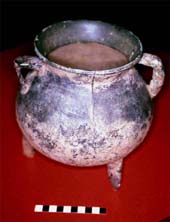
Report on the finding of a bronze medieval cooking pot.
Finder, Ken Phillips, club secretary.
The pot was found on our Clubs tenth anniversary rally in Cumbria. A friend and myself had been searching a pasture field nearly all morning, finding pre-decimal coins, the odd Georgian coin and musket balls etc. We decided to go back to the car for a cup of tea, but felt it was worth returning to the same field, as there was a chance of finding some silver coins.
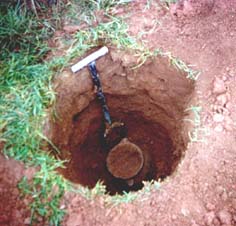
On our return, I had been detecting about ten minutes when I got a good clean signal that sounded like a pre-decimal penny. After digging down about eight inches and not finding the target I thought it must be in the side of the hole, so I made the hole wider to get my search head down. The signal was still coming from the bottom of the hole so I carried on digging, still no target and I was about to give up thinking it must be very deep iron. At this point my friend came across, checked the hole with his machine and urged me to carry on. Digging deeper and having to scoop the soil out by hand I spotted a small curved strip of dark green metal, gently working round it revealed what appeared to be the rim of a bronze pot.
By this time other detectorists had started to gather round to see what was going on, because by now we had quite a substantial crater going. It took over an hour to dig down around it to the base, and when it was lifted out of the ground the tripod legs on the bottom showed it to be a Medieval cooking pot. Apart from some damage to one of the legs the pot was intact, which makes it quite a rare find as usually only fragments are found. The find was reported to Nick Herepath from Liverpool Museum, who is the Finds liaison Officer for our area. Nick kindly came down and recorded it, dating it as late Medieval circa 14th - 15th Century.
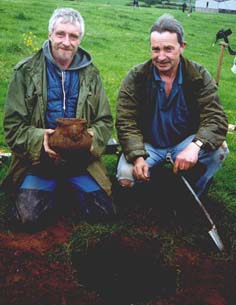
The cooking pot was found at a depth of two feet with a Fisher 1235X, and this has started me thinking again about my metal detecting technique. The reason for this is that motion type detectors cannot discriminate against large pieces of deep iron, so over the years that I have been metal detecting how many Bronze age axe heads and other artefacts have I walked away from? It is only when you actually recover an artefact from this sort of depth yourself, that you realise not all very deep targets are made of iron.