|
by Christophe Wiart
Scientific Journals
|
Allorge L., Wiart C.
and L.E. Toe, (1995), Kopsia
terengganensis
L. Allorge & C. Wiart (Apocynaceae), A New Malaysian Species. Acta
Botanica Gallica, 42 (5): 433-437. (ISSN 1253-8078).
Shasya U., Ali M., Hamid A., Awang K., Wiart C., Gaillard J.F.
& M.
Pais, (1997), Terengganensine
A and B, Dihydroeburnane Alkaloids from Kopsia
terengganensis. Tetrahedron
Letters, 38 (9): 1571-1574. (ISSN
0040-4039/97).
Shar M., Manaf A., Mawardi M., Wiart C. & Jasbir S.D.,
(2000), Apoptotic and Necrotic
Cell Death Manifestation in Leukemia Cells
Treated with Methylgerambullin a Sulphone from Glycosmis calcicola,
Journal of Biochemistry,
Molecular Biology and Biophysics, 4: 253-261.
Wiart C.,
Kumar A., Mogana S., Norhanom A., Kasturi S., (2000), Screening of Tropical
Plants of Malaysia (Perak), Journal
of Tropical
Plants, 1, 6-10, (ISSN: 1511-8525).
C. Morel, D. Guilet, J.M. Oger, D. Séraphin, T. Sévenet, C. Wiart, A.
Hamid A. Hadi, P. Richomme et J. Bruneton (1999). New 6-Acylcoumarins
from Mesua
racemosa, Phytochemistry,
50 (7), 1243-1247.
D. Guilet, C. Morel, N. Noyer, M. Cornec, D. Séraphin, C. Wiart, A.
Hamid-A. Hadi T. Sévenet, P. Richomme et J. Bruneton (1999). Four New
4-Phenylcoumarins from Calophyllum dispar.
Isolation and Hemisynthesis, Heterocycles,
51,
67-76.
Wiart C.
et al. (2001), Sesquiterpenes and
Alkaloids from Scorodocarpus
borneensis, Phytochemistry,
58(4): 653-656.
Wiart C.,
(2001), Herbal Medicine, Research Bulletin, University of
Malaya Medical Center, 1.
Wiart C.,
S. Mogana, S. Khalifah, M. Mahan, S, Ismail, M. Buckle, A.K.
Narayana, M. Sulaiman, (2004), Antimicrobial
screening of plants used
for traditional medicine in the state of Perak, Peninsular Malaysia.
Fitoterapia, 75:
68 – 73.
|
Books
|
PRACTICAL
HANDBOOK OF PHARMACOGNOSY (ISBN 9839236644)
The 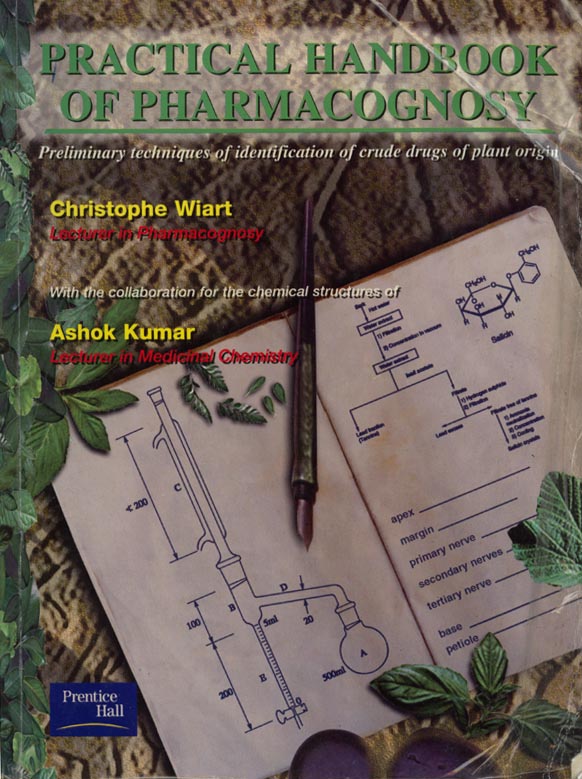 increasing
intake of medicinal plants in health care products and cosmetics has
provoked a drastic come back for pharmacognosy and a
serious need of
pharmacists knowledgeable in pharmacognosy. increasing
intake of medicinal plants in health care products and cosmetics has
provoked a drastic come back for pharmacognosy and a
serious need of
pharmacists knowledgeable in pharmacognosy. 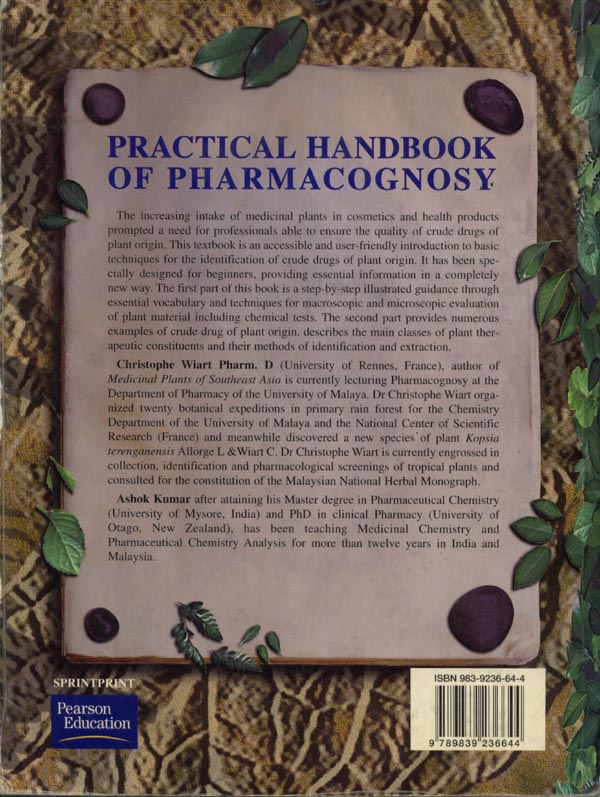 The
purpose of this
book is to introduce basic terminology, which may help pharmacists to
familiarize themselves with official pharmacopoeial texts, and it also
provides basic preliminary techniques to prepare crude drugs, to constitute
monographs or in to identify plant samples. The purpose of
this book is not to compete with well established textbooks or official
pharmacopoeial texts but it is to introduce botanical, microscopical, physical
and chemical basic methods which may contribute
to a better
understanding of pharmacognosy for
pharmacists, students, researchers
and industrials. The first part of this book introduces
the methods of
identification of crude drugs of plant origin.
This part provides a
basic knowledge in botany, microscopical, chemical
and physical
techniques. The second part of this book
describes the main classes of
plant constituents as well as some techniques of extraction and
identification. The
purpose of this
book is to introduce basic terminology, which may help pharmacists to
familiarize themselves with official pharmacopoeial texts, and it also
provides basic preliminary techniques to prepare crude drugs, to constitute
monographs or in to identify plant samples. The purpose of
this book is not to compete with well established textbooks or official
pharmacopoeial texts but it is to introduce botanical, microscopical, physical
and chemical basic methods which may contribute
to a better
understanding of pharmacognosy for
pharmacists, students, researchers
and industrials. The first part of this book introduces
the methods of
identification of crude drugs of plant origin.
This part provides a
basic knowledge in botany, microscopical, chemical
and physical
techniques. The second part of this book
describes the main classes of
plant constituents as well as some techniques of extraction and
identification.
MEDICINAL
PLANTS OF SOUTHEAST ASIA (ISBN 9679787257)
This book is a
simple guide to the Southeast Asian 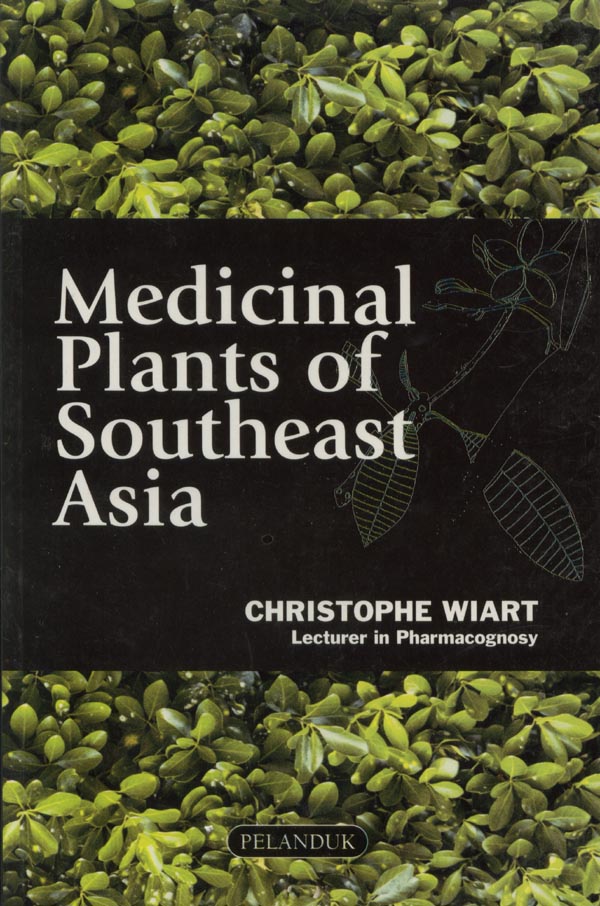 medicinal
plants intended for medicinal
plants intended for 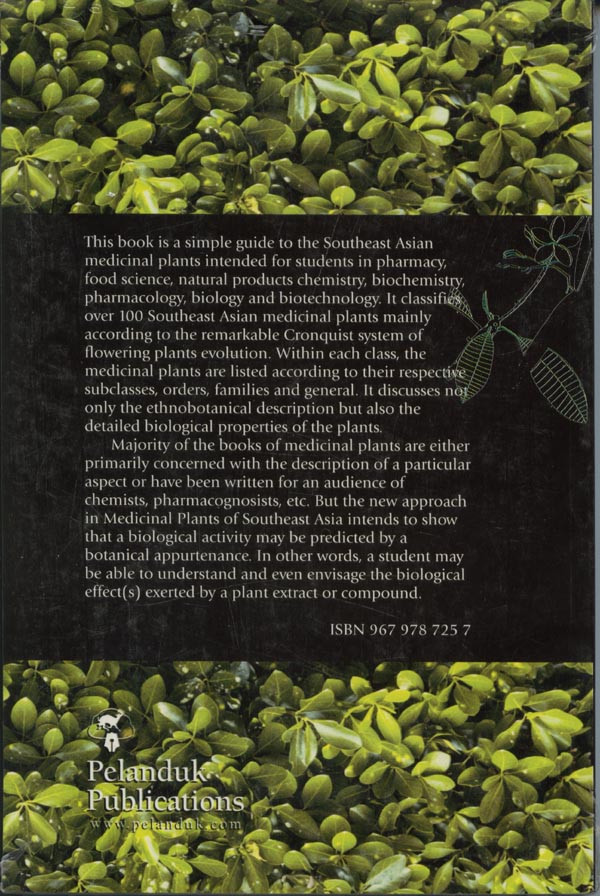 students
in pharmacy, food science, natural products chemistry, biochemistry,
pharmacology, biology, and biotechnology. It classifies
over 100 Southeast Asian medicinal plants mainly according to the
remarkable Cronquist system of flowering plant evolution. Within each
class, the medicinal plants are listed according to their respective
subclasses, orders, families and genera. It discusses not only the
ethnobotanical description but also the detailed biological
properties of the plants. Majority of the books of medicinal plants are
either primarily concerned with the description of a particular aspect
or have been written for an audience of chemists, pharmacognosists,
etc. But the new approach in medicinal Plants of Southeast Asia intends
to show that a biological activity may be predicted by a botanical
appurtenance. In other words, a student may be able to understand and
even envisage the biological effect(s) exerted by a plant extract or
compound. students
in pharmacy, food science, natural products chemistry, biochemistry,
pharmacology, biology, and biotechnology. It classifies
over 100 Southeast Asian medicinal plants mainly according to the
remarkable Cronquist system of flowering plant evolution. Within each
class, the medicinal plants are listed according to their respective
subclasses, orders, families and genera. It discusses not only the
ethnobotanical description but also the detailed biological
properties of the plants. Majority of the books of medicinal plants are
either primarily concerned with the description of a particular aspect
or have been written for an audience of chemists, pharmacognosists,
etc. But the new approach in medicinal Plants of Southeast Asia intends
to show that a biological activity may be predicted by a botanical
appurtenance. In other words, a student may be able to understand and
even envisage the biological effect(s) exerted by a plant extract or
compound.
MEDICINAL
PLANTS OF SOUTHEAST ASIA, Second Edition (ISBN 9832473233)
 Medicinal
plants
of Southeast Asia, second edition, is a simple guide to the medicinal
plants representative of the pharmacopoeias of countries
in Southeast
Asia namely Medicinal
plants
of Southeast Asia, second edition, is a simple guide to the medicinal
plants representative of the pharmacopoeias of countries
in Southeast
Asia namely 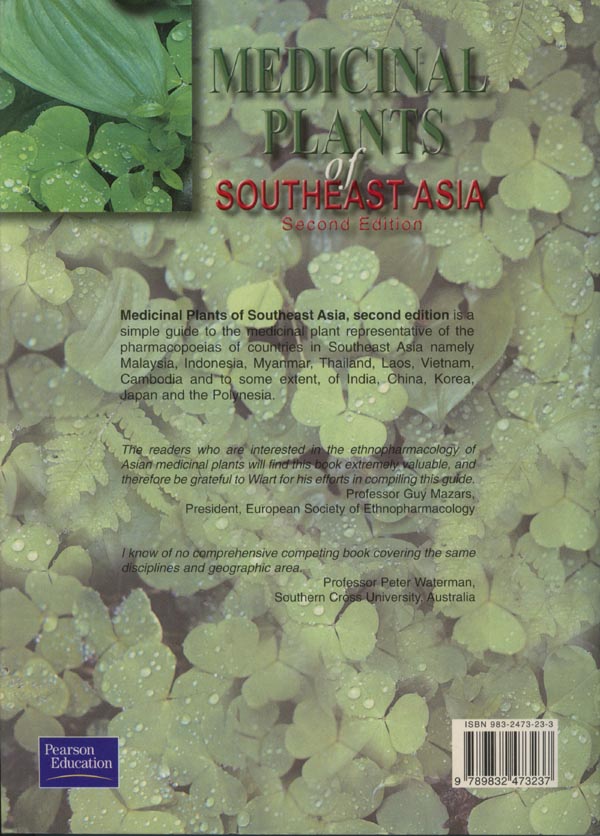 Malaysia,
Indonesia, Myanmar, Thailand, Laos, Vietnam,
Cambodia and to some extent, of India, China, Korea, Japan and
Polynesia. The book is prefaced by Professor Guy Mazars, President of
the European Society of Ethnopharmacology. Malaysia,
Indonesia, Myanmar, Thailand, Laos, Vietnam,
Cambodia and to some extent, of India, China, Korea, Japan and
Polynesia. The book is prefaced by Professor Guy Mazars, President of
the European Society of Ethnopharmacology.
Reviewers:
|
“The readers
who are
interested in the Ethnopharmacology of Asian medicinal plants will find
this book extremely valuable, and therefore be grateful to Wiart for
his efforts in compiling this guide.”
Professor Guy Mazars,
President of the European Society of Ethnopharmacology.
“I know of no other comprehensive competing
book coverin the same disciplines and geographic area.”
Professor Peter
Waterman, Southern Cross University, Australia.
“Christophe Wiart has collected together 225
of the most
important plants of the region, and thoroughly researched the
scientific literature for as much validated information as possible,
using many primary sources...the book serves as a source for
researchers wishing to look at new plants with interesting folk-lore
usage…This is a clear and comprehensive account of the most important
plants of Southeast Asia, and is essential reading for anyone
interested in the medicinal plants of this scientifically rather
neglected region.”
Professor Elizabeth M.
Williamson, School of Pharmacy, University of London. (Phytotherapy
Research
Volume 17, Issue 7, 2003. Page 842).
|
|
|