
| Sun | | | Earth | | | Moon | | | Mercury | | | Venus | | | Mars | | | Asteroid | | | |
| Jupiter | | | Saturn | | | Uranus | | | Neptune | | | Pluto | | | Comet | | | Constellation | | | Galaxies |
Mercury
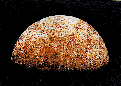
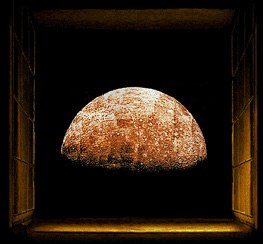
Mercury, the planet nearest the Sun, is the second smallest planet in the solar system. Only slightly larger than the Earth's moon, Mercury's surface is covered with craters. This tiny planet does not have any rings or moons.
Mercury, the innermost planet of the solar system, is a little bigger than the Earth's Moon. The surface of the planet is covered with craters, like the Moon, but temperatures there can reach over 800oF because Mercury is so close to the Sun and rotates so slowly. Scientists believe that the interior structure of Mercury includes a metallic core, an intermediate rocky layer, and a thin brittle crust.
The composition of Mercury is probably high in iron, although surface features indicate that volcanic activity once existed at the surface. There is little evidence of motions near the surface of the planet now, although at earlier times during Mercury's evolution the surface was much more active. We know relatively little about Mercury, compared to most of the other planets, because it is relatively difficult to see and only one spacecraft has studied the planet.
