
| Sun | | | Earth | | | Moon | | | Mercury | | | Venus | | | Mars | | | Asteroid | | | |
| Jupiter | | | Saturn | | | Uranus | | | Neptune | | | Pluto | | | Comet | | | Constellation | | | Galaxies |
Sun
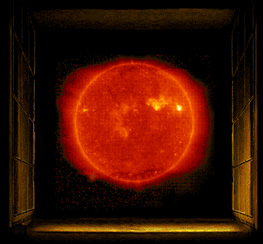 |
The Sun is the closest star to Earth and is the center of our solar system. A giant, spinning ball of very hot gas, the Sun is fueled by nuclear fusion reactions. The light from the Sun heats our world and makes life possible. The Sun is also an active star that displays sunspots, solar flares, erupting prominences, and coronal mass ejections. These phenomena impact our near-Earth space environment and determine our "space weather." |
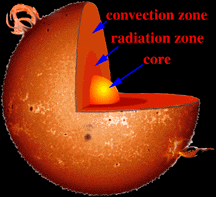
| To understand how our Sun works, it helps to imagine that the inside of the Sun is made up of different layers, one inside the other. The core, or the center of the Sun, is the region where the energy of the Sun is produced. Even on Earth we know that the Sun produces energy because we see sunlight and we feel hot on a summer day. The Sun's energy, which is produced in the core, travels outwards. The energy travels first through the radiative zone, where particles of light (photons) carry the energy. It actually takes millions of years for a photon to move to the next layer, the convection zone. At the convection zone, energy is transferred more rapidly. This time it is the motion of the gases in the Sun that transfers the energy outwards. The gas at this layer mixes and bubbles, like the motion in a pot of boiling water.This bubbling effect is seen on the surface of the Sun, and is called granulation. |
 |
Some Pictures of Sun

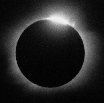
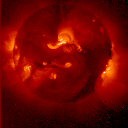
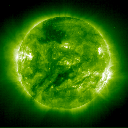
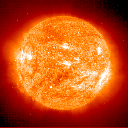
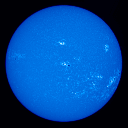
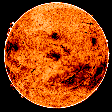
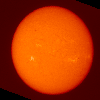
Click the pictures to enlarge !
