Fear of the Thunder God is the Beginning of Wisdom
By what authority do I dispense wisdom and pass judgement about Kite Aerial Photography? By my own
count I've created, what? 4 decent pictures? In how long? This is hardly a body of work to which to
point with pride. But if indeed we learn from our failures then maybe I have some wisdom as well as
crashed kites, tangled
lines and blurred, muddy and boring snapshots. IF we learn from our failures. Big "If"
there. Maybe you can learn from my failures. Besides, I've been wanting to try my hand at a web page for some
time now so now I can inflict the reader with unwarranted KAP advice AND beginner's HTML.
My biggest learning experience . . .
The Bad Day at Battery Buchanan
The day dawned bright. No, it really didn't, but that's the way cautionary tales are supposed to start
so my revisionist weather history for Columbus Day 2002 has a glorious and oblivious sunrise.
Channel 6 Weather Guru George Elliot had predicted a mostly cloudy morning with a strong south wind and
a line of thunderstorms in the early to mid-afternoon. An adequate, if not perfect, morning to try to
photograph the Southport - Fort Fisher Ferry.
The Fort Fisher ferry terminal is just north of the boat launch at "The Basin," a semi-enclosed stretch of
flat water where the Corps of Engineers closed New Inlet following the Civil War (known more often as
The War of Northern Aggression around here.) Overlooking the Basin to the south and the Ferry Terminal to the North,
much as its fields of fire formerly overlooked New Inlet and Fort Fisher proper, lie the remains of Battery Buchanan,
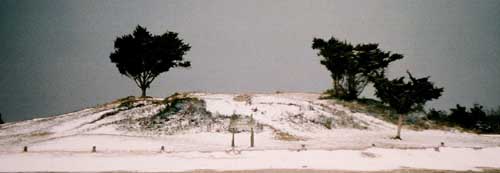
Fort Fisher's southernmost gun battery. Battery Buchanan resembles nothing so much as a flattened relic sand dune. No more than 15 or 18 feet above grade, by
Coastal Carolina standards this is a major hill. It's also a convenient spot to fly a KAP Kite if you want to photograph
the ferry.
 I launched my Sutton Flowform 16 into a good steady breeze and let out about 100 ft. of line. The kite was
pulling strong and was rock solid in the sky. I tied off the line to my dog stake and attached the rig and camera
to the line with with the crocodile clips - the first time I used them. I then let out another 15 feet or so until
the rig was hanging steadily at eye level and set the camera to the proper angle and direction so that it would be
aimed at the ferry landing when at altitude and started the camera intervalometer. I loosed the line from the dog
stake and continued letting out line. So far, so good.
I launched my Sutton Flowform 16 into a good steady breeze and let out about 100 ft. of line. The kite was
pulling strong and was rock solid in the sky. I tied off the line to my dog stake and attached the rig and camera
to the line with with the crocodile clips - the first time I used them. I then let out another 15 feet or so until
the rig was hanging steadily at eye level and set the camera to the proper angle and direction so that it would be
aimed at the ferry landing when at altitude and started the camera intervalometer. I loosed the line from the dog
stake and continued letting out line. So far, so good.
Except that I didn't fully pull out the slip knot in the line I had used to tie off on the dog stake. I mistakenly counted
on the line tension to pull out the knot. The line
had twisted on itself at the hitch and I saw a tight little knot going up as I let out the line. I tied off the
line again and started to walk the line down to unsnag the knot. I had barely noticed but in the 5-10 minutes this
had all taken the sky had darkened and the wind had picked up and was now blowing Bft 5 with gusts. Multiple gusts.
But one gust was all it took as the line snapped at the knot and kite set off over the salt marsh next to the battery
and the rig and camera plummeted out of sight below the lip of the hill. I guess I was identifying a little too much
with the camera as my first thought was "oh, this is gonna hurt."
I set off after the whole kite and caboodle through the brambles down the backside of the battery in time to
see the kite settle on the reeds at the edge of the salt marsh adjacent to the ferry terminal. Not easy, but
it was low tide and I would be able to retrieve it there. As I started looking for my camera I noticed the flowform
start to rise off the reed tops and inflate in another gust. Why do flowforms have to be so easy to launch?
The line stretched back over the salt marsh from the kite through a line of scrub oak along the battery side
of the marsh. The scrub oak provided enough resistance on the line to allow the kite to fully inflate and start pulling
the line through the brush until the first crocodile clip snagged on a branch. With this added resistance the kite
flew back into the air in its full glory. The crocodile clip wasn't meant to hold slippery braided dacron from moving
laterally through its teeth under load and slowly, evenly, with a steady 15-20 pounds of resistance,
paid out the line as the kite flew higher. It was humbling
to see a scrub oak and a hunk of molded plastic fly the kite as skillfully as I ever had.
Eventually the broken end of the line slipped through tree and clip and, with no more load, I watched the flowform
collapse and fall AGAIN - this time 150 feet out in the Cape Fear River directly in the path of the incoming
Southport-Fort Fisher Ferry. I was right: this was starting to hurt.
Putting the kite behind me for the moment I started looking for the camera and rig. By this time the sky was getting
darker than is comfortable for 11:00 AM and the wind was whipping enough that I was happy to be in the lee of
the battery. One smart thing I had done: painted the various pieces of my wooden camera rig a bright fluorescent
orange. I now started finding little pieces of orange painted wood and eventually a battered camea
all along the the shrub line. It looked like the frame had broken on first impact, wrenching the tripod mount out
of the camera body, and then what was left of the frame had been dragged and bounced over the ground and whacked against the trunk
of the scrub oak as the kite took its last flight before its last swim. There were pieces of frame and camera
scattered over about 40 feet, much like pieces of the Scarecrow in The Wizard of Oz after his run in with the troop
of Flying Monkeys. As I drove home I didn't feel much better. The radio in the car let me know that a Severe Thunderstorm
Advisory and a Tornado Warning had been issued for the area since 10 that morning. It was a bad day to be me. It was a bad
day to be anywhere around me.
Lessons Learned:
So what, specifically, have I learned from this and other mishaps? Well, thanks for asking, I was just about to tell you
- Watch the weather. Kitefliers spend most of their time with the wind at their backs. It's just the nature
of their task. What this means is that unpleasant weather can sneak up and catch them (me) unawares. Sailors, just as
dependent on wind, tell themselves to always "keep a weather eye." "Weather" is a synonym for "windward." When a sailor
keeps a weather eye he is not only paying attention to what the weather is doing, he is watching the sky to windward
to see what the weather is doing there because it will likely be doing the same thing here in a short time. It's a neat
little pun. For kiters "keep a weather eye" can be a synonym for "watch your ass."
- Understand Line Strength. A common misconception is that rated line strength (breaking strength) is absolute.
If I fly a kite on a 200 pound line, then that line should not break until it's lifting me off the ground. Line
strength is a way to compare one line with another, but should not be taken to have any bearing on reality. It's a
laboratory measurement under controlled optimal conditions with perfect line. If you need to relate line to
actual conditions, use working load, generally 1/5 the breaking strength and adjust downward as the line gets older,
as conditions deteriorate or as the expense of the kite increases.
- Tension. All lines stretch under tension. Stretch can be a help or a hindrance and lines selected to maximize
or minimize but all lines stretch under tension and deteriorate under tension. This is important for kitefliers because
when you bring a kite down by winding the line, that line stays under tension until the next time you fly and the line
loses some stretch and strength. I had not been following my own advice and my line had noticeably and significantly
deteriorated. The line had obviously discolored and faded in spots where it had lost strength. Walk your kite down and
coil the line loosely and your line will keep its strength longer. If you do use your winder to bring down your kite,
unspool and rewind the line under no tension before storing the winder for any length of time.
- Knots and Twist. Choose your knots wisely. Some knots are easy to tie, some knots are less likely to slip, and
some knots preserve line strength. Knots where the line twists around and crosses itself at sharp angles weaken the
line strength. Knots where the line is laid alongside itself preserve line strength. It's one reason why I've forsaken
the bowline for the climber's knot. Snags and tangles can easily turn into knots under tension, especially when the line
is twisted, and are more likely to
be a point of failure.
On Battery Buchanan the line snapped at a slip knot which didn't slip free because the line was too
twisted. Many kitefliers avoid line twist by using a swivel at the bridle. I don't trust swivels because they
are often weaker than the line on which they're placed, they add weight, and they don't work as well (they don't properly
swiv) when under tension. When you're winding your line after bringing down your kite is the proper time to eliminate line
twists.
Lines wound on a halo winder are especially susceptible to line twist when the winder is held in one hand and line fed over
one side of the winder. I now make a point to periodically switch hands/sides when winding a halo winder: 15 turns on
the left followed by 15 turns on the right followed by . . . well, you get the idea. When letting line off the reel I
try to keep the line rolling off straight, letting the reel turn. If I'm letting out a lot of line at once by letting the
line unspool rapidly off one side or the other I try to switch sides every 20 or 30 feet of unspooled line. Keeping the
line untwisted means that any slip knot I may use slips free when it's supposed to, makes other knots easier to untie, and
minimizes snags and tangles in loose line. Some aphorism about ounces and pounds and preventions and cures is wiggling
around at the edge of my conscious mind but I can't quite recall it right now.
- Material Strength. 2 1/4' pine lath surely has many uses (not that any spring to mind) but building a strong
KAP rig? No. It's light, it's easy to cut, easy to paint . . . and easy to smash. If I'm tempted to build another wooden
rig, I'll use a stronger wood.
- Tripod Mount. A short length of a 1/4" bolt may be perfectly adequate to secure a camera to a tripod but is
not sufficient to keep a camera secured to a KAP Rig when the rig comes tumbling down. Worse, the weak link among Rig,
bolt and Camera is camera. If I build another double U type rig with another camera I will not rely solely on the
tripod mount.
- Weight. There have been many days where there has been enough to wind to lift a kite
but not quite enough to lift the camera rig. Every ounce counts and I'd rather try to shave weight
on the rig than automatically fly a larger kite. On other days I've been stymied when the rig and camera
have been too light. The Marvin Box rig I use presents a good bit of cross section which catches
the wind and can get the camera juking and swinging on the line even when the kite is solid in the sky.
That's annoying. I've been toying with the idea of placing extra removable weight on the frame
of the rig to dampen the swing on high wind days. I haven't actually gotten around to doing this mainly
because there's something about adding weight to my rig on purpose that really irks me. But, just
because it's counterintuitive doesn't mean it's wrong.
- Do Not Trust the Intervalometer To come
- Film So far I've had my best results using Kodak Royal Gold 400.
Less expensive consumer films like the Kodak Max line are designed for the greatest latitude in exposure, assuming that your camera's metering system is inaccurate or that your camera doesn't have a metering system at all. Using the Max films you can shoot in a wide variety of lights and still get printable results. The tradeoff is increased grain, inconsistent contrast, and somewhat muddy colors.
I've shot a few rolls of Kodak's Portra from the kite as well. Grain was acceptable with the 400 VC and 400 UC and, as the suffixes might suggest (Vivid Color and Ultra Color,)the colors were vivid.
Contrast, however, was lacking. This is to be expected in a film aimed at wedding photographers. In other uses, I would use Portra 100 and push it two
stops and rate it at 400. This usually increases contrast nicely but also increases grain. However, using a P&S camera has its drawbacks. The Samsung Evoca reads all film ratings through the DX coding on the cannister and has no means to manually enter this data. I've had some luck in manually altering the DX coding with electrical tape, but that is not a 100% solution and seems a bit overkill for this use.
I'm currently shooting with Kodak's new High Definition 400 speed color film but I'm as yet unconvinced it's any better than the Royal Gold 400. Even by Kodak's own measurements the two have identical graininess (Print Grain Index=39.)
I've fiddled a bit with B&W KAP, usually with the intention of hand tinting the prints, but haven't yet had any decent results. B&W's strengths are continuous gradations of tone. If I were to KAP some spreading wheat fields or the like, B&W might be the ticket, but so far the subjects I've been working on demand not just color but punched up color.
I'm well aware that there are other manufacturers of film than Kodak. BUT, I grew up in Rochester, NY and still have some loyalty to the Great Yellow Father. When Fuji starts making a decent B&W film and chemistry, I might start thinking about trying their other products, but probably not. This is not subject to negotiation.
- Some Places To Not Fly To come
- More To Come