The
purpose of this document is to review some group fighting tactics developed
jointly by Crackhead Bob, Aeolus, Roland Underwood, Princess Leah, and
myself. Some of these tactics might be outdated as monster attributes and
spawns change, but it should be looked at as our way of battle. As I am
a warrior, many of these tactics will deal specifically with warriors.
General
Hunting Tips
Equipment
Most
people know certain things to bring with them when they hunt: good weapons,
armor, bandages and the like. Here are a few more things that might help.
-
Potions-
Especially greater heals, cures and greater refresh. Potions are a fast
heal or cure when you are waiting for a bandage or don't have mana. Potions
are great in emergencies when timed with a bandage.
-
Extra
weapons- Always bring at least 2 weapons of each type you normally use.
Certain weapons, notably katanas, wear quickly due to their speed. I normally
take 2 katanas and 2 shields, and 2 bows in the case of archers.
-
Extra
recalls scrolls- So often, we rescue someone or a party member, only to
discover he has no way of getting back. 3 recall scrolls is a minimum for
me. These are in addition to the charges in your runebook. You should always
have 3 loose recalls.
Recalling
in
When
recalling into a spot, have your paperdoll ready or prepare an arm/disarm
macro. It is very likely there will be something very close that wants
to hurt you. You should always assume that you will be recalling right
next to the toughest monster that might spawn in that area.
Healing
Deciding
what will be your primary mode of healing may dictate what your character's
skill set will be. If you are planning to take up magery as a primary skill
(over 50), it might be best if you drop standard bandage healing in favor
of magical healing once magery and intelligence reach a reliable level.
If you do not intend magery to be one of your primary skills, bandage healing
is an absolute must for an adventurer.
The
main strength of healing is the capability for healing greater than the
greater healing spell, the ability to cure poisons and resurrect and, most
importantly, its true power is in more than one person healing each other
(cross-healing). This skill is so often the most underrated and overlooked
in inexperienced warriors, and in my opinion, a measure of a true warrior's
abilities lie in his healing.
There
is a degree of timing and discipline when it comes to cross-healing. First,
you always want to have a partner declared, especially in situations where
there are several members and subparties within parties. Secondly, and
most important, you will have to be able to trust your partner to be watching
you. As a general rule, if my health drops to 1/3 - 1/4, I will apply my
own bandage or use a potion. And finally, be generous, even wasteful with
bandages. You never know when either yourself or your partner will get
dp'ed, or flamestruck. Apply bandages as soon as you see or hear damage,
whether hunting solo or in groups.
As
a magic healer, you have the advantage of speed and range over healing
others. But so often inexperienced magic healers waste mana on late cures
and empty greater heals. This is because the mage is not aware of either
the warrior's or his partner's ability to heal, and if in fact there is
any healing going on between the two at all. In a “tank” formation, it's
best to either immediately cure the person, or wait 5 seconds after he
has been poisoned. Usually the former is the preferred method of curing.
An alternative in the case of good cross-healing is to initiate a greater
heal shortly after he has been poisoned, targeting once he has been cleared
of poison.
Attack
Order
In
cases where you are being attacked by a diverse group of monsters, choosing
the right opponent to kill first can be the difference between life and
death. There are some general guidelines, but there are plenty of exceptional
cases. But this may help you adopt the right mindset in evaluating these
types of situations.
There
are several factors in determining whom to attack first.
Poison
ability and level
Attack
and ground speed
Damage
per hit inflicted
Magical
or missile attacks
Hit
points of the monster
Presence
or absence of healer or other party member
These
are roughly arranged in their order of importance. Let's use some examples:
-
Example
1:
T2A north of Papua
A
Wyvern, a Scorpion, a Stone Harpy and an Imp.
Defender
type- Single melee style warrior
Order-
Scorpion, Wyvern, Stone Harpy, Imp
Reasoning-
The Scorpion and Wyvern can poison without being flagged. The Scorpion
should die first because it has very low hp, can poison, and is best to
get out of the way quickly. Wyvern and Stone Harpy are close in order,
because while the Stone cannot poison, it can deliver damage quickly. The
Wyvern is very fast and has less hp than the Stone, and can deliver level
4 deadly poison. The Imp is virtually harmless as long as it is not attacked
or flagged. In reality, I would try to separate the Stone and Wyvern using
their difference in speed, especially if I were alone. The Scorp and Imp
are too slow to keep up.
-
Example
2: Northeast peninsula near Minoc
An
Air Elemental, an Orc Lord, an Orc Mage and a Troll
Defender
type- Melee warrior
Order-
Orc Lord, Air Elemental, Troll, Orc Mage
Reasoning-
The Orc Lord is very fast and can deal out damage quickly. The Air is the
same, but if flagged you will get magery attacks in addition to quick damage.
The Orc Mage does the least physical damage, but has magic potential greater
than the Air (this is often overlooked), and is best fought alone. If the
warrior is in a group, then the Orc Mage and Air can be taken out simultaneously,
leaving the Troll last.
-
Example
3: Northeast peninsula near Minoc
An
Air Elemental, an Orc Lord, an Orc Mage and a Troll
Defender
type- Mage/Archer
Order-
Air Elemental, Orc Mage, Orc Lord, Troll
Reasoning-
With ranged characters, speed becomes much more of an issue. The Air is
by far the fastest. It would be best to string out the enemies and handle
them in order of speed. The reason why the Orc Mage is taken before the
Lord is because physical damage can be avoided with the luxury of range.
Just keep your eye on your stamina after taking two magical creatures down.
There
is a class of creature that falls into the “vermin” type. Vermin are so
easy to deal with, and do so little damage that there are cases where vermin
are actually desired to encounter.
-
Example
4- “The Amoeba”
Brigands,
Mongbats, a Headless, an Orc Mage and a Snake
Defender
Type- Any warrior type
Order-
Snake, Brigands, Orc Mage, Headless, Mongbats
This is
a case where you could use the Mongbats and Headless to actually buffer
you against stronger opponents. Because Brigands often carry bows and maces,
they should die after the initial nuisance, the Snake. Snakes are very
hard to see, they should be targeted and killed immediately. Then, you
could use the Headless to shield you from the Mage until the Brigands are
dealt with. Regardless of armor, vermin contribute little damage or bandage
slippage. In Fellucca, we would try to keep Mongbats at our back in case
we needed a quick way out of a crowd.
-
Contingencies-
There are some creatures, that absolutely take precedence over any kind
of order. These creatures are called “juggernaut” class, because their
combined speed, physical damage, hit points, and magic/poison ability are
too much for even cross-healing to effectively counter. The best measure
against these monsters is no contact at all, attack only with missile or
magic.
Examples-
Poison Ele's, Ophidian and Terathan Knight Errants and Avengers, Krakens,
Ogre Lords, Blood Ele's.
Unfortunately
for a pure melee warrior, juggernaut class monsters are impossible to destroy
with any efficiency.
 Includes
more examples for both warriors and non-warriors, some group examples and
more multi-class examples (like #'s 2 and 3). Includes
more examples for both warriors and non-warriors, some group examples and
more multi-class examples (like #'s 2 and 3).
Group
Formations
This
section considers tactical group formations for dealing with different
hunting situations.
-
Lead
and trap - One or two preferably melee types with good parrying leads
a group of spawn from its insertion point to a prepared area with a group
waiting.
Best
uses- Situations where there are more missile or magic types in group than
melee, also where monster spawns may include juggernauts mixed in with
lesser monsters.
Examples-
Ophidian Mound, Terathan Fortress.
Worst
uses- Areas where spawn is not highly varied and there are plenty of melee
warrior types in group.
Examples-
Shame Lvl1, Orc Forts.
Notes:
In the case where there are several decent parry in the group, defer to
the weakest healer to be the “leader”, as healing will be more important
for the ones keeping him healed.
-
Dispersed
with partners - Entire group splits into subgroups of 2-3 and covers
a predetermined area. Subgroups are mainly responsible for healing within
themselves.
Best
uses- Open areas where spawn is not highly varied, or not difficult for
the group.
Examples-
Shame Lvl1, Orc Forts, Outdoor hunting such as Oasis.
Worst
uses- Situations where monster spawns may include juggernauts mixed in
with lesser monsters, or monsters require more than 1 dedicated healer
for the targeted person.
Examples-
Ophidian Mound, Terathan Fortress, Destard, Wrong Level 2.
Notes:
It is best to “even” the healing abilities of subgroups. Pair strong healers
with low hp or weak healers, pair average hp/healer types together.
-
The
Tank Formation - Of all group formations discussed, by far the most
important, due to its overall versatility and convenience of use, is the
tank formation. The tank formation can be used in almost any situation,
and should be considered the default formation in highly dangerous encounters.
There are a few roles in this formation:
-
The Point
Man- The point man is usually the toughest guy to kill in the group standing
still. He should have good melee skills, parry, and preferably good magic
resistance. He will function as the tank's armor, and will lead spawns
to the formation. He will also flag anything that spawns near the group.
-
The Body-
The body is responsible for keeping the point man alive. Good healers,
warrior types up front, followed by bandage healing archers, bards and
others. Keeping the point man alive is actually more important than offensive
capability.
-
The Cannon-
This is the high powered range, heal and cure on the fly end of the tank.
It should be mainly inaccessible, made of combat type mages, bards, and
others who heal with magic. This point should also be collapsible in cases
where spawn is totally encompassing.
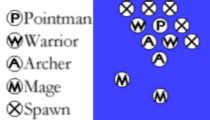
There
are millions of different variations on the tank, but the concept is always
the same- tough, rigid contact point with enemy backed by solid healers
and powerful ranged healers. Cross-healing and keeping the enemy off the
soft spots of the group is as critical as group coherency. A moving tank
formation can perform sweeps of hostile areas, and helps guarantee the
gating mage does not get disturbed while providing a quick getaway. The
point man should be able to give directions on whom to kill first. After
all, he knows which of the enemy is hurting him the most.
The
Hunt Leader
Regardless
of his role in any formation, there should always be a designated hunt
leader, either appointed by the guildmaster, or elected by the group. Hunt
leaders are responsible for the entire group, but that does not mean he
should die with the group (see later). This section deals with some considerations
for the hunt leader.
Tips
for hunt leaders:
-
Head check-
Make sure you know where your party members are, especially if you cannot
see them. Make sure those who are lagging respond to you; if not, you may
need them directly in your presence. Be aware of people joining and leaving
the group.
-
Equipment
check- Knowing where you are going ahead of time is great for making repairs
or getting appropriate equipment prior to the hunt. As a leader, it's a
good idea to carry more than just what you need; expect some of your group
to be lacking things like extra cloth or recall scrolls, so carry a few
extra.
-
Ammo check-
About every 45 minutes to an hour it's a good idea to ask your group if
they need to bank, if they are running low on supplies, and to take a break.
People tend to die when they get greedy with hunting and overloaded with
gold, and haven't checked their regs, bandage or arrow supplies. The most
entertaining hunts usually do not last longer than 1 hour (also the best
survival rate).
-
Check
in, check out- The hunt leader should make arrangements for when people
arrive or leave. More importantly, when someone dies due to lag and his
ghost is stranded, it's a good idea to mark where the person died to send
a gate for the ghost in the future. If this can't be done, make arrangements
for the ghost's rescue.
-
For the
good of the group- This section is where many leaders have disagreements
about, as some of the things here might be considered cowardly, or un-herolike,
but these are things that should be considered:
-
Sometimes
there are members of the party who constantly wander off, get lost, or
are a continual problem to keep track of. Those people are important, but
never as important as the rest of the group. Someone that is constantly
a problem like that should be left behind in cases where the rest of the
group is at risk. Warn the member that by doing their own thing, they are
compromising the safety of the others as well as themselves.
-
There
are members of the group whose lives are more important than the others’.
These are the rezzers, the gaters, and you. If the team only has 1 person
who can res, that person should be allowed to live save all others, as
in a case where there is only one member alive you would want it to be
the one who can res the others! You are an important member to keep alive
as well, but if it comes down to you or the guy who can res, I hope you
can understand.
-
Some people
think that members of the guild have an obligation to lay down their lives
for each other. While no one disputes this is a noble thing to do, always
keep your brothers in mind when you decide you want to go back to that
dungeon or spawn and get your stuff back. Is that stuff really worth potentially
more than what your friends are risking for you? Their lives and their
stuff? Are you selfish enough to gamble someone else's lives and things
for the sake of yours? Of course people are willing to do this for their
friends, but it should not be expected. And why would you be bringing something
so valuable that your friends may have to die for it?
-
Don't
be afraid to be bossy- After all, what are you there for? If there is a
someone who has a clear understanding of what to do, who should do what
and how, by all means delegate! More often than not, your team will admire
your leadership if you are making the right calls. If you are not the boss,
and you feel the leader is making a dicey call, politely suggest an alternative.
Note:
I have found that being the leader of the group means, embracing all the
blame for losses, and denying all the glory in victories. The leader has
to be the hardest working person in the group. It is the leader who understands
that the true authority is in submission. |



