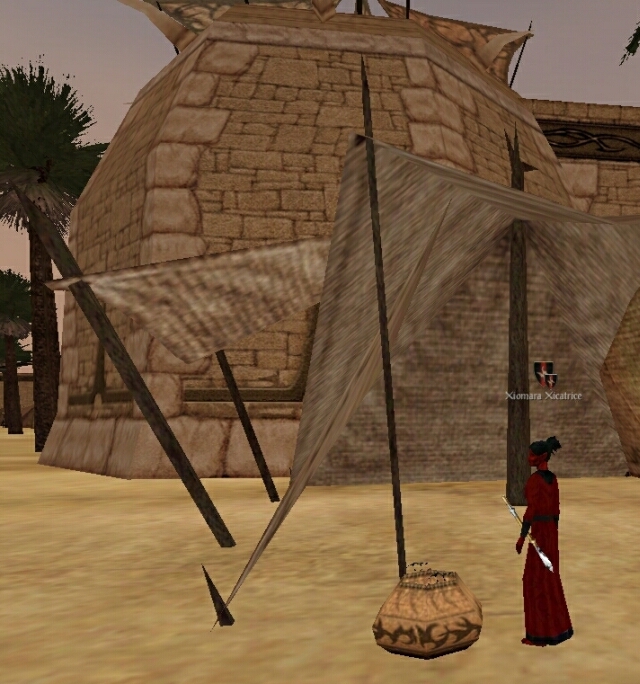
Here on the ground we see a typically fine large utility basket of Irekei manufacture. Note the colored patterns woven into the work; Irekei basketmakers use a variety of materials, botanical and mineral dyes, and even bird feathers to produce meaningfully decorated articles even for daily use. This basket is probably used for the storage of grain; note the double handles integrated into the reinforced upper rim. It can easily be carried between two people, even when full.
Basketweaving is a craft passed from mother to daughter, or father to son. Finely-made baskets may form part of a dowry or bride price, and the finest will be used for storing precious things, family jewels, or as cradles for infant children.
Each virakt, each family within a virakt, and each individual weaver within a family will have his own unique signature pattern of basketry, though the differences may well be too subtle for the untrained eye to discern. While well-made baskets may last for generations, depending on use, those used most frequently are replaced yearly, and it's traditional to have a replacement in progress at all times for those most likely to wear out.
The tent-topped tower in the wall behind Xi'a, as shown, takes the same rounded shape as a basket and is also thought to resemble (as does the basket) the natural shape of some cacti.
The tent is characteristic of three-walled tents used by merchants in Khar Th'Sekt. The central pole is the entire trunk of a small tree, the nubs of branches that once formed its crown left and sharpened as a deterrent to anyone or anything larger than a bird perching on it, or attacking and collapsing the tent from above (a necessary precaution where warfare commonly involves flight). Note that the ends of the poles over which the body and awnings of the tent are stretched are similarly sharpened for the same reason, and even the peg holding the bottom edge of the tent in place is truly a spike. Commonly it is embedded in the ground first and the fabric stretched over and fastened onto it afterwards. Let the stranger watch his step when walking through a market or camp full of such tents!
| Previous | Next | |||
| Home | Image 6 of 30 |

