|
Situated 1300-1425 m high on the slopes of
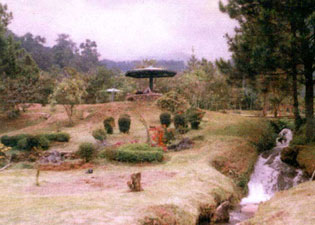
Mount Gede-Pangrango, Cibodas Botanic Garden contains beautiful
mountain scenery with impressive views across the Cipanas
valley of West Java. The Garden covers about 125 ha of undulating
topography, with large grassy expanses, rocky coniferous areas,
and valleys filled with tree ferns and waterfalls. Cibodas
Botanic Garden is a popular recreational center for the Greater
Jakarta area as well as a research station for students and
scientists studying tropical montane flora The Cibodas Botanic
Garden was founded in 1862 by the botanist and curator "Johannes
Elias Teysjmann" as an extension of the Bogor Botanic
Garden. Now one of four Indonesian Botanic Gardens (Kebun
Raya Indonesia), the Cibodas Botanic Garden is a part of the
Indonesian Institute of Sciences (LIPI). The average rainfall
is 2380 mm, and the weather is cool (18?C) and moist. The
Garden is located ? 45 km southeast of Bogor, or ? 100 km
southeast of Jakarta.
Collections and Supporting Facilities
The Garden currently maintains a collection of 5831 living
specimens from 1206 species. Among the most prominent collections
of the Cibodas Botanic Garden are the floral gardens, cacti
and succulents, bamboo, palms, conifers, Euphorbia and Myrtaceae
collections. Native Indonesian plants worth seeing include
the orchids, the fern collection, the IndoneThe Garden maintains
a herbarium and seed museum for research, development and
conservation purposes. The 4521 herbarium specimens from 1503
species consist of those collected from the Garden and from
the Gede-Pangrango National Park which is annexed to the Garden.
The 649 species in the seed museum are used as a reference
for seed identification. Historically the Cibodas Botanic
Garden is associated with the introduction of quinine to Indonesia.
Here that valuable species was planted for the first time,
introduced from South America. A few years later, the plants
had to be transferred to another, more suitable place, but
the introduction of exotic plants to Indonesia continued.
Worth mentioning are the introduction of Eucalyptus species
from Australia, and the conifers from Europe and America,
which now dominate the landscape. The succulents Aloe and
Agave, and the Acacia, Callistemon and Camellia plants were
introduced for decorative purposes, in addition to many other
temperate species which can be seen in the commercial nurseries
alongside the roads leading into the Garden. Facilities such
as a guest house, library and nursery are available for scientists,
research workers and students who wish to study the Garden
and the mountain flora of Mount Gede-Pangrango.
Cibodas Waterfalls
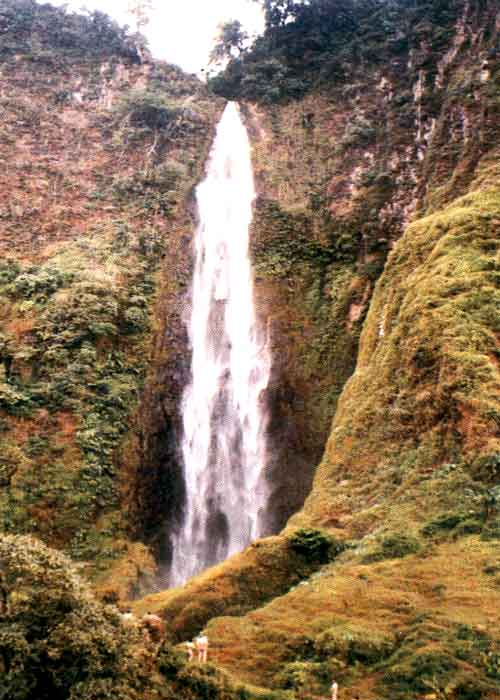
There are a variety of waterfalls in Cibodas Botanic Garden,
some human-made, and some naturally occurring in the landscape.
Visitors can trek through the forest to a lovely natural waterfall
or drive their cars over a specially constructed shallow waterfall.
|
