MnLRT...Moving Minnesoootans Through the New Century
 2000-2002
| 1999 | 1998 | 1997 | 1996
2000-2002
| 1999 | 1998 | 1997 | 1996
|
MnLRT...Moving Minnesoootans Through the New Century |
|
|
|
2000-2002
| 1999 | 1998 | 1997 | 1996
|
|
Light Rail Summary: During the 1999-2000 legislative sessions the Minnesota Legislature approved state funding for a 12 mile Light Rail (LRT) line between the Mall of America, MSP International Airport, the West Bank of the University of Minnesota and Downtown Minneapolis - known as the Hiawatha Corridor LRT Line. State and local funding will make up approximately half of the $625 million cost, the other half coming from Federal grants. The line will cost about $12 million annually to operate. Rider fares and local income sources will cover about 2/3 of this cost. While anti-rail activists (many of whom have prowled the halls of the state legislature since the 1950s-60s when the Twin Cities' streetcar system was dismantled) continue their assault on transportation choice and a cleaner environment, concerned citizens, non-profit organizations like MnLRT, many elected officials and Minnesota businesses continue to work together to see the Hiawatha line built. Once up and running, supporters envision the Hiawatha line being one link in a network of clean, modern, cost effective trolley, LRT and commuter rail lines serving the Twin Cities Metro area and outstate Minnesota as well. Plans are already underway for the next LRT line which could connect downtown St. Paul to the State Capitol, the University of Minnesota and downtown Minneapolis along University Avenue. During the 2002 legislative session, House Republicans blocked funding for the Northstar commuter rail line, which would have connected St. Cloud and the northwestern suburbs of the Twin Cities with Minneapolis (and eventually St. Paul and Hastings). Check out the latest information right from the sources:
|
|||||||||||||||
|
October
2002
For more information contact Transit for Livable Communities, 626 Selby Avenue, Suite A, St. Paul, MN 55104 - 651-767-0298 tlc@tlcminnesota.org The Southwest
Journal Interviews Candidates for Governor of Minnesota Governor candidates: their positions on big Downtown projects
|
||||||||||||||
|
August
2002
The candidates for governor all agree that transportation is a mjor issue facing Minnesota. And all except one agree that transportation choice, including LRT and commuter rail, should be part of the mix. Here is a rundown of the 4 major candidates's transportation stances:
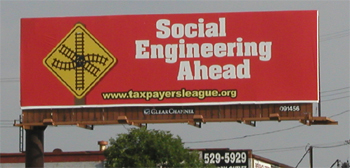
Social Engineering. You're driving on it!
New York
supports cycling, walking and trasit alternatives!
May
2001
At a time when gas prices are rising, automobile congestion on roads and highways is escalating and the health effects of automobile-born pollution are becoming better known, it is quite interesting that House Republicans continue to push the same expensive, worn-out solutions to mobility - mainly more and wider highways, more and longer commutes and more dependence on polluting transportation. MnLRT is also quite perplexed at why so-called "fiscal conservatives" would force Minnesotans to fund the more expensive and less effective transportation option (more and wider highways only) and why these "fiscal conservatives" would introduce new taxes on businesses that freely choose to move where their employees have access to real transportation choice like LRT. Contact the members of the Transportation Legislative Conference Committee, your own elected representatives and Governor Jesse Ventura and tell them that the House plan stinks. Transportation Legislative Conference Committee Members Sen. Dean Johnson, Chair (DFL) 15/Willmar Phone 651-296-3826, FAX 651-296-6511, E-mail sen.dean.johnson@senate.leg.state.mn.us Sen. Randy Kelly (DFL) 67/St. Paul Phone 651-296-5285, FAX, 651-296-6511, Email sen.randy.kelly@senate.leg.state.mn.us Sen. Jane Ranum (DFL) 63/Minneapolis Phone 651-296-8061, FAX, 651-296-6511, E-mail sen.jane.ranum@senate.leg.state.mn.us Sen. Mark Ourada (R) 19/Buffalo Phone 651-296-5981, FAX 651-296-9441, E-mail sen.mark.ourada@senate.leg.state.mn.us Sen. Roy Terwilliger (R) 42/Edina Phone 651-296-6238, FAX 651-296-9441, E-mail sen.roy.terwilliger@senate.leg.state.mn.us Rep. Carol Molnau, Chair (R) 35A/Chaska Phone 651-296-8872, FAX 651-296-3949, E-mail rep.carol.molnau@house.leg.state.mn.us Rep. Tom Workman (R) 43A/Chanhassen, Phone 651-296-5066, FAX 651-296-3949, E-mail rep.tom.workman@house.leg.state.mn.us Rep. Mary Liz Holberg (R) 37B/Lakeville Phone 651-296-6926, FAX 651-296-3949, E-mail rep.maryliz.holberg@house.leg.state.mn.us Rep. Rich Stanek (R) 33B/Maple Grove Phone 651-296-5502, FAX 651-296-3949, E-mail rep.rich.stanek@house.leg.state.mn.us Rep. Mary Murphy (DFL) 8A/Hermantown Phone 651-296-2676, FAX 651-296-4165, E-mail rep.mary.murphy@house.leg.state.mn.us Report
Shows Twin Cities Congestion Growing But Transit, Not More Lanes, Key
to Reducing Commuter Misery Building new roads or adding more lanes may not be the solution for congestion that many believe it is, based on data from other regions. Dallas, for example, has 62% more highway lane miles per person than the Twin Cities. Yet the average person in Dallas is stuck in traffic for 46 hours annually, eight hours longer than the average Twin Citian. Metro areas with good transit service place a much lower congestion burden on commuters, according to an analysis of the TTI data by the Surface Transportation Policy Project in Washington, DC. This is because more commuters have the opportunity to avoid congested highways. The Congestion Burden Index, developed by STPP, measures both the severity of traffic congestion and the degree to which commuters are exposed to it. The Twin Cities ranks 20th (out of 68 cities) on the new Congestion Burden Index. Chicago, despite its notorious congestion, ranks much better than the Twin Cities because of its excellent public transit system. The new index combines TTI's measure of rush-hour congestion with federal data showing what portion of commuters are exposed to congestion because they drive to work. "This report shows that providing more choices, not more lanes, will ultimately provide commuters with relief from growing congestion," said John DeWitt, Co-Executive Director of Transit for Livable Communities. "Given these findings," added DeWitt, "it's disturbing that Republicans in the Minnesota House have approved a transportation bill that will reduce transit service and limit our ability to plan new rail lines." In regions around the US, an increasing number of Americans are finding a route out of congestion; recently released figures show that the growth in transit ridership is now outpacing the increase in driving. During the past five years, transit use grew 21% while driving grew only 11%. [See American Public Transit Association at www.apta.com] A number of regions similar to the Twin Cities have more lane miles of highways and freeways on a per person basis and still have worse congestion. The information below shows the percentage increase in per person lane miles and delay for five similar regions. Republicans in the Minnesota House are proposing a constitutional amendment that could add $165 million annually in new roadway spending statewide.
The Surface Transportation Policy Project is a nationwide network of hundreds of organizations, including planners, community development organizations and public interest groups, devoted to improving the nation's transportation system. A metro area fact sheet with additional data on commuting patterns, congestion rankings, and road capacity in the Twin Cities is available at STPP's website, www.transact.org. A full copy of the report can also be found at the web site. A complete copy of the TTI report is available at web site mobility.tamu.edu Transit for Livable Communities (TLC) is a transit advocacy group, based in St. Paul, which is working for improved transit in the Twin Cities region along with development patterns that support transit, walking, and biking. For more information, call TLC staff John DeWitt at 612/338-1871 (cell: 612/483-5139) or Barb Thoman at 651/767-0298. U.S. District
Court Judge Orders Excel Energy to Move Utility Lines for Hiawatha LRT
Line Spokesperson Mary Sandok of Excel Energy remarked, "We are disappointed in the ruling, and our attorneys are reviewing our options." MnLRT urgers Xcel Energy and Qwest, who are obligated under long-standing State and Federal laws to move utility lines for legitimate public purposes such as roadway/highway construction and rail construction, to cooperate with the citizens and taxpayers of Minnesota to move the utility lines as expected, particularly since the Hiawatha LRT line and other Metro Transit operations will be large customers of both. American Gridlock: Traffic is making millions sick and tired. The bad news? It's going to get worse unless things change in a real big way. A recent article by U.S. News & Word Report concludes what supporters of transportation choice have long known: That the uncontrolled subsidy of highway building, encouraging far-flung commuting patterns and near complete automobile dependence in many American communities is having disastrous economic, social and environmental effects - and that many Americans are noticing these effects for the first time. The report states, "Traffic, everyone knows, is one of the bigger hassles of modern life. But just in time for Memorial Day, a blizzard of brand-new data confirms just how bad congestion has become. Since 1982, while the U.S. population has grown nearly 20 percent, the time Americans spend in traffic has jumped an amazing 236 percent. In major American cities, the length of the combined morning-evening rush hour has doubled, from under three hours in 1982 to almost six hours today. The result? The average driver now spends the equivalent of nearly a full workweek each year stuck in traffic." "Traffic influences not just where Americans live, but how they live. Studies repeatedly show that people making long commutes are at a higher risk for a host of maladies. High blood pressure, sleep deprivation, and depression top the list. Meni Koslowsky, a psychologist from Bar-Ilan University in Israel and author of the book Commuting Stress, notes that Type A personalities, competitive and anxious about wasting time, are particularly prone to being unnerved by traffic. Koslowsky has also found that women who face long commutes are more stressed and depressed by the experience than men and show greater unhappiness with their home lives. Stressed-out commuters with little time for loved ones also don't have much time for community involvement, it turns out. Robert Putnam, a professor of public policy at Harvard University, has conducted extensive studies of the reasons behind Americans' decreasing involvement in social groups like the PTA, church, recreational clubs, and political parties. Putnam's conclusion? Long commutes are a bigger reason than almost any demographic factor. The relationship can be plotted on a curve, Putnam says: For every 10 minutes spent driving to work, involvement in community affairs drops by 10 percent." The report goes on to note, "Catch-22. Will building new highways help people who don't want to use mass transit or who can't afford to live where it's available? Not really. Consider what it would take just to accommodate the projected growth in traffic in San Diego over the next 20 years if auto dependency isn't reduced. San Diego is expected to grow by 1 million persons by 2020. If current patterns continue, that would mean an additional 685,000 cars. Today, there are five parking spaces available for every car in San Diego and parking is still a problem. To find sufficient parking spaces for another 685,000 cars, the city would need an additional 37 square miles of parking lots." The insightful report concludes, "So, embrace change. A recent survey sponsored by Smart Growth America, a new coalition of public-interest groups, asked a cross section of Americans: "Which of the following proposals is the best long-term solution to reducing traffic in your state? Build new roads; improve public transportation, such as adding trains, buses and light rail; or develop communities where people do not have to drive long distances to work or shop." Three quarters of respondents called for either improving mass transit or developing less auto-dependent communities; just 21 percent called for building new roads. Talk about a tipping point. America's long love affair with the car, it seems, may have finally soured into a less healthy relationship, one based not on freedom but on its opposite." For the full report go to usnews.com (http://www.usnews.com)
|
|||||||||||||||
|
January 2001
WHY: The Full Funding Grant Agreement (FFGA) from the Federal Transit Administration (FTA) completes Congressional review January 14th, bringing $334 million in FTA money to the $675 million project. This will complete all current funding elements, allowing the project to move forward. The owner of the Hiawatha Line will be the Metropolitan Council; the operator will be Metro Transit; the Minnesota Department of Transportation (MN/DOT) is responsible for Design and Construction; the Metropolitan Airports Commission (MAC) is responsible for Design and Construction of the Airport Tunnel. Other funding partners include Hennepin County.
|
||||||||||||||
|
October
2000 Anti-LRT
Activists Continue Anti-Rail Rampage & Cloud the Issues Anti-rail
lobbying organizations include: LRT -
Rail Spotlight: France |
||||||||||||||
|
June
2000 The State of Minnesota, City of Minneapolis, Hennepin County, MnDOT and the Minnesota Public Utility Commission insist costs be born by the utility companies, as required by Minnesota law and by precident established in the construction of roads and highways across the state. In its defense, NSP, one of the utilities involved along with US West, argues "the true costs of LRT should be identified and spread among those likely riders -- not hidden in our customers' electric bills." Opinion:
Public utilities in the state of Minnesota have been granted right-of-way
to place utility lines and other utility infrastructure along, under and
adjacent to Minnesota roads and highways for many years. With this grant
of access to public utilities, Minnesota has passed laws and established
precident requiring utility companies to move those utilities in situations
of valid public purpose. NSP and US West should comply with Minnesota
state law and move the utilities at their cost, not at the cost of the
Hiawatha project. To require transit (non-highway) projects to incur costs
for the relocation of utilities would not only violate the law, but would
be hypocritical and would premanently bias costs of non-highway transportation
options, while at the same time permanently understating the costs of
road and highway projects. |
||||||||||||||
|
May
2000 Legislation
Preserves Minnesota's Funding for Light Rail on Hiawatha Corridor But
Funds $596 Million in New Highway Construction, With Just a Drop for Transit Also included in the bill was $596 million in spending for so called "bottleneck repair" and funding for outstate "transportation corridors" and a pittance of funding, $25 million, for Metro Area transit. In typical pathetic style style, neither Legislative leaders nor MnDOT officials have provided the public with any measures of effectiveness on either congestion or noise and pollution reduction. Minnesotans continue to be put in the dark in terms of the true costs and benefits of all our transportation options. This is simply $596 million of taxpayers' money that will go toward making congestion worse than ever, creating more pollution, and subsidizing more urban sprawl. Senate vote:
64-2 in favor of the bill. Anti-Rail
Rep. Tom DeLay Derails LRT in Houston, Texas
|
||||||||||||||
|
April
2000 In addition, the Federal Aviation Administration (FAA) gave the go-ahead for the Metropolitan Airports Commission (MAC) to contribute up to $70 million toward the project. This funding will go toward the costs of tunneling under the runways of MSP International airport as well as toward the costs of rail stops at the two airport terminals. Both announcements are a major step forward in transportation choice for Minnesota. Special thanks to the thousands of Minnesota voters and the many honest, dedicated elected and unelected officials who worked against all odds to get Minnesota to this important milestone - the first step in building a balanced and sustainable transportation system in Minnesota. MnLRT would also like to thank Governor Jesse Ventura and the Ventura administration for their tireless support of transportation choice, policies which are absolutely instrumental in assuring Minnesota's future competitiveness in an increasingly global economy. Star-Tribune Editorial on Smart Growth ("Compete or retreat -- 'Smart growth' is smart business") Transit
Action Alert! Keep Light Rail On Track!
Information on both the Minnesota House and Senate can be found at http://www.leg.state.mn.us St. Louis light rail hits Home Run House
Speaker Sviggum Distorts Transportation Debate In his article, the Speaker asserts "those trying to prop up the Hiawatha Corridor project in Minneapolis are grasping for straws and failing to set responsible spending priorities." In fact, the speaker forgot to mention the $1.3 billion House Republicans intend on spending for a 12 mile stretch Highway 212 into the southwest suburbs and prairies - a project which, if completed, would add an additional 75,000 trips per day to an already congested 494/Highway 5 interchange. The Speaker also forgot to mention the $600 million plus already spent on Highway 394, a project that has made congestion in the western suburbs worse than it has ever been before. MnLRT wonders who exactly is failing to set responsible spending priorities. In addition, Speaker Sviggum asserts "from corporate profits to personal vendettas against the governor to frugality run amok, questioning the other side's motives is merely a diversion from the real issue: Should the people of Minnesota shoulder the cost of light-rail transit systems?" MnLRT and the throusands of other Minnesota taxpayers who do support Light Rail do in fact question the motives of anti-rail extremists in the State Legislature and elsewhere in the private realm, particularly when key information is left out of the debate, when facts and figures are distorted, and when certain elected officials outright lie to the public. Anti rail activists have a 30+ year history of massively funded distortion campaigns that are purposefully intended to prop up urban sprawl type development and to continue to subsidize an automobile dominated transportation system. The behavior of the 'other side' leaves Minnesotans no other choice but to question motives. Speaker Sviggum goes on to state "Lawmakers are right to question a multimillion-dollar project when they are faced with concerns including the estimated cost-to-benefit ratio that shows a 42-cent return per tax dollar spent; a failure of examiners to do a cost-effectiveness study that truly considered options (as Minnesota law requires); and continued misinformation filtered to them from the Transportation Department." Speaker Sviggum forgot to mention that the law to which he refers, which is intentionally biased in favor of roads and highways, was written by anti-rail activist Phil Krinkie (R-Shoreview). Representative Sviggum also forgot to include the cost-to-benefit ratios for specific road, bus routes, or air travel options, for example 394, 35W, 169, 212, Highway 96, so that taxpayers could actually compare different options. Instead, the Speaker, as asserted elsewhere in MnLRT's web site, would rather feed the public distorted pieces of misinformation in order to warp the debate and continue the games of special interest politics that are so rampant today, even here in Minnesota. Finally, the good Speaker writes "outstate, a growing number of Minnesotans are concerned that a legislative commitment to lightrail will cost taxpayers billions of dollars through increased taxes, expanded fees for services, and utility rate hikes. LRT will require an operating subsidy indefinitely, and no one knows how high those costs will run." Which 'growing number of Minnesotans' is that? What figures show that trend? Here again, the Speaker gives us all a prime example of how low anti-rail activists and their soft-money campaign supporters will stoop. The Speaker has never had the foresight to question the billions of dollars of tax money Minnesota spends each year on roads and highways, a bill that grows each and every year, yet now has the gall to suggest that taxpayers will not know what LRT will cost. In fact, we do know what LRT will cost. Unlike the money poured into roads and highways over 40+ years, the costs of LRT, including the Hiawatha LRT Line have been examined nearly to death. The total Hiawatha Corridor costs are $548 million. It will cost $10-12 million per year to operate, $6-8 million of which could be re-captured through providing smart, business-friendly opportunities like concessions and advertising. In fact, MnLRT would like to ask Speaker Sviggum
If the Speaker
is honest about telling Minnesotans the truth about how their tax dollars
are really being spent, he will come clean and answer these basic questions.
Only then can Minnesota taxpayers make truly informed decisions. Speaker
Sviggum can answer these questions at any time by emailing MnLRT at mnlrt@yahoo.com.
Answers will be posted here. |
||||||||||||||
|
March
2000 Call Transit for Livable Communities at 651-767-0298 for more details. Minnesota
House Axes Light Rail Funding |
||||||||||||||
|
February
2000
Call your state and local elected representatives and tell them you want Minnesota to invest in real transit and real transportation choice, not the same worn-out, one sided approaches of the past 40 years. Star Tribune Editorial on Balanced Transportation, LRT and Economic Competitiveness Trolleys
on the Midtown Greenway Transit
Supporters & Anti-Rail Extremists Square-Off in Classic Debate Proponents of LRT included Ted Mondale, chairman of the Met Council, Paul Weyerich, founder of the Free Congress Foundation, and Peter Calthorpe, founder of Calthorpe Associates. Anti-rail activists on the panel included State Representative Phil Krinkie of Shoreview, Darrel McKigney of the anti-rail Taxpayers League of Minnesota, and 'economist' Randal O'Toole of the Thoreau Institute. The debate will be re-broadcast on public television in March. More details to follow. LUI:
Legislating Under the Influence Call Speaker
Sviggum and ask him how spending spending $15 billion on roads and
highways only is "more cost effective" than investing $3 billion in a
balanced transportation system that actually saves money in the long run.
Office: (651) 296-2273 Home: (507) 789-4673 email: rep.Steven.Sviggum@house.leg.state.mn.us
. Contact your elected representative in the Minnesota
House of Representatives and tell them you support Light Rail. Clinton
Budget Includes $20 Million for Hiawatha LRT - Federal Match Expected
Fall 2000
The Road to Nowhere: Highway 212, Highway Activist-Legislator Carol
Molnau Remains Fixated Call State
Representative Carol
Molnau and tell her to stop the extension of Highway 212 and invest
in Light Rail or Commuter Rail instead. Office:
(651) 296-8872 Home: (612) 448-3513 email: : rep.Carol.Molnau@house.leg.state.mn.us  |
||||||||||||||
|
January
2000 Induced
Demand: New and Wider Highways Result in More Congestion In Cincinnatti,
Ohio Successful
New LRT Line in San Jose, California Will $70
Million for Six Mile Freeway Widening Reduce Congestion? Crosstown
Highway 62/I-35W Interchange Costs Rise to $85 Million Anti-Rail
Legislators Continue Crusade Against LRT, Promote Highway Widening
|
|
|
|
Special thanks to Transit for Livable Communites, a non-partisan, grass-roots transportation advocacy group, whose objectives are to communicate critical transportation decision-making information to the Minnesota public. Our Privacy Statement: Minnesotans for Light Rail Transit and TLC will never, ever, under any circumstaces sell, distribute, or disclose the names and/or email addresses and/or the written/verbal conversations of individuals that contact us. All contact between individuals and MnLRT/TLC will remain strictly private under the laws of the State of Minnesota and in compliance with all laws in the United States of America. For further information contact: Minnesotans
for Light Rail Transit Transit for
Livable Communities This is the experimental site under development for Minnesotans for Light Rail Transit and Transit for Livable Communities. Once the site gets closer to completion it will be moved to a more prominent and permanent location. Last updated: Spring 2001 This page
hosted by |
Minnesota Minneapolis St. Paul Twin Cities Light Rail Transit LRT Transportation Public Rail Community Environment Minnesota Minneapolis St. Paul Twin Cities Light Rail Transit LRT Transportation Public