Karamjeet Singh's Himalayan Home

 Kulu is the valley of the Upper Beas.
One of the major western Himalayan rivers, the Beas, however, does not cut across the main
range and has a relatively shorter high mountain run. It's large catchement area though, has given rise to some of the most
extensive temperate forests in the western Himalaya. In terms of it's physical geography also, the area has some unique
characteristics. Heavy glaciation during the last ice age affected the topography considerably, leaving extensive rocky
moraines and hanging valleys, making the modern day Kulu valley a trekker and beginning mountaineer's delight.
It is the smaller valleys at the head of the main Beas valley that make Kulu valley paradise. Solang Nala, primary source
of the Beas, is a veritable textbook model of the gradations in alpine landscape, flora and fauna, all compressed within
a few kilometers. At the head of the Solang Nala is the Beas Kund plain, encircled by a great amphitheatre of peaks, glaciers and icefalls.
Prominent, is the Hanuman Tibba massif at nearly 20,000 feet, it's 8 km long glacier giving birth to the main stream of the Beas.
In 1977 Solang Nala was proposed as a possible UNESCO biosphere reserve under the UNESCO project on Man and the Biosphere.
Unfortunately for Solang Nala, nothing came ofit and today the valley is under severe ecological stresses. Extensive road
building activity, especially in the Upper Solang Nala, and the attendant destruction of the forests as they become more amenable
for exploitation, has led to the disappearance of bird and animal species frequently seen in the area 15 years ago.
 Fully 1800 square kilometers of land in the Upper Beas is designated as Reserved or Protected forest. But appearances can be misleading.
Species diversity is on the decline and the moist temperate forests, home to various species of Himalayan wildlife are fast disappearing. Species seen
frequently in Solang Nala in earlier years included the rare Western Tragopan pheasant, The Monal pheasant, the Himalayan
Black Bear, Leopard, Yellow throated Marten, the Musk deer, Serow, Tahr and Ibex. The last four mentioned, ungulates, seem to have almost
disappeared from the area nowadays as has the Tragopan pheasant.
Fully 1800 square kilometers of land in the Upper Beas is designated as Reserved or Protected forest. But appearances can be misleading.
Species diversity is on the decline and the moist temperate forests, home to various species of Himalayan wildlife are fast disappearing. Species seen
frequently in Solang Nala in earlier years included the rare Western Tragopan pheasant, The Monal pheasant, the Himalayan
Black Bear, Leopard, Yellow throated Marten, the Musk deer, Serow, Tahr and Ibex. The last four mentioned, ungulates, seem to have almost
disappeared from the area nowadays as has the Tragopan pheasant.
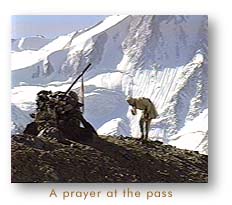 At the head of the valley lies the Rohtang pass at an altitude of 13,400 feet. This is more or less where the monsoon comes
to a halt. North are the arid, cold deserts of Lahaul and the Transhimalaya. This also constitutes the abrupt dividing line
between two of the world's great faunal realms, the oriental to the south and the palearctic to the north. Local lore has it that
Kulu derives it's name from Kulantapith, meaning the 'end of the habitable world'. Appropriate enough when one stands atop the
Rohtang and views the icy desolation beyond.
At the head of the valley lies the Rohtang pass at an altitude of 13,400 feet. This is more or less where the monsoon comes
to a halt. North are the arid, cold deserts of Lahaul and the Transhimalaya. This also constitutes the abrupt dividing line
between two of the world's great faunal realms, the oriental to the south and the palearctic to the north. Local lore has it that
Kulu derives it's name from Kulantapith, meaning the 'end of the habitable world'. Appropriate enough when one stands atop the
Rohtang and views the icy desolation beyond.
The most important town and tourist destination in the Beas valley is Manali. A town that till 30 years ago did not exist on the map, today
boasts of some 350 odd hotels and nearly 2,000 tourist taxis! This development has not been the result of any planned growth
but has literally mushroomed like some mining town out of the wild west. A major causative factor was the closure of Kashmir as a
tourist destination in the late 80's. By the mid 90's the situation had deteriorated considerably with large scale pollution of
the Beas and the surroundings. Luckily, a few years back, the Himachal High court stepped in and banned constructions
near the river as well as further hotel constructions in all major towns in Himachal. Court intervention became necessary
because of the shocking acts of the then Union Minister for Environment & Forests who happens to own a major resort in the area. Thus
the administration blindly overlooked diversion of the course of the river itself, thus endangering many downstream villages, by the hotel management
in connivance with local authorities. Manali, however remains an important destination because it serves as a jumping off point
for treks to Inner Chamba, Parvati, Lahaul and Zanskar / Ladakh. From Manali you can chose the Kalihain pass into Bara Banghal, one of Chamba's
most beautiful, fascinating and isolated areas.A further trek, across the abandoned Nakora pass, brings you to the holy lake
at Manimahesh. Or you can cross from the Hampta pass into Lahaul. Or take a variety of extremely
tough routes to the headwaters of the Parvati. Alternatively, you can drive to Darcha in Lahoul and trek into Zanskar, or go up the Miyar
Nala, and into Zanskar via the Kang la, the area has infinite possibilities and dozens of disused passes.
 Kulu is also the valley of the Gods. Every village here has it's own resident devta or deity. A legend relates how this came to
be so..... In another aeon, when Gods still walked the Earth, Shiva, the Destroyer, and his consort Parvati, were crossing
the Hampta pass. It was a lovely morning, the mountains aglow with the rising sun and both Shiva and Parvati could not
but stop to enjoy the views. Seeing nature's raptures, Shiva got carried away and started dancing. When the Lord of the Universe
dances, the mountains tremble - old mountain saying. An entranced Parvati, in the meanwhile, lost her hold on a pittari
she was carrying. The container fell and as it rolled away, it's lid came off and some 350 odd minor gods whom Shiva had
imprisoned inside, flew out and down, to the villages of the Kulu valley.
Kulu is also the valley of the Gods. Every village here has it's own resident devta or deity. A legend relates how this came to
be so..... In another aeon, when Gods still walked the Earth, Shiva, the Destroyer, and his consort Parvati, were crossing
the Hampta pass. It was a lovely morning, the mountains aglow with the rising sun and both Shiva and Parvati could not
but stop to enjoy the views. Seeing nature's raptures, Shiva got carried away and started dancing. When the Lord of the Universe
dances, the mountains tremble - old mountain saying. An entranced Parvati, in the meanwhile, lost her hold on a pittari
she was carrying. The container fell and as it rolled away, it's lid came off and some 350 odd minor gods whom Shiva had
imprisoned inside, flew out and down, to the villages of the Kulu valley.
Once a year, on the festival of Dassera, celebrated all over India as the day Lord Ram slew the demon king Ravan, the gods
are brought in procession from all over the valley to the maidan at Kulu. Then takes place a 10 day jamboree, the mela, where
assembled villagers buy, sell, dance, eat, drink and generally make merry. All manners of trade are carried on. Oracles abound, ready
to tell your fortune while in the grip of a seeming fit, as do local dentists, their only instruments a pair of pliers and a bottle of clove oil.
Kulu is also famous for it's apples. Interestingly, apple is not indiginous to the Himalaya and was an English import, over a
hundred years ago. While meaning enhanced incomes for the growers of the valley, apple cultivation also had serious long
term consequences for the environment. Orchards have encroached onto forest land and in earlier years, before plastic
crates were made mandatory, packaging crates consumed generations of stately oak and cedar.
 This region of the western Himalaya is home to diverse wildlife including a large number of endangered species protected
under schedule 1&11 of the Indian Wildlife Act. Poaching, combined with habitat destruction, is making serious inroads into the populations of three species of significant commercial value - The Musk Deer moschus moschiferus,
the Himalayan Black Bear selenarctos thibetanus, and the male Monal pheasant lophophorus impejanus.The Monal Pheasant is also Himachal's state bird and was once found practically all over
the Western Himalayas. But the disappearance of their habitat in the form of dense ground vegetation has brought the Monal to the brink of extinction.
Monals formerly occured in the front ranges of the Himalayas, around Hill stations such as
Simla, Mussourie and Dalhousie. Whereas the last reported Monal sighting at
This region of the western Himalaya is home to diverse wildlife including a large number of endangered species protected
under schedule 1&11 of the Indian Wildlife Act. Poaching, combined with habitat destruction, is making serious inroads into the populations of three species of significant commercial value - The Musk Deer moschus moschiferus,
the Himalayan Black Bear selenarctos thibetanus, and the male Monal pheasant lophophorus impejanus.The Monal Pheasant is also Himachal's state bird and was once found practically all over
the Western Himalayas. But the disappearance of their habitat in the form of dense ground vegetation has brought the Monal to the brink of extinction.
Monals formerly occured in the front ranges of the Himalayas, around Hill stations such as
Simla, Mussourie and Dalhousie. Whereas the last reported Monal sighting at Simla was prior to 1920 and it's been ages since any has been seen at Mussourie,
they are however relatively numerous in both Kulu valley and Kinnaur. Poaching also continues to take a serious toll. The bane of the Monal
is his irridiscent crest, highly prized as hat ornamentation by the hill men in the Western Himalaya. In fact poaching
is rampant inspite of stiff penalties provided by law, enforcement being a different matter at 10,000 feet on a remote mountain
slope. While the Musk deer and the Monal pheasant are already pretty rare, the Black bear is not far behind though he has
the advantage over the other two in terms of numbers and natural defences.
Omnivorous with razor sharp reaction speeds, he is unfortunately no match for the
gun. For the locals, besides being a pest , for he raids crops and orchards, his bile and fat are highly
prized in all sorts of medical quackery.
Simla was prior to 1920 and it's been ages since any has been seen at Mussourie,
they are however relatively numerous in both Kulu valley and Kinnaur. Poaching also continues to take a serious toll. The bane of the Monal
is his irridiscent crest, highly prized as hat ornamentation by the hill men in the Western Himalaya. In fact poaching
is rampant inspite of stiff penalties provided by law, enforcement being a different matter at 10,000 feet on a remote mountain
slope. While the Musk deer and the Monal pheasant are already pretty rare, the Black bear is not far behind though he has
the advantage over the other two in terms of numbers and natural defences.
Omnivorous with razor sharp reaction speeds, he is unfortunately no match for the
gun. For the locals, besides being a pest , for he raids crops and orchards, his bile and fat are highly
prized in all sorts of medical quackery.
The Great Himalayan National Park was set up in 1984 and comprises the valleys of the Sainj and Tirthan, tributaries of the
Beas. This area in fact has probably the largest extant populations of the large mammals in the Western Himalayas. Ungulates like Tahr
and Ghoral, as well as Serow, are reportedly present in large numbers, as well as the Musk deer. Both species of Himalayan
bear, the red ursus arctos, and the black, alongwith the leopard, are present especially at Rolla in the upper Tirthan
valley. However, it in pheasant species that the area really abounds. Besides the Monal, we have Cheer catreus wallichi
and the Western Tragopan tragopan melonocephalus. Such dense forests at such a comparatively accesible
location do not occur anywhere else in the Western Himalaya. The presence of lower altitude Oak forest in the Tirthan valley
is also unusual compared with other parts of the Beas valley. One of the major factors contributing to the natural state of the forests
is the absence of the Gaddis and their flocks. Inner Siraj does not lie on any of the Gaddi migratory routes and has thus been
spared the gross changes in vegetation that the Gaddi and Gujjar flocks bring about. This threatens species that require a
dense ground cover, like the Cheer and Western Tragopan pheasants.
The Western Horned Tragopan, is the rarest of the Pheasant species in the western
Himalayas. Earlier found in a broad crescent down from Pakistan to the Garhwal region in U.P, it now exists only in isolated
pockets, the largest being in the upper Beas and Kinnaur regions of Himachal.
The total world population of these exotic birds is estimated at less than 5,000 in the
wild, and the prospects for the future are not really promising inspite of conservation
programmes. The main problem is the thin spread of the species and the high altitude
coniferous forests that they inhabit ,make effective policing difficult, to say the least . 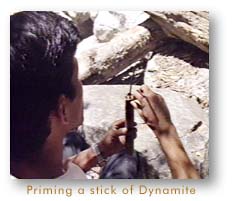 Tragopan are hunted for meat, plummage and are sometimes accidentally, mistaken
for Monal, whose winter habitat they share.
Tragopan are hunted for meat, plummage and are sometimes accidentally, mistaken
for Monal, whose winter habitat they share.
The Beas too, is a fertile stream, rich in fish. It is of course famous for it's trout but is also well known for Mahseer, amongst the largest in the
western Himalaya. Fish species have suffered though because of pollution and overfishing. The expansion of towns, especially Kulu
and Manali, did not keep pace with the infrastructure, leading to the dumping of gargabe and other wastes untreated into the river. The situation
is marginally improved today. The extensive use of dynamite for fishing has also taken it's toll of fish populations.
 Index
Lahaul
Index
Lahaul
|
This page hosted by
 Get your own Free Home Page
Web Page Design and Images Copyright©: Karamjeet Singh