

The historic town of Vellore in India’s southernmost state, Tamil Nadu, has
long been known for its magnificent fort and ancient temple,
renowned hospital and medical college, Parry’s factories and
the vast industrial estate in nearby Ranipet. A new landmark is the Vellore Institute of Technology (VIT), known for its international standard of technical education and research facilities.
Vellore Institute of Technology is located in India's southern most State, Tamil Nadu, between the important South Indian cities of Chennai (formerly Madras) and Bangalore (considered the Silicon Valley of South Asia). The Institute's main entrance is on the Katpadi - Ranipet highway. The Institute is 140 km west of Chennai and 205 km east of Bangalore on National Highway 46. The nearest airport is Chennai, 2 ½ hours’ drive away. Bangalore too has a major airport. These two cities can also be reached by train, entraining at Katpadi Station, 3 km from the Institute
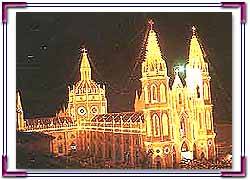
The Gateway to South India with their rich architectural heritage, culture and civilization and the fourth largest city of India, Chennai is a center for culture, rich in its vibrant traditions of music and dance crafts that have retained their pristine purity. The city has a rich Dravidian heritage. It traces its origins to ancient times when it traded with the Far East and the West in perfumes, spices, silks and skins. It's the land of Bharat Natyam, the most popular classical Indian dance today. Among the major places of interest are fort St. George, St. Mary's Church, Santhome Cathedral - The remains of St. Thomas were kept here, Government Museum, Kapaleeswarar Temple, Anna Zoological Park, and Marine Beach - the most prominent feature of Chennai and the second longest beach in the world, which runs from the harbour in the north to the Cathedral in the south.
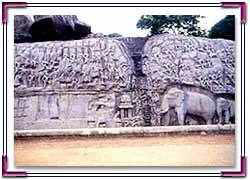
Mahabalipuram the ancient capital and sea port of Pallava kings is famous for its SouthIndian temple architecture. But today it is a sleepy village living on its past glory and the tourist traffic. The sculptures and carvings are fascinating. Mahabalipuram is also known as the "city of seven pagodas" for out of solid stone were carved exquisite rock temples. Five of the temples are known as "Rathas" and on their walls the story of Hindu mythology has been lovingly carved out. The most famous of them is group of five rathas. This ratha is dedicated to the five Pandava princes and their consort-wife Draupadi. A group of elephants one of them 5 meters long known as "Arjuna Penance" is the most prominent feature of this sculpture.

Stately Mysore with its free lined boulevards, grand palaces
and gardens is one of the India's finest cities. Among the places
of interest are the Maharaja's Palace - the Palace built in
Indosaracenic style is profusely decorated and gilded, Chamundeshwari
Temple, Zoological gardens, the Cauvery art and craft emporium and
Brindavan Gardens.

Named Bendakalooru, the Town of Boiled Beans by its King Veera Ballala, who was hungry and famished, received a meal of boiled beans from a kindly woman. Bangalore since then has become the Garden city of India. Among the places of interest are Vidhan Soudha, Lalbagh Botanical gardens spreading over 240 acres, the Fort, Tipu Sultans summer Palace originally built in Mud in 1537 was rebuilt by Haider Ah, a couple of centuries later and bull temple which has a huge monolithic statue of Nandi.


 In a state where scenery and terrain is perhaps more varied
than in any other part of the country, where the forested slopes
of the majestic hills of the western ghats vie with the magnificent
beaches of the Coromandel coast, it is indeed difficult to decide
which is the best feature of multi-faceted Tamil Nadu.
Located 120 kms away from Madurai, Kodaikkanal is a beautiful
hill station and is at an altitude of 2133m on the southern tip
of the upper Palani hills in the Western ghats. Kodaikkanal has a
bracing climate where temperature do not vary much from summer to
winter. Fruits like plums and plantains grow abundantly on the wooded
slopes apart from a wide variety of flowers, among which is the
famous Kurinji flower which blooms once in twelve years.
In a state where scenery and terrain is perhaps more varied
than in any other part of the country, where the forested slopes
of the majestic hills of the western ghats vie with the magnificent
beaches of the Coromandel coast, it is indeed difficult to decide
which is the best feature of multi-faceted Tamil Nadu.
Located 120 kms away from Madurai, Kodaikkanal is a beautiful
hill station and is at an altitude of 2133m on the southern tip
of the upper Palani hills in the Western ghats. Kodaikkanal has a
bracing climate where temperature do not vary much from summer to
winter. Fruits like plums and plantains grow abundantly on the wooded
slopes apart from a wide variety of flowers, among which is the
famous Kurinji flower which blooms once in twelve years.
