 .Glyceryl Trinitrate


Thin-layer Chromatography (TLC):
TLC is similar to paper chromatography. Both are open bed techniques in which substances are separated by the differential migration that occurs when a solvent flows along a thin layer paper by papery chromatography or by a fine powder spread on a glass or plastic plate by TLC. But Most of the substances are separated faster and more efficient by TLC than paper chromatography.
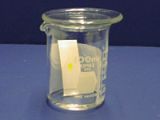 |
| Simple TLC Setup with TLC plate |
Results from Thin-layer chromatography by different system: System TD - Rf 71, System TE – Rf 86, System TF – Rf 72.
High Performance Liquid Chromatography (HPLC):
The technique of HPLC is based on the same modes of separation as classical column chromatography, i.e. partition, adsorption, ion exchange and gel permeation, but it differs from column chromatography in that the mobile phase is pumped through the packed column under high pressure. The principal advantage of HPLC compared to classical column chromatography are improved resolution of the separated substances, faster separation times and the increased accuracy, precision and sensitivity with which the separated substances may be quantified.
Results from High Performance Liquid Chromatography by system HY-RI 499:
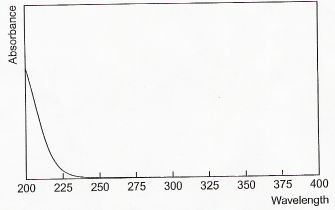
Infra-red Spectrum:
When a simple 2 atoms joined molecule is examined by infrared spectrophotometer in the gas phase, a value of absorbance can be obtained. The absorbance is due to the transition between the bottom vibrational state V0 and the first excited state V1 in the bond. However only the bond which is dipole can be interact with electromagnetic radiation. But most of the organic molecules, even of small organic molecules, have plenty of asymmetry and the modes of vibration are complex. Because of the data obtained from IR analysis for a polyatomic molecule having large number of bonds is very complex. It can be used as a unique fingerprint identity for the molecules.
Results from Infra-red Spectrum: Principal peaks at wavenumbers 1647, 1279, 843, 1013, 903, 754cm-1.
Gas chromatography:
It is a technique used for separation of the components of a mixture in the gaseous state by partition column chromatography using a gaseous mobile phase. It requires the vaporization of the sample, which is carried through a column at a suitable temperature by a stream of carrier gas, mobile phase. During the passage of the vapour of the sample through the column, separation of the components of the sample is achieved by adsorption effects or by partition effects.
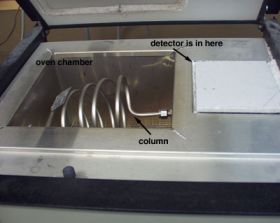 |
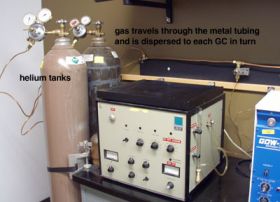 |
Results from Gas Chromatography: In plasma, the limits of detection of Glyceryl Trinitrate should be 0.0025 ug/L.