

Coinage
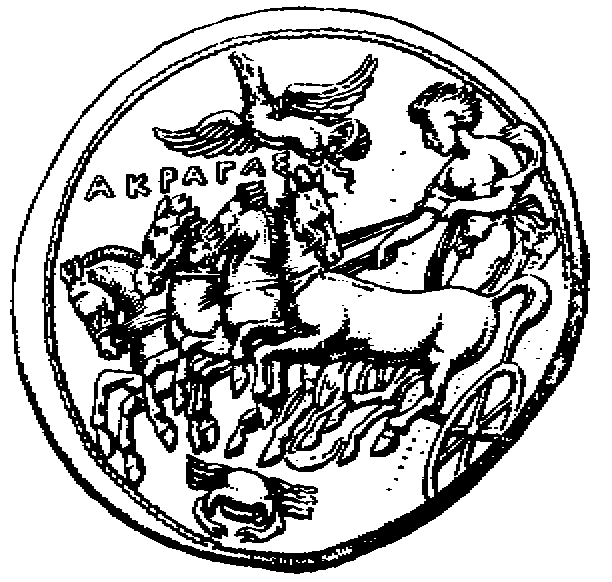
As in D&D the standard coin is a silver piece, called, in Greece, a drachma. Silver coins of greater value are very common, including the didrachm (worth 2 silver pieces) and the tetradrachma (worth 4 silver pieces). A rarer coin is the 10-drachma piece called a decadrachm. Finally tiny silver coins called obols are worth (in Heroes of Delphi at any rate) one-tenth of a drachma. This is how D&D coins compare:
1 gold piece = 1 silver decadrachm
1 silver piece = 1 silver drachma
1 copper = 1 silver obol
On page 155 of the Dungeon Master's Guide details are given of the role of the moneychanger. This profession was a lucrative one in ancient Greece. City-states are jealous of their own coinage and often demand that 'foreign' coins are exchanged (for a price) by these middlemen in the city agoras (meeting place market) across Greece. The DM should decide for himself whether or not he wants to use the historical moneychanger in his game, or whether he wants to gloss over this aspect of life for the sake of simplicity.
Obviously in any game set within a particular historical period, the entire gamut of D&D weaponry will not be available. In Heroes of Delphi there are no exotic weapons and there are only a limited number of simple and martial weapons available for Greek characters. The weapon of choice is the 2-3m longspear, useable one handed (making it a Medium weapon not a Large one) and weighing only 3 lb. It is cheap, dangerous and nasty. By contrast the humble shortsword and scimitar are sidearms, second-rate weapons used as a last ditch measure. Likewise shields are very popular, almost a required piece of kit. Get a shield!
The available Simple Weapons are:
Unarmed Strike
Dagger
Sickle
Club
Quarterstaff (bakterion)
Shortspear
Sling
Javelin
The available Martial Weapons include:
Handaxe
Lance (kamax)
Shortsword
Scimitar (machaira)
Great Club
Longspear
Shortbow
Composite Shortbow
Armour
The Greeks recognised the division of combat protection into light, medium and heavy and there was a single type of Greek armour for each category.
Heavy Armour
The combatant wears an expensive bronze breastplate as well as a crested Corinthian helm that protects the nose, cheeks and neck. His legs are protected by bronze greaves and his forearms by bronze vambraces.
Cost 600 gp
Armour Bonus +6
Max Dex Bonus +0
Armour Check Penalty -6
Spell Failure 40%
Speed 20ft*
Weight 40lb
Donning 4 minutes/1 minute/1 minute
Medium Armour
The warrior wears a corselet of white stiffened linen with shoulder straps and a skirt of tough linen strips (pteruges). He continues to wears greaves on his legs and either a Corinthian helm, the simpler Pylos helm (which is a tapered dome shape without any neck or face protection), a Petasos helm (a metal sun-hat worn by cavalry) or a Phrygian helm (tapering to a blunt point).
Cost 200 gp
Armour Bonus +4
Max Dex Bonus +3
Armour Check Penalty -4
Spell Failure 25%
Speed (30ft) 20ft
Weight 30lb
Donning 4 minutes/1 minute/1 minute
Light Armour
The combatant has no greaves or vambraces and has abandoned encumbering body armour. Instead he wears only a metal helmet.
Cost 15 gp
Armour Bonus +1
Max Dex Bonus +8
Armour Check Penalty 0
Spell Failure 5%
Speed (30ft) 30ft
Weight 3lb
Donning 1 round/1 round/1 round
Shields
Two types of shield are very common in Greece, the small leather-covered wicker shield called the pelta, and the large wooden shield covered with bronze called the hoplon. The hoplon is used by hoplites and the pelta used by skirmishers and peltasts. Note that some barbarian tribes might use large wicker shields; the Persian army makes great use of them. In Heroes of Delphi shields are more useful than their D&D counterparts.
Shield, small (wicker/wood)
Cost 3 gp, Armour Bonus +2, Armour Check Penalty -1, Spell Failure 5%, Weight 5lb
Shield, large (wicker/wood)
Cost 7 gp, Armour Bonus +3, Armour Check Penalty -2, Spell Failure 5%, Weight 10lb
Shield, large (bronze-covered)
Cost 20 gp, Armour Bonus +2, Armour Check Penalty -2, Spell Failure 5%, Weight 15lb
Equipment
The following items of equipment from the Players Handbook are not found in the Greek world:
Backpack
Barrel
Bottle
Flint & Steel
Lantern
Mirror, Small Steel
Mug
Paper
Piton
Ram
Rope, Silk
Sledge
Soap
Spyglass
Climber's Kit
Disguise Kit
Magnifying Glass
Water Clock
Monk's Outfit
Ale
Barding
Dog, Riding
War Pony
Saddle, Exotic
Sled
However, the DM should add the following items to the equipment lists:
Shoulder Bag 1 gp, 1lb
Amphora 2 gp, 30 lb
Olives 2 cp, 1/2lb
Honey 1 sp, 1/2lb
Fish Cakes 1 sp, 1/2lb
Flint & Tinder 1 sp, *
Ships
The Rowboat and Keelboat (called in ancient Greece a Round Ship) have their Greek equivalents. The Longship is a very light galley called a pentekonter (and the Greek equivalent also sports a ram). Meanwhile the D&D Galley is the formidable Greek trireme, the undisputed mistress of the Mediterranean and the heaviest warship of the period. It has three banks of oars. The D&D Warship is the bireme, sporting two banks of oars, an older design, but useful as a second-line ship and the favoured vessel of small states and pirates. There are no Sailing Ships.
Siege Engines
The earliest known artillery pieces were invented in 400BC in Syracuse, just within our time frame. The D&D Ballista has its Greek equivalent called the katapeltes (literally 'shield-piercer' - the origin of our word catapult). The Greeks had their own Rams, often metal-plated points for penetration. They were also experimenting with the onager ('wild ass'} which is an early Heavy Catapult. These cost three times the standard D&D price due to their rarity. There are no Light Catapults. Siege Towers are well known, in fact the Trojan Horse is suspected by many historians to have been a very early siege tower.