Private Newspapers
 EthioZena
Reporter
Fortune
Capital
Addis Tribune
Addis Admas
SS Informer EthioZena
Reporter
Fortune
Capital
Addis Tribune
Addis Admas
SS Informer
News Search
Ethio News Sites
Blogs
Opposition Parties
BBC
Civil Society
ET Language Radio
Separatist Fronts
Other Armed Org.
Research
UN/ Food Security
Finance
Human Rights
Eritrea
Sudan
Somalia
Djibouti
Kenya
Yemen
International
Sport
|
Dec 30 2008. The Punishment of Virtue Birtukan Mideksa - a brave human being who stood up for her rights and for the rights of all Ethiopians - has been arrested. Five or six TPLF goons roughly grabbed her and shoved her into a car. Mesfin Wolde Mariam - a 78 year old man - was bashed in the head with a gun for asking the TPLF operatives not to mistreat Birtukan. Three years earlier, these same goons executed the wife of an oppposition leader while he was being arrested. This is TPLF. The Promotion of Vice: - If one had to look for a person who is the exact opposite of Birtukan Mideksa, look no further than Bereket Simon. A corrupt, servile thug who lost his seat in the 2005 election and then forced a rerun where he claimed to win with 99% turnout. He has nothing to do with the rural constituency he supposedly represents. In fact he represents no one except Meles Zenawi. He stands for no principle other than loyal service to powerful, armed people. He has no special interest in governance other than the opportunities it affords him to live the corrupt villa-and-landcruiser lifestyle of the Ethiopian elite. To hear this vile individual comment on Birtukan Mideksa's arrest recalls the theme of Sarah Chayes book on Afghanistan - "The Punishment of Virtue." Sadly, today's comment by Berhanu Nega is a conclusion that I think most even-handed observers will agree with:
Anything short of violence should be done to get rid of the TPLF. Dec 28 2008. Birtukan Mideksa issues a classy statement in response to TPLF intimidation see EthioPolitics website Here is an excerpt from her statement where she describes her reaction when two policeman came to her house to tell her to report to the Federal Police on account of public statements regarding the 2007 pardon:
"What had surprised and amused them, is for me a fundamental principle that I will also live by, stand for, and risk imprisonment for: the rule of law, or constitutionalism." COMMENT: Ethiopia needs Birtukan-calibre people to serve in positions of leadership and responsibility. People like this are a valuable resource. On the other we don't need a TPLF police force that after 18 years still doesn't know and doesn't care about the law, the constitution, and the rights of human beings. BACKGROUND: The TPLF is intimidating the prominent leader of the Ethiopian opposition UDJ party, threatening her with imprisonment if she doesn't "clarify" certain public statements she made about the aftermath of the 2005 elections. It will be remembered that the opposition parties almost certainly won a majority of seats in parliament during the 2005 elections, but the governing TPLF stopped the ballot counting and then declared itself winner weeks later. Peaceful protests such as strikes and demonstrations were declared illegal. Nevertheless, citizens of Addis Abeba peacefully exercised these inalienable human rights that belong to them. They engaged in a peaceful city-wide stay-at-home strike. They tried to organize peaceful (actually mild) demonstrations. The TPLF reacted viciously with a campaign of beatings, arrests, and killings. An elected opposition member of parliament was killed while he was peacefully sitting and talking with friends. The situation degenerated into stone-throwing riots that the TPLF blamed on the opposition. Major opposition leaders were arrested and sentenced to life in prison after a laughable show trial that attracted universal condemnation abroad. Meanwhile, the TPLF fraudsters, abusers, and killers have remained completely unaccountable. The abuses of the TPLF resulted in severe cuts in aid from foreign donors. In order to get the money flowing again, the TPLF devised a face-saving negotiated "pardon" process that ended witht the opposition leaders freed from jail after two years. I am using "TPLF" to refer to the Ethiopian government for two reasons (a)there is very little difference between the ruling party and the government - any visitor to Ethiopia will be able to discern that with little effort, and (b) , although the TPLF is only 25 percent of an ethnic coalition referred to as the EPRDF, the other three parties are not independent and were created by the TPLF in the late 1980s. These servile ethnic parties have not initiated a single policy of national importance in their 20 years of existence. Nov 15 2008. The Somalia Intervention: Another Seyoum Mesfin Fiasco
The answer lies with Ethiopia's unwritten "shadow" constitution, which requires a crony of Meles to be installed in every position of national importance in the government of Ethiopia. Ethiopia's foreign minister for life, Seyoum Mesfin, is a very important crony. So although he is producing fiasco after fiasco, he is secure in his position. Very few people could have kept their jobs after a performance as abysmal as Seyoum Mesfin delivered during/after the Badime war. His performance ranks as a first class international embarrassment with severe negative consequences for Ethiopia. The Ethiopia foreign ministry officially informed the Boundary Commission that "everybody knows that Tserona is in Eritrea." Well, this same team of Meles cronies has been tasked with sorting out Somalia's internal politics, selecting allies for Ethiopia, guiding the IGAD negotiations, and securing support from the West and from regional powers for Somalia's transitional government. What has been the result? Another first class fiasco. Seyoum Mesfin selected the obstinate and divisive Col Abdullahi Yusuf as Ethiopia's ally and helped get him selected as the transitional government's leader. Its been downhill from there. Western support has been tepid. Arab governments are hostile or at best indifferent. Ethiopia decided to break relations with Qatar. Meanwhile Abdullahi Yusuf has been a disaster as president. Fiasco after fiasco. This is the result of Melesian cronyism that prevents talented Ethiopians from serving their country at the highest levels of government. MELES TRIES TO HIDE RECKLESS GOVERNMENT BORROWING: Committee Submits Findings on Auditor General�s Report - Addis Fortune. October 19, 2008
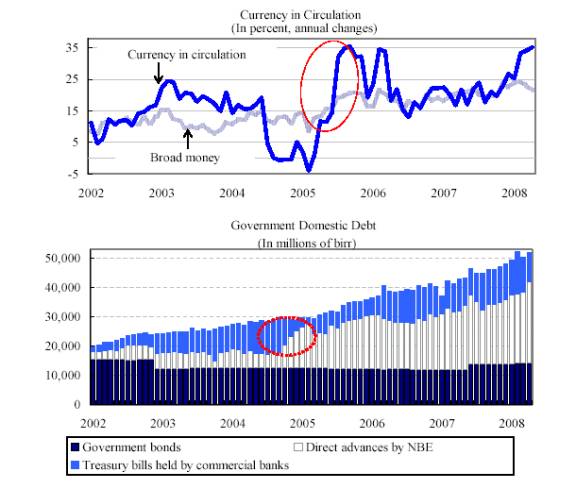
"Teklewold Atnafu, governor of the NBE, told Parliament that his bank lent only 2.8 billion Br in the stated period and described the report as "a complete fib." "However, Sufian Ahmed, minister of MoFED, told Parliament that the government had borrowed 6.8 billion Br in 2005/06 but at the same time had four billion Birr in its accounts found in different banks that the General Auditor should have considered." Who is lying? Look at the chart again. Teklewold Atnafu says the NBE only lent 2.8 billion birr. The IMF chart clearly contradicts this. The massive jump in government borrowing began around 2005 and has continued through to 2008. This is one of the major contributing factors to the devastating inflation in Ethiopia. Rather than face the problem and take responsibility, Meles attacked and smeared the auditor general and forced the NBE to come up with stupid excuses about an extra four billion birr lying around in government bank accounts. This is nonsense. Scroll down and look at the huge perent jump in the "currency in circulation" that the IMF has circled in red (FIRST CHART). There was a 35% increase in currency in circulation in one year (2005)! There is no way that could happen without massive government borrowing. October 20, 2008 - China announces major rural land reform, leaving Ethiopia, North Korea, and Cuba as the last, starving, stubborn, holdouts in the world:
The announced changes, which face huge implementation challenges, could also reduce the social tension and riots resulting from a system that has tolerated massive land grabs by corrupt local officials in league with developers. "This is potentially the real deal," said Scott Rozelle, a senior fellow at Stanford University. If enacted, "it gives a household a very valuable asset that it can collateralize or sell."" COMMENT: - North Korea is perpetually starving. So is Ethiopia. Cubans are hungry too. The smartest minds in Ethiopia and in the world have researched land tenure in Ethiopia and made numerous calls for reform. All heavily backed by data. But Ethiopia has a deaf, dumb, and blind government. No one can tell them anything. It doesnt matter how many people starve. They spend their energy attacking NGOs. After 17 years in power, the EPRDF should have implemented reforms that made foreign food aid and the accompanying NGOs unnecessary. But again, no one can tell them anything. Not even this major policy change in China - a country they claim to be copying - can affect the brain of Meles Zenawi. Conclusion: The only way to achieve REAL land reform in Ethiopia is to overthrow the government of Meles Zenawi. Look again at one of these numerous studies that Meles tossed in the trash. Not a single TPLF/EPRDRF cadre has read this research report:
A PERSPECTIVE ON FAMINE IN ETHIOPIA - September, 2008 -
"I used radioactively labeled sugar water to trace the distribution of liquified food through a colony of common black ants. We found that portions of the food brought in by a single worker reached every other worker in the colony within 24 hours after prolonged bouts of reciprocal feeding. Within a week, all the colony members were carrying approximately the same quantity of the radioactive material... The crop [crop = a specialized food storage organ] serves as a social stomach. What a worker holds in her crop at any given moment is approximately what the rest of the colony posseses." "So when the whole colony as a whole is hungry, the same is true of each of the foraging workers." - Edward O. Wilson, 1996. In Search of Nature, p. 64-67 - "Ants and Cooperation" Compare the situation, as described above, for a colony of ten million ants, to that of Ethiopia, a country of 80 million (advanced?) humans. In both cases, a tiny number of indivuals make all the key decisions. In ant colonies it is the Queen. In Ethiopia it is the TPLF Politburo. What is different? In ant colonies the Queen's children share exactly the same food as everyone else in the colony (actually virtually all are the Queen's children). In Ethiopia, the TPLF Politburo (and their allied ethnic parties), do not share all their food with the rest of the country. Proof of this can be seen in the photograph of these elite leaders walking acros the new Abay bridge last week. Their stomachs are fat and protruding at the same time that eight million Ethiopians are starving. Countries with advanced, enlightened, leadership, don't let this situation happen. Gandhi would have been fasting right now. Presidents and prime ministers of most democracies would have personally taken charge of the relief efforts. They would have made it their number one priority. But Ethiopian leadership is different. The stories about famine conditions in Ethiopia are not stopping. People are suffering. Children are dying. But the government that controls these suffering people has other priorities. The people in government do not suffer. They are not hungry. Their children are not dying. The huge gulf between the experience of the people in government, and the experience of the people not in government explains a lot. It explains why the government is defaming the NGO relief organizations. It explains why the government is trying to minimize and dismiss the suffering of the people as being minor, and "not a serious problem". Ethiopia accused of hiding famine as millions starve Times Online, (UK), September 18, 2008
"This situation would be shameful in any other country," the report concludes. "The US Government cannot in good conscience allow the food operation to continue in its current manifestation." AUGUST, 2008 - Recent Inflation in Ethiopia and Policy Responses IMF Research Report - Ethiopia Selected Issues, published July 31, 2008 This research report shows that inflation in Ethiopia is worse than in any African country except Zimbabwe. How did inflation get so out of control? Read the report and look at the figure below (note: red circles drawn by IMF research staff).
What happened in 2005? Why did currency in circulation and government debt increase rapidly that year? Note particularly the sudden jump in direct advancees to the government from the National Bank. Why? Consider two features of today's Ethiopia. (1) Ethiopia has a huge governmental bureaucracy compared to most other countries. These people need to be paid salaries every month. In addition, there is a shadow bureaucracy of tens of thousands of TPLF/EPRDF cadres stationed all over the country. These people need to be paid too (directly or indirectly the money comes from the government). Both these categories of bureacrats are unproductive (i.e. they do not grow food or manufacture goods). But they have money (provided by the government) to buy food and goods. (2) According to the World Bank (2007) fifty-five percent of the economy is composed of public enterprises. Most of these are unproductive, uncompetitive, loss-making enterprises. But they need money to operate, and they get that money from the government. In addition to these public enterprises, there are inefficient, unproductive enterprises owned by the TPLF/EPRDF. These enterprises are also provided with money from the Commercial Bank of Ethiopia. Most of the loans they took in the past (over two billion birr) were never paid back. All that money is circulating in the economy and worsening the balance between available money and available goods. After the elections in 2005, the TPLF/EPRDF panicked and abandoned normal fiscal policy restraints. Huge amounts of money were poured into the hands of bureaucrats and cadres so that they could "buy" support and calm the population. Government enterprises also went on a spending spree. But how about production? It stagnated (especially food production) because centralized government-controlled agriculture is a failure. Everyone knows this. Combine the huge increase in the money supply with stagnating food production (or actually declining food production on a per-capita basis) and you have the brutal food price inflation that is devastating Ethiopia's poor. But the TPLF/EPRDF ruling classes are doing ok because they have arranged large pay increases for themselves. So this is why they have litte interest in this topic and are actively trying to hide the famine conditions prevalent in much of the country. How long can this go on? Read the IMF report and recent World Bank reports. The TPLF/EPRDF is running out of money. Their reckless spending is damaging the economy. They are on the verge of bankrupting the country. Their strategy from 2005-2008 relied on lavish, unproductive government spending. That strategy has now run its course. The TPLF/EPRDF may soon enter a crisis stage as they fight among each other for a share of the diminishing amount of money available from the government. Why does famine occur in Ethiopia over and over and over again? According to Amartya Sen, winner of the 1998 Nobel Prize for economics:
Famines are easy to prevent if there is a serious effort to do so, and a democratic government, facing elections and criticisms from opposition parties and independent newspapers, cannot help but make such an effort. Not surprisingly, while India continued to have famines under British rule right up to independence (the last famine, which I witnessed as a child, was in 1943, four years before independence), they disappeared suddenly with the establishment of a multiparty democracy and a free press. Other researchers have refined this thesis by noting that although famines may occur in democracies, they are quickly addressed and death rates are greatly reduced as compared to autocracies (such as TPLF-controlled Ethiopia). Award-winning scholar and author Jared Diamond notes that one of the reasons societies fail to solve the problems facing them is that the ruling elites insulate themselves from the consequences of their actions. Thus the TPLF land policy, telecom monopoly, fertilizer trade monopoly, etc... has zero impact on whether the TPLF/EPRDF ruling class will have enough food to eat. A famine in Bugna wereda has no impact on the TPLF's control of the area because they have imposed the repulsive Bereket Simon as the parliamentary representative of that area. Bereket Simon has nothing to do with Bugna wereda. He owes his position to constant servility to Meles Zenawi not to service to the people of Bugna wereda. Today, millions of Ethiopian children in the Oromia region face death each night because they have no food. At this exact moment, Kuma Demeksa, an Oromo high official who supposedly represents the people of Oromia, will be gorging himself along with hundreds of other servile ethnic nationalists at a state dinner hosted by Meles Zenawi. All Revolutionary Democrats of Ethiopia will be feasting over the next few days to celebrate their control of power. That what the UN calls a "catastrophic" famine is underway in parts of Ethiopia has no impact on the food available to these people. They will gain weight and loosen their belts because they are fully insulated (for the moment) from the consequences of their misrule. The ethnic nationalism represented by Kuma Demeksa and other servile ethnic politicians is referred to as "Castrated Nationalism". The organization of society into ethnic nations and its top down control via castrated ethnic parties was the governing strategy in the Soviet Union and Yugoslavia. This technique, which was partnered with a vicious campaign against the emergence of civic democratic parties, only served to aggravate ethnic tensions and lead to the violent breakup of those societies. The TPLF is following exactly this technique. Castrated ethnic parties are cultivated while emerging civic parties are persecuted. On top of this we have the extreme poverty of Ethiopia. If the relatively advanced Yugoslavia and Soviet Union failed, what will be the result in Ethiopia? WHAT IS THE SOURCE OF TPLF WISDOM ? |
Michelin Map - South Somalia (220K) Somali News Sources Garowe Online
OGADEN CRISIS Is the ONLF Struggle an Asset or a Liability? WardheerNews, Dec 6, 2007 Who does the ONLF represent? Awdal News Network, Nov 25, 2007 Child hunger 'crisis' in Ogaden BBC, Oct 30, 2007. - Ethiopia's own disaster agency declares the situation is critical The Political Roots of the Current Crisis in Region 5 T. Hagmann, Wardheer News, Sep 25, 2007 23-PAGE REPORT OF UN OCHA MISSION to Ogaden Sep 19, 2007 Tales of horror from Ogaden AFP, Sep 7, 2007 Conflict in the Ogaden and its Regional Dimension Chatham House Report, Sep 7, 2007 Meles, Time Magazine Sep 6, 2007) - - not a single hut has been burned
MSF Press Release: Urgent Appeal to Government of Ethiopia Despite repeated appeals the Gov't of Ethiopia has denied MSF access Sep 4 2007
Eyewitness Report of Ogaden Crisis
Villages deserted, burned in Ethiopia's Ogaden - MSF Reuters, Sep 4, 2007
US Announces Emergency Aid to Ethiopia's Ogaden Region
VOA News, Aug 24, 2007.
An elderly goat herder, beside himself with indignation, launching a diatribe in front of a senior local official. He had lost two sons, he said, fighting for Ethiopia against Eritrea. And now the soldiers come to his village, chase everyone out and burn their houses, and then have the effrontery to tell him he is not a true Ethiopian.
BBC Report from Jijiga , Aug 14, 2007.
Red Cross confirms pull-out from Ethiopian region Reuters, Aug 2, 2007.
ICRC deplores expulsion from Somali Regional State Intl. Cmte. of the Red Cross, Jul 26, 2007
Red Cross rejects Ethiopian accusations AP, Jul 26, 2007.
The Ethiopian gov't is blockading emergency food aid and choking off trade... hundreds of thousands of people at risk of starvation... New York Times, July 21, 2007
Ethiopian troops burned or ordered civilians to vacate at least a dozen villages around the towns of Degehabur, Kebre Dehar and Wardheer.
Human Rights Watch, Jul 4, 2007
|
||||
|
Theory of TPLF Ethiopian Chauvinism November 14, 2007 Children die in Somalia violence CNN, Nov 11, 2007.
Comment: The TPLF/EPRDF has no public relations policy. It only has a propaganda program directed at the population internally. Externally, it gets confused and doesn't know how to talk to people who are outside its control. The public relations advisor to Meles, Bereket Simon, is fiercely devoted to the TPLF/EPRDF. He is hostile, aggresive, dismissive and insulting to anyone who asks questions. This is not an intelligent person (likely borderline retarded), so this is why public relations in Ethiopia is an embarrassment. The Ministry of Foreign Affairs recently put out a press release about a "Boarder War." Obviously english is not their first language, but does the Ministry of Foreign Affairs in Ethiopia have an English Dictionary? Have they heard of a concept where they hire competent English-speakers to check their press statements so that they don't make a fool of themselves? Foreign Minister Syeoum Mesfin - appointed for life - is a nice person it seems, but is simply incapable of doing this job. He suffered no consequences for badly damaging the country with his unacceptably substandard performance during the Eritrea conflict. This all proves the TPLF/EPRDF is an emerging aristocracy; not a meritocracy. Hard working, intelligent, capable Ethiopians (even Tigrean-Ethiopians) are not wanted. All the positions were filled 17 years ago by unqualified members, friends, and relatives of the TPLF/EPRDF. So this is why Ethiopia always looks stupid in the foreign press; the TPLF/EPRDF can't even speak up and explain or defend itself properly. Boarder: A person, especially a lodger, who is supplied with regular meals - (Webster's Dictionary) Excerpts from Rep. Smith's Newmakers Speech on Ethiopia and Human Rights Congressman Smith's Website, Oct 22, 2007.
I was struck by his all-knowing tone. Guilty! They're all guilty simply because Meles says so? No trial? Not even a Kangaroo court? Comment: Why is Meles keeping files on opposition leaders? Doesn't he understand the basic concepts of separation of power, constitutionalism, and justice? Why is this Dergist practice continuing? In his book "Consilience", E. O. Wilson describes the dyadic instinct: "the proneness to use two-part classifications in treating socially important arrays. Societies everywhere break people into the in-group versus out-group, child versus adult, kin versus non-kin..." This dyadic instinct and other mental processes such as essentialism and reification were very useful to stone age tribes. They help solidify group identity, and promote in-group cooperation. But they can be "maladaptive" i.e. harmful to the success of the diverse societies that we currently inhabit. Meles has a strongly developed dyadic instinct and this makes it hard for him to appreciate the diversity and sincerity of Ethiopians who oppose him. Ethiopian politics consists of the EPRDF vs. the traitors. In-group vs out-group. The in-group exhibits noble sentiments, the outgroup is driven by base motivations. A brittle Western ally in the Horn of Africa - While things are getting better in much of Africa, Ethiopia risks getting left behind Economist, Nov 1, 2007.
Just as the government is slowing the pace of economic expansion for fear that individuals may accumulate wealth and independence, so it is failing to move fast enough from a one-party state to a modern, pluralist democracy. Again, the reason may be that it is afraid to. TPLF/EPRDF is afraid because the villa-and-landcruiser lifestyle its members enjoy in Addis Abeba is directly tied to TPLF control of the government. Yes, the life of the average person in Tigray has improved marginally. But look at how the lives of TPLF members, friends, and relatives has improved. The primary purpose of the TPLF is to ensure the best possible life for TPLF members and ensure the best future for their children. Their children will be marrying into the multi-ethnic, cosmopolitan, wealthy elite of Ethiopia. This is why they need to live the elite, high-status lifestyle in Addis Ababa. This is why they arrest, kill, suppress, harrass, and intimidate Ethiopian citizens. This is why they cannot spend their time worrying about the problems of the common people of Tigray. This is why they are so enraged by HR2003.
|
||||||
|
Somalia JNA Document Repository
|
IDEOCOSM Ideas and their role for Ethiopian Democratization (A Research Agenda) Dangerous Ideas: Five Beliefs That Propel Groups Toward Conflict Papers Presented at the 4th International Conference on the Ethiopian Economy Catechism for Ethiopian Nihilism The Course Of True Nationalism Never Did Run Smooth Leave None to Tell the Story: Genocide in Rwanda, Propaganda and Practice "Never forget that the person on the other side is human" |
|||||
|
Small Michelin Map of Southern Somalia
Larger (211K) Michelin Map of Southern Somalia
Map of Somali Clans
Southern Somalia
|
||||||
| . | ||||||