|
NGO with UN consultative status supporting interfaith cooperation 100 years of advocacy and dialogue for liberty and equality |
iarf |
International Association for Religious Freedom
|
NGO with UN consultative status supporting interfaith cooperation 100 years of advocacy and dialogue for liberty and equality |
iarf |
_________________________________________________________________
IARF World
No. 2, 2000 - ISSN 1028-2955

IARF Centenary Celebrations 1900 - 2000
The IARF at 100: Looking Back and Ahead
Strategic Planning
Young Adult Participation in the IARF
The Millennium World Peace Summit of Religious and Spiritual Leaders
IARF Centenary Celebrations 1900-2000
Events to mark one hundred years of the IARF have been occurring around the world. They started in India with the Ceremony attended by our President and the new General Secretary, and presided over by the Governor of Karnataka State (see the article by Dr. Khan below). In mid- May, the General Secretary was interviewed for the BBC World Service "Focus on Faith," and the fact of our centenary was broadcast world wide. On 25 May, the day itself, Rev. Robert Traer made a speech to commemorate the occasion in Boston, USA, the city where IARF began (see Rev. Traer's speech).
The Japanese Liaison Committee conducted a deeply moving tribute to five distinguished predecessors at the end of July (see the article by Yuji Inokuma), and finally, one hundred candles were lit by Europeans at Klingberg in Northern Germany in October (see the article by Manfred Paul and Andrew Clark).
Centenary Celebrations in India
The South Asia Coordinating Council celebrated the IARF Centenary along with the India Chapter at Bangalore on the 1 March 2000. Invitees included people from different religious groups such as Hindus, Muslims, Christians, Buddhists and Sikhs. The President and General Secretary of IARF travelled to India to participate in the Centenary celebration. A press conference was held on 29th February at the Bangalore Press Club where Eimert van Herwijnen and Andrew Clark addressed the press. Visits to various religious places such as a gurdwara and the Mahabodhi International Meditation Centre were organised.
In his speech last 1 March, Eimert van Herwijnen presented the goals and objectives of the IARF in their Indian context. He referred to the history of the organisation and the challenges for the future, and concluded with the following comments: "Whatever will come out of the process will always have to comply with the principles of respect for human dignity and tolerance for others' views and beliefs. We will want our experience of one hundred years to benefit those who need support in their struggle for survival, those who need allies fighting for human rights, including the right of religious freedom. I have only been here over a week, but have visited several projects and am impressed with the work. I am convinced that the large and active IARF membership in India will be able to continue with their positive contribution. I salute you all for the work you have done and no doubt will do in the future." (Dr. Mumtaz Ali Khan)
Centennial Ceremony in Japan
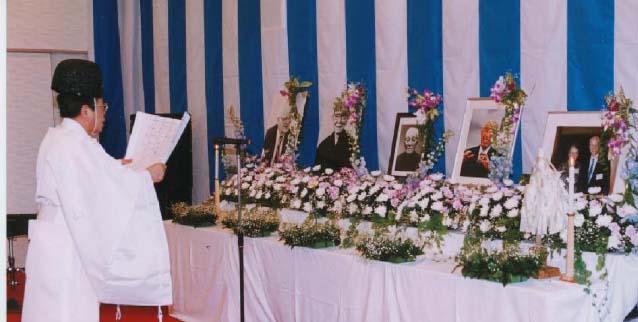
On 29 July 2000, the IARF Japan Liaison Committee conducted a Joint Memorial Ceremony at Hotaka Shrine in cooperation with the IARF Japan Chapter, IALRW Japan, Rissho Kosei-kai, Ittoen, Konko-kyo Church of Izuo, Japan Free Religious Association and Tsubaki Grand Shrine.
More than 110 people from the said organisations participated in this ceremony and each organisation conducted rituals in their own way to pay their sincere respects for five deceased forerunners who had truly devoted themselves for the development of worldwide interfaith movements as well as IARF.
All the participants, at the end of the service, offered and placed flowers in front of the photographs of the five distinguished people, which were carefully set up on the altar in the hall of Hotaka Shrine Guest House. Their names were unforgettable for all of the Japanese participants, Dr. Dana MacLean Greeley, the first President of the Unitarian Universalist Association, Dr. Homer A. Jack, the first Secretary General of the World Conference on Religion and Peace, Dr. Shinichiro Imaoka, the founder of the Japan Free Religious Association, Rev. Toshio Miyake, the founder of the Konko-kyo Church of Izuo and Rev. Nikkyo Niwano, founder of Rissho Kosei-kai.
During the offering of the flowers, music dedicated and performed by the well-known synthesiser composer, Mr. Kim Shin, provided a solemn moment for all of the participants. (Yuji Inokuma)
Reporting and Reflecting on the IARF Conference in Klingberg
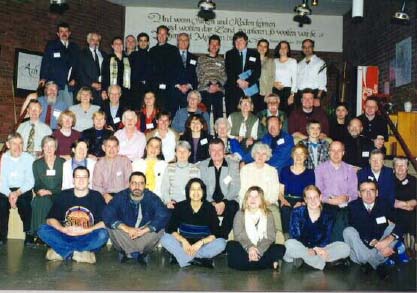
The sound of a gong opened the European Conference "Liberal Religion and IARF at a Crossroads: Our Planning for the 21st Century," the European contribution to celebrate the centenary of the IARF, on the morning of 27 October 2000 at the German Unitarians' Youth and Education Centre Klingberg, near the Baltic Sea. About one third of the 63 attendees from nine countries (including Israel and Egypt) were young adults; and although they were partly busy with a special programme, the conference as a whole profited from out of some of the younger people's stimulating suggestions.
Eight faith traditions, roughly speaking, were united during the conference. There were Jews, Christians, especially in a variety of liberal groups that are forming themselves as minorities within or in the context of the European mainstream Churches and Muslims.
Another three traditions originated from the Indian subcontinent: Hindus, Sikhs and Buddhists. Unitarians and Free Religious, the latter also sometimes calling themselves Humanists, partly being offsprings of the left wing Reformation in Europe, are considered here as belonging to one faith tradition; and lastly there were the adherents of the Baha'i religion. As it has proved so often during IARF events, Klingberg showed it again: variety meant creativity and thoughtfulness for analysis, because planning was the key issue of our gathering.
The conference had three keynote speakers: Our president, Eimert van Herwijnen, reviewed IARF's present situation and the need for strategic planning. Dr. Stephan Mögle Stadel gave a beautifully illustrated lecture on Dag Hammaskjold's "Heritage: Markings on the Road to World Peace." This was followed in the evening by Dr. Andreas Roessler who spoke "On the Indispensability of Liberal Religion for a Europe of Tomorrow." He was not in favour of relativism but reminded us that "Liberal religion has also the task to keep alive the truth question and to this end to bring followers of several religions into contact with each other..."
The majority of our time in sessions was spent in groups responding to the questions on which our Strategic Planning is based:
• What is our ultimate goal? (Criticising the draft Statement of Purpose for IARF)
• What are the current and future European and Middle East religious freedom advocacy issues and their principal causes?
• What are the key assumptions which link broad programme types (Meetings and education or advocacy and so on) positively to the overall goal of religious freedom?
• Programme design exercises to create new programmes (Looking at objectives, methodology., output and key assumptions)
• Setting strategic objectives: Groups were asked to project what the annual report of IARF's activities should be in 2006 and devise a "draft report."
"Lighting a hundred candles" was the message of the closing ceremony. A hundred wicks in small round wax receptacles were spread over four areas, separated but arranged one after the other. Why four? Because our Association's name is made up of four letters. The wicks on each letter were lit in turn by speakers Wolfgang Jantz, Dorle Gehrmann, Ramola Sundram, and Manfred Paul, symbolising the German Chapter, the past, the future and the international aspect of IARF. When it came to the "f" Manfred J. Paul closed the ceremony by saying:
"Every religion has its spiritual 'centre.' If several religions and beliefs are joining in an association, as it is the case with IARF, one can imagine a renewed and strengthened religious hub that does not exist in reality, but can be thought of in terms of something unspeakable, at best perhaps as a 'mystery' as Raimundo Panikkar, the well known Catholic theologian, named it once. One possibility to make this secret visible, perceivable, partly at least, may be the four letters which we are lighting here in front of us. Let us shape in confidence the years lying ahead of the International Association of Religious Freedom. Its spiritual drive may live in all of us!"
(Manfred J. Paul and Andrew C. Clark)
The IARF at 100: Looking Back and Ahead
Dr. Robert Traer
IARF General Secretary, 1990-2000
The International Association for Religious Freedom, or IARF, is the oldest international interfaith organization. Its history spans the 20th century and reflects many of the difficult issues that confronted religious leaders and scholars during that tumultuous period, particularly in Europe and in the United States. Unitarians and free or liberal Christians provided leadership throughout the century, and in the last two decades they have been ably assisted by Japanese lay Buddhists and shrine Shinto priests and also by Indian Brahmos, Buddhists, Christians, Jews, Sikhs, Muslims, and members of the Ramakrishna Mission.
The IARF began in 1900 on May 25th in Boston, Massachusetts at the 75th anniversary meeting of the American Unitarian Association. Its original name was the International Council of Unitarian and Other Liberal Religious Thinkers and Workers. "The object of this council," its founders declared, "is to open communication with those in all lands who are striving to unite Pure Religion and Perfect Liberty, and to increase fellowship and cooperation among them."
The initial Congress was held in London in May 1901 in response to an invitation from the British and Foreign Unitarian Association. It lasted three days and as many as 2,000 persons attended its sessions. Proceedings were published under the title Liberal Religious Thought at the Beginning of the Twentieth Century. The 2nd Congress was held in September 1903 in Amsterdam under the title "Congress of Religious Free-thinkers," and the Council held its 3rd Congress in 1905 in Geneva under the title "Congress of Religious and Progressive Christians."
In 1907 the Council returned to Boston to hold the "Fourth International Congress of Religious Liberals." The opening ceremony included Jewish, Muslim, Hindu and Roman Catholic participants, but Protestants and Unitarians were in the great majority. Charles Wendte, the General Secretary, characterized all the participants as "religious liberals" and the 1907 Congress urged its participants to embrace liberal religion: "Liberalism is to us a temper, an attitude of the mind, a disposition of the heart towards truth. Liberalism is the supremacy of the spirit over the letter in religion. It is the mind in a state of growth . . .."
Several women spoke to the Congress in 1907 including Julia Ward Howe of Boston, who also composed a hymn for the event. In an address entitled "Good Will to Men" Booker T. Washington, Principal of the Tuskegee Institute in Alabama, expressed "a peculiar debt of gratitude to those of the liberal faith" who helped to banish slavery from American soil. In his opening address Samuel A. Eliot, the president of the Council, proclaimed: "The significance of this gathering is that it is composed of men and women who in the pursuit of truth and righteousness dare to commit themselves unreservedly to the control of the law of liberty." Eliot appealed to "conscience, reason, and experience" and called upon the "Brethren of the Liberal Faith" to unite as "pioneers of pure religion and perfect liberty" in order to bring peace to the earth.
The 1910 Congress was held in Berlin as the "World Congress of Free Christianity and Religious Progress." Speakers included the German scholar Adolf Harnack, the American theologian Walter Rauschenbusch, and the German historian Ernst Troeltsch. A decade after its founding what would become known as the IARF was taking shape. A Council that was at first largely Unitarian had become an interfaith Congress. It was concerned with religious freedom, tolerance, and cooperation among religious groups. Reason and goodwill were promoted to redress social issues, and women as well as men were chosen as leaders. By 1910 a Congress included interfaith devotions, presentations and programs in the languages of its major participants, a concern for the rights of religious movements in the country where it was held, and pre or post Congress excursions.
World War I temporarily halted the movement that had begun in 1900, and after the war it was more than five years before the "Seventh Congress of Free Christians and Other Religious Liberals" was convened in Prague in September 1927. Then in 1930 at Arnhem, Holland the thirty-year old movement was organized officially and renamed "The International Association for Liberal Christianity and Religious Freedom." Writing in 1936 the Dutch leader, H. Faber, suggested that the IARF was in the "second period" of its development: "We realize that it has to fulfil a real task in the present world situation. This task is not only to unite the liberal Christians and other religious Liberals the world over, but to give testimony of what Free Christianity is and strives after." This was the focus of the IARF until World War II once again put its energies on hold.
Soon after the liberation of Holland in 1945, the IARF Secretariat reopened and began relief work in the distressed parts of Europe. The 13th Congress of the IARF was convened at Amsterdam in 1949 to address the topic: "The Mission and Message of Liberal Religion." "As religious liberals," the Congress participants affirmed: "We stand for Religion against the rising tide of secularism in a world that has very largely accepted a materialistic, if not an atheistic philosophy. We stand for Tolerance in a world that is increasingly dominated by sectarianism and bigotry. We stand for Liberty in a world that has at many points surrendered to arbitrary authority. We stand for Reason in a world that has succumbed to an alarming degree to blind emotionalism. We stand for Individual Responsibility in a world that puts its trust chiefly in mass movements and a regimenting State."
In August 1952 the IARF Congress met in Oxford, England. The theme was "Authority and Freedom in the Modern World," and the Congress was divided into five sections: Theology, World Religions, Sociology, Religious Education, and Science and Religion. The section on Theology addressed the question: "How can the liberal resolve conflicts arising between faith and reason?" The section on World Religions discussed how religions other than Christianity recognized freedom, and the section on Sociology sought restraints on individualism through "forms of community life in which the individual and society are properly balanced." The section on Religious Education looked for ways to help children "grow freely into a world motivated by the ideal of freedom while at the same time helping them to discipline their freedom in terms of the needs of the community." And the section on Science and Religion asked: "To what extent do the results of scientific investigation have any authority for the religious minded layman?"
In 1955 the IARF held its 15th Congress in Belfast, Northern Ireland on the theme, "Liberal Religion in an Age of Anxiety." Afterwards, Frederick M. Eliot of Boston wrote: "the significant thing about the Belfast Congress . . . was the obvious desire of everyone to rise above a dogmatic liberalism and affirm the truly inclusive nature of the fellowship of the I.A.R.F."
The 16th Congress of the IARF was held at the University of Chicago in August 1958 on the theme, "Today's Religions Can Meet the World's Needs Today." The evenings of this Congress were devoted to addresses by members of "the five great world religions." The purposes of the IARF in 1958 were: "(1) to bring into closer union the historic liberal churches, the liberal element in all churches, and isolated congregations and workers for religious freedom; (2) to draw into the same fellowship free religious groups throughout the world which are in essential agreement with our ways of thinking; and (3) to open and maintain communication with free Christian groups in all lands who are striving to unite religion and liberty, and to increase fellowship and cooperation among them."
In 1969 the IARF Congress returned to Boston and addressed the theme, "Religious Encounter with the Changing World." The 20th IARF Congress focused its discussions around four areas of concern: (1) "The Christian in the Modern World," (2) "The Religious Approach to the Modern World," (3) "Dialogue of World Religions," and (4) "Peace, Justice and Human Rights." In Boston the name of the IARF was changed from the International Association for Liberal Christianity and Religious Freedom to the International Association for Religious Freedom. Also in 1969 Japanese Shinto and Buddhist groups-the Konko Church of Izuo and Rissho Kosei-kai-joined the Association, and the following year Tsubaki Grand Shrine was enrolled as a member.
In 1987 the IARF Congress was held at Stanford University in California. The theme of the Congress was "World Religions Face the 21st Century," and for the first time small group discussions called "Circle Groups" were introduced into the program. A revised statement of purpose was approved at the General Assembly of the Congress that included the following statement: "IARF is an inter-religious, international, intercultural organization. It advocates religious freedom in the sense of: (a) free, critical and honest affirmation of one's own religious tradition; (b) religion which liberates and does not oppress; (c) the defense of freedom of conscience and the free exercise of religion in all nations. IARF advances understanding, dialogue and readiness to learn and promotes sympathy and harmony among the different religious traditions. It is dedicated to a global community of mutual cooperation among religious communities and adherents of different religions. It strives for an attitude of openness to truth, to love and to justice."
In 1990 the IARF held its 27th Congress at Hamburg, Germany on the theme, "Religions Cooperating for One World." Hans Küng delivered the opening address with the now well-known title, "No Peace in the World Without Peace Among the Religions." In 1993 the IARF held a three-day Congress in Bangalore, India and then co-sponsored a four-day centennial observance of the 1893 Parliament of the World's Religions in Chicago with the World Conference on Religion and Peace, the World Congress of Faiths, and the Temple of Understanding. In 1996 the IARF convened its 29th World Congress at Iksan City in the Republic of Korea, in cooperation with Won Kwang University on the occasion of its 50th anniversary. And in 1999 the IARF held its 30th Congress at the University of British Columbia in Vancouver, Canada on the theme, "Creating an Earth Community: A Religious Imperative."
The end of the 1960s marked a turning point, not only for the IARF, but also for what we now call "the interfaith movement." Support for interfaith dialogue in the World Council of Churches and the shift in Roman Catholic teaching due to Vatican II led to an increase in inter-religious activity around the world. In 1970 a few key members of the IARF, led by Dana Greeley and Homer Jack, launched the World Conference on Religion and Peace as a strategy to promote cooperation among mainstream religious constituencies. Not all IARF leaders were happy about that, but now there is a collegial relationship between the two organizations.
For more than twenty years IARF and WCRP dominated the international inter-religious field. In 1993, however, the centennial observance in Chicago of the 1893 Parliament of the World's Religions, demonstrated the tremendous interest in interfaith cooperation. In the past half decade new international organizations have developed in New York and San Francisco, and the Chicago group has held a second Parliament of the World's Religions. In addition, national and local interfaith organizations have sprung up all around the world.
The growing popularity of interfaith cooperation, however, is not without its problems. In my book, Quest for Truth: Critical Reflections on Interfaith Cooperation, I suggest that we now face the danger of an interfaith bazaar where religious conviction and spiritual wisdom are reduced to marketplace commodities. The liberal spirit of the IARF, which has long encouraged not only tolerance but also critical thinking about religion, is conspicuously absent in much of what is being promoted today under the banner of "interfaith."
This is where the IARF faces its greatest challenge. Now that tolerance and mutual respect for religious diversity is fashionable, at least in the West, it is no longer sufficient to champion slogans such as "unity with diversity." We have to think carefully about "what unity" we support and "what diversity" we welcome. Here is where the liberal tradition of critical thinking that has distinguished the IARF for a century is so important.
An amusing anecdote will illustrate this point. In 1991 when I contacted the Charity Commission in the United Kingdom to secure charitable status for the IARF, I was told that the historic purpose of the Association "to advance liberal religion" was not acceptable. The Charity Commission required that the stated purpose be "to advance religion." I recall saying to the Charity Commission official: "Who would ever want to advance religion without any qualification? The IARF promotes religion that is liberating and religion that respects freedom of conscience. We don't promote religion that is oppressive. " I lost the argument, however, and the first purpose of the IARF in its British constitution is "to advance religion."
Whether or not the IARF uses the phrase "liberal religion," it must ensure that it supports religious life that is liberating. This is why the IARF embraces interfaith cooperation and endorses religious freedom. Without religious freedom, there will be repression. And without interfaith cooperation, there will be greater intolerance and discrimination. Therefore, in order to support liberal religion in the 21st century the IARF needs to embrace interfaith strategies that strengthen religious freedom.
The IARF cannot assume that building relationships between organizations and individuals from different religious traditions is, in itself, a mark of success, even though it may be a prerequisite for effective action. Is the interfaith work of the IARF actually achieving greater tolerance among religious communities? Is the IARF helping to create structures that promote the human dignity of each person and encourage greater justice in our societies? These are the questions we need to answer.
I can point to some activities of the IARF that I think may meet this standard. The Association has supported at the UN Commission on Human Rights, as a matter of principle, the right of freedom or belief for all religious groups, including those that do not share its commitment to pluralism. The IARF has sponsored local interfaith programs in India and the Philippines that have encouraged people to resist "communalism" by taking social and economic initiatives in support of religious and ethnic harmony. Muslim villagers near Calcutta have begun to celebrate Divali, except for the religious offering to Hindu idols, as an act of solidarity with their Indian neighbors that they hope will lead to improved relationships. Christian and Muslim leaders in the Philippines have, through the IARF, begun to discuss the resentments that divide their communities. Japanese IARF members have met with Korean IARF members and publicly expressed regret for the suffering of Koreans during the Japanese occupation of the Korean peninsula in the middle of this century.
In Korea in 1996 resentments were smoldering when the IARF brought Japanese young people together with the Korean descendants of a generation that had suffered greatly under the harsh occupation of the Japanese. The Japanese young people said they didn't know about what had happened during the war, but the Koreans refused to accept that as an excuse. The two groups drew apart for a time. Then a young Japanese man crossed the divide and apologized to the Koreans, both for what Japanese had done to the Korean people during the war and also for the ignorance of his generation. Furthermore, he pledged that he and his friends would try to build a better future for both peoples. That act of humble self-criticism and repentance enabled the Koreans to offer forgiveness and also their pledge of cooperation.
One hundred years ago in this great city, a few men and women set out to cooperate with all those who strive "to unite Pure Religion and Perfect Liberty." In 1907, at the first of two Congress held in Boston, participants pledged to support "an attitude of the mind" and "a disposition of the heart towards truth" by promoting "the spirit over the letter [of the law] in religion." At mid-century, Frederick M. Eliot of Boston told IARF members gathered in Belfast for the 16th Congress that "in the period between the first and second world wars there developed what might have proved to be a divisive and ultimately fatal emphasis on doctrine as more important than freedom." But, in Belfast, he felt it was plain that "the original spirit will prevail."
This Spirit did prevail in 1969 in Boston, at the 20th IARF Congress, when Japanese participants joined the Association and the name was changed from the International Association for Liberal Christianity and Religious Freedom to the International Association for Religious Freedom. And in 1987, at Stanford University, the 26th Congress clearly stated that the IARF "advocates religious freedom in the sense of: (a) a free, critical and honest affirmation of one's own religious tradition; (b) religion which liberates and does not oppress; (c) the defense of freedom of conscience and the free exercise of religion in all nations."
The International Association for Religious Freedom has a contribution to make to interfaith cooperation in the 21st century. By continuing to support religious freedom and critical reflection, the IARF may help to lift our eyes from the market stalls of the interfaith bazaar to the heights of the human spirit, where pure religion and perfect liberty are one.
NOTES
The Results of the Strategic Planning Questionnaire
Introduction:
. The membership questionnaire was inserted in the "iarf World" (April edition) which was sent out in May. It had a circulation of about 2000 copies. This article is a modified and edited version of the full report and incorporates suggestions made by the Executive Committee at is November meeting. It includes some commentary for guidance.Interpreting the response:
We received 85 completed questionnaires representing the views of 33 organisations (who had also consulted with a further 87 of their office-bearers or members in order to answer), and from 52 chapters, branches or individual IARF members. (These 52 forms incorporated the views of a further 237 individuals.) Thus our responses were from 415 individuals, including 33 organisations, all from 21 countries and recorded on 85 forms.
The methodology is not a quantitative one. We attempted to use the questionnaire as a qualitative tool in order to elicit the range of views and perceptions held by the membership responding to the keys aspects raised by the International Council members in their meeting in April 2000. The response was far from uniform for quite different reasons. North Americans individually gave a low priority to "yet another questionnaire", however the Japanese, for whom the English language is an additional hurdle, gave few replies on behalf of their large well-managed organisations which are used to having an agreed policy. Thus the bulk of the 85 questionnaires received came from Europe and South Asia (particularly India and Sri Lanka) in about equal measure, and reflected the different regional conditions.
The Mission Statement:
Here are the major questions raised by the draft mission statement:
Would a Preface help?
Comments on the Draft Mission Statement:
"Freedom from State interference or discrimination in religion or belief"
There are two types of comment on this phrase:
"Tolerance and harmony between religious communities"
There were suggestions to change the abstract nouns "tolerance" and "harmony" to "respect", "understanding" "acceptance" or "awareness". In particular tolerance seemed too minimal and (for others) harmony seem to ignore genuine differences.
Tolerance is actually a recognition that there are religious practises, or "truth claims", which are deeply questionable but whose adherents we would wish to protect from any religious or legal victimisation. So, we do both have an interest in Truth, and also want to protect those who may hold religious views, or be in religious organisations, which do not of themselves meet our criteria of acceptability. Harmony is at the other, idealistic end of the scale. It is particularly important in Japan.
"Respect by religious communities for the human dignity of their members"
Predictably, the main problem here lies with the definition of "human dignity". It seems to over-ride the rights of the religious communities to set their own peculiar rules. There are connotations of both human rights and "liberal religion", being in part the right of the individual to make his/her own choices and to pursue the Truth. Western cultures would stress the entitlement to "individuality" of each believer, but this is not a universal cultural trait, so we need to be collective as well.
"Religious freedom is a fundamental human right"
This key point in IARF's rationale, which answers the "Why" question, should be re-sited at the beginning of the statement.
"Thus the IARF supports co-operation among groups from different religious traditions and solidarity with communities suffering religious persecution or discrimination."
The few queries here related to the appropriateness of, or modifications to, the concept of "solidarity".
What might a revised Statement of Purpose look like ?
"The International Association for Religious Freedom (I.A.R.F.) was founded in 1900 as an organisation to bring together people concerned with religious liberty.
Today a wide range of religions and beliefs exist which potentially have a positive and constructive contribution to make to human society. The freedom to hold, practise and respectfully bear witness to such religions or beliefs, whether of one's heritage or choice, is a precious and fundamental human right.*
This requires:
To this end, the IARF works with and between:
- - - - - - - - - - -
*(cf. United Nations Universal Declaration of Human Rights: Article 18.)
Suitability of the draft Mission statement:
Again over 90% of respondents rated its suitability as good or "totally suitable", however the remainder had their doubts.
Suitability:
For within IARF, respondents saw the usefulness of the statement as being its clarity and focus, giving guidelines and objectives to the membership. Externally however it was welcomed as a communication and educational tool for a critical dialogue with others, including governments. It also allows for those who are not "deistic". It could assist in joint project planning; it offered a model; and helped create solidarity with other faith groups and as well as promoting a culture of Religious Freedom. It does not avoid the difficult issue of how religions should treat their own members.
Problems:
Two of the internal problems identified were: by one group which did not accept this use of the concept of human rights, and two which doubted their capacity to design specific programmes in connection with the statement. Nor is there any explicit guidance on the possible misuse of religious freedom to legitimise "proselytisation" or so-called "cults claiming to be religions".
In conclusion, there did not appear to be any insuperable problem with such a statement, although it is deemed wiser to call it our "Statement of Purpose" in order to avoid reactions to the negative connotations of Mission and missionaries....
Religious Freedom issues and their principle causes:
We attempted to follow the categories of issue implied by the three aspects of the mission statement: State interference/discrimination, harmony/tolerance by other groups, and accountability of religious communities for respecting their members' human dignity.
While some respondents took refuge in over-simplicity, most struggled to name the issues of concern accurately and to identify their real causes. The person who wrote "many and complex" across the whole space was of course truthful if not helpful ! IARF's future depends upon penetrating analysis leading to correct, manageable programme design. Some responses were exceptionally well thought through, which showed the potential for effective planning.
In the end, whilst our categorisation remains a useful tool, it will need to be supplemented to enhance the picture which emerges from the responses. The key element for the purpose of analysis showed the most significant division as being:
The connection between religion and politics was made quite explicitly by several respondents; religion can be a very powerful social force, and consequently a temptation to politicians.
In terms of understanding each issue, particularly in terms of how it can be addressed, the underlying questions are about change:
Thus it became easier to organise and present a summary of the data received in answer to the question: "What are the religious freedom issues in your area, and what is the principal cause of each of them? It is worth listing the responses in detail to increase our awareness.
A: Requiring primarily Government-sponsored change:
B: Requiring changes in available Religious Education and its Production
Many respondents identified "ignorance of other religious traditions" and clearly implied that this could be rectified either with "educating the public" or better religious education in schools. There was both a great groundswell in favour of this type of programme as well as many indicators of the problems. We must not over-look the obvious assumption of whether (or how we can ensure that) the young will actually be interested enough to learn what we wish to teach.....There are some very sharp professional questions to be asked.
Meanwhile, our respondents identified their experience:
C: Incidents of intolerance and disharmony, including some Particular Issues with special causes, which require carefully designed local work in society to improve the situation:
With respect to Proselytism:
It is important to remain very aware of this issue, which has so troubled the relationships between different faith or denominational traditions. Our respondents raised two specific examples:
D: Discrimination, intolerance or alleged malpractice within a religion towards its own members where change has to be internal in the faith tradition's standards of conduct:
It was noticeable that there was little reference to these, the most difficult areas of change to be tackled. Although the subject is in the draft mission statement, it is not high in the consciousness of respondents. Indeed, since we may assume a preponderance of those from the "more liberal wings" of their religious traditions, there may be a warning that they are less inclined "to look within".
IARF's Organisational Strengths, Achievements and Weaknesses.
We sub-divided the responses into "internal" (referring to IARF as an organisation with all its layers) and "external" (projects which serve the public or community). Very briefly:
Perceived strengths and achievements are:
Internally, the great majority of respondents saw their participation in the IARF Congresses and
regional conferences as being their most meaningful and main activity.
Externally, the pattern of responses showed no predominant type of activity as an IARF strength. Our intervention and representation at the United Nations and work with ancillary NGO committees was one definite programme type. Starting an interfaith programme and human rights organisation in Hungary was another which had been inspired by IARF.
Various practical community projects of ecology, credit and medicine were undertaken in South Asia. However the direct work on religious tolerance was variously between Muslim, Hindu or Christian communities, and also involving youth and women in interfaith work.
There had been some specific advocacy for religious freedom in Tibet and Nigeria. In Nigeria there was some interaction with liberal Muslims as well as believers in traditional religions.
For the Japanese groups particularly, they felt that their international experience helped them when they came back to their local communities.
Perceived Weaknesses are:
Internally, the N. American region has long been sensitive to the weakness of participation of those beyond the Unitarian family, and even that is seen to be declining. The question was also raised as to whether the modern interfaith movement had in fact moved ahead of the IARF chapter. In Europe, N. America and S. Asia the word "unfocussed" was used...
The Europeans express their concern about their isolation from each other. Some saw too little participation in IARF Congresses because of their expense and the use of English language, and some were unhappy with a perceived bias towards liberal Christianity. Member groups are too small and too old and in some countries financially weak. There is also the "imposition of the English language" (as expressed by Esperantists).
The S. Asians felt the lack of contact with and visits from IARF officials. Meetings and members' involvement were felt to be insufficient.
Some Japanese thought that the JLC might need to be re-structured if work for Religious Freedom is re-defined in terms of concrete actions and programmes rather than friendship. This was also recognised by the perceived problem that while IARF Congresses provide a focus, this is then lost because no follow-up actions are planned. How could the number of member groups be increased ? More youth involvement is also necessary.
Externally, In S. Asia project design and execution in the community were problematic: social service projects were felt to be too short-term, lacking a holistic approach, spread too thinly, insufficiently funded, lacking young volunteers, and insufficiently prepared for the phasing out of assistance. In fact it is not clear that such projects are primarily concerned with religious freedom per se.
The Japanese observed that they were not involved in religious freedom issues in a "hands on" way.
Prioritising Broad Types of Objectives/Programmes for IARF's Strategy.
First it is important not to interpret the data below as statistically significant. The sample was very much a self-selected one, and not necessarily representative except of those who were concerned enough to answer the questionnaire (assuming that they received it !) These priorities should not therefore be used to exclude certain types of work, but rather to inform us of how those who did respond currently see the situation.
Globally, the three programme types most frequently given the first or second priority were:
The next group giving the equivalent priority with middle level frequency were:
The lowest priority was given to:
Mutual Support and Interfaith Allies and Activities:
Rather a lot of detailed information was collected in terms of suggested support for IARF as an organisation and for its external projects. The membership of 56 other interfaith organisations or coalitions was recorded: N. America 8, Europe 29, Asia 16 and 3 others.
Comments and further Advice:
Two of several such comments were:
Next Steps:
From the information received, the Executive Committee has given guidance to the Secretariat on preparing a Strategic Plan for the period 2001-07. This will be brought to the International Council at its meeting from 22-25 March 2001. Each region, branch or member group will be asked to consider how it can help to develop work that fits into the overall plan.
Andrew C. Clark
28/11/00
Ramola Sundram
It is evident from the Membership Consultation questionnaire and further discussions that have ensued that young adult programmes are vital and should take a high priority in the future. I look forward to focussing on this in my role as IARF Programme Co-ordinator with specific responsibilities for young adult programmes. Let me give you a brief summary of some of the activities in which I have been involved over the last few months.
I was invited to be one of the facilitators at a conference run by Minorities of Europe held in Coventry in August, 2000. The interfaith programme was chosen by 40 young people from a wide variety of countries in Eastern and Western Europe. I believe that it is important to take part in events sponsored by other organisations for many reasons, not least, that there are further opportunities to meet and engage with young people from different backgrounds and faith traditions. I was so impressed by the young people that we invited some of them to attend our meeting in Germany in October.
20 young people took part in the IARF conference which took place at Scharbeutz, Germany in October. They comprised young adults and consultants who were from our member groups and also others from organisations in Europe and the Middle East whom we felt would make a positive contribution to our Strategic planning process. We are extremely grateful for the hard work put in by the young people who did not shy away from tackling difficult issues with the other participants. They noted the evident need for IARF in Europe to have a wider multi-faith base to draw on. The important role of modern technology with regard to communication was highlighted and great emphasis was placed on networking. The young adults had a very practical approach and the quality and suitability of programmes were thought to be paramount.
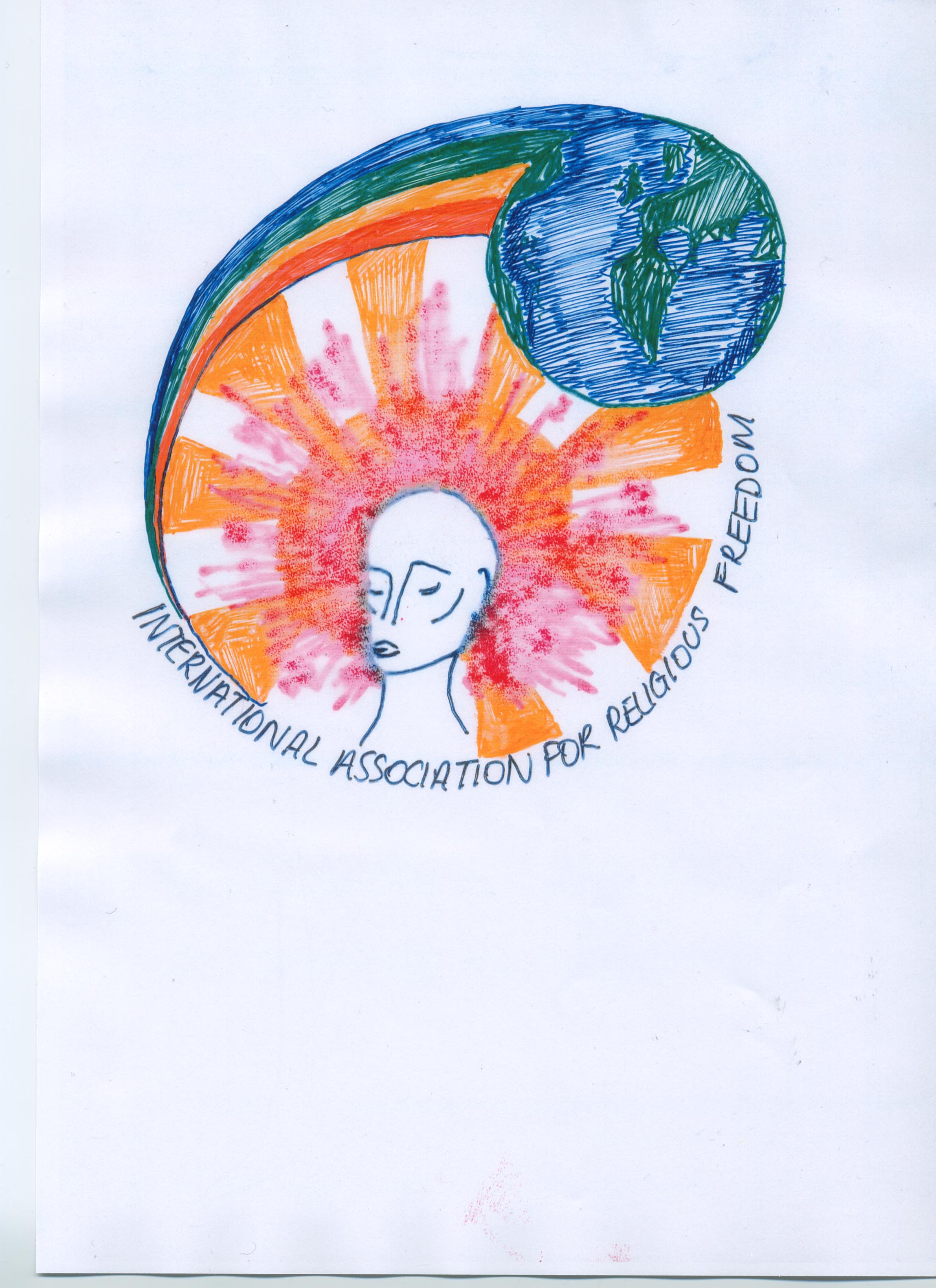
Andrew Clark and I were invited to speak to 6th formers (16-18 year olds) in Bolton, UK in October. The event was designed as an interactive lecture and Andrew and I ran various discussion groups. It was an extremely enjoyable and stimulating experience to be able to engage with such lively young people. One group chose to create a new logo for the IARF. It must be borne in mind that they were given very little time to produce this piece of work, but here is one idea. Here is a brief explanation of the picture according to the student. Religion and belief relate to people, so therefore these are emanating from the person's head. The wide variety of beliefs are partly indicated by the colours of the rainbow and the international nature of IARF is shown by the globe.
I am currently working on creating an inter faith network of young adults in Europe and the Middle East. They will have leadership potential and will be from different faith traditions. They should be seriously committed to gaining further training so that they can carry out inter faith work in their own countries. It will be a tripartite venture, so that we will initially work in Eastern and Western Europe and the Middle East. The core team will work with young adults in each of these countries on specific projects and we envisage this programme running for several years. The Israel Interfaith Association and the South Group of Research, two of our member groups are presently assisting with the Middle East component. (More information and an update will follow in the next IARF World) We believe that it is essential that we are involved in constructive and meaningful encounter and active programmes.
We are looking at models of good practice and examples of projects in which young people from different faith traditions can work together. A specific example has taken place in Jerusalem organised by the Israel Interfaith Association, where Jews, Muslims and Christians cleaned the Muslim Cemetery on Mount Zion.
I have reported on activities in Europe and the Middle East, but you can be sure that we will be continuing to work hard to encourage and energise young people from a wide variety of faiths in other regions of the world. I hope to provide further details in the next issues of the newsletter.
It is proposed that the Congress will be based in East & Central Europe starting in three sites for two days in Budapest, Koloszvar and Prague, travelling on the third day, and convening into a plenary session for up to three days in Budapest. The dates will be Monday 29th July to Saturday 3rd August 2002, so put these dates in your diary! More details will follow in the next edition of the IARF World.
A Congress Steering Committee is being established and a first meeting of some of the members was held in Budapest on 13th November to manage all the local arrangements including the venues, food, travel, accommodation and logistics. [See photograph of some of the people at the first meeting]. There will be local committees to look after the arrangements for each of the three first stage venues.
People will be able to select the venue of their choice for the first stage and then all will travel to Budapest on the third day. During the first stage participants will be able to gain an understanding of the religious freedom issues in the host countries. This would be done partly by various faith groups that will come to present their recent histories. It is also proposed to commission a book for delegates that would particularly assist non-Europeans to appreciate the complicated and traumatic religious history of Europe and the current issues.
All will come together at the end of the day of travel for an evening event in a beautiful riverside setting in the lovely old city of Budapest. The next three days of the Congress will take place on one site and delegates and participants will be accommodated in a range of nearby hotels and hostels
The Millennium World Peace Summit of Religious and Spiritual Leaders
Opened at the United Nations in New York 28-31st. August 2000
This summit was organised in co-operation with the U.N. Secretary General's Office, and it was this fact that was one of the key elements in helping IARF to decide to attend. One of the intended outcomes was the creation of an on-going Advisory Council of Religious and Spiritual Leaders to serve as a resource for the Secretary General. We took the view that despite reservations about the event and what or who it represented, we should try to enhance its potential for good.
The first task was for IARF to write to the Secretary General Kofi Annan appreciating his predicament concerning the Chinese objection to the presence of HH the Dalai Lama. We urged "most strongly that in (his) Inaugural Address (he would) include a clear and courageous reference to the absence at this Summit of all religious leaders who suffered repression in their homelands." We referred particularly to The Declaration of the Elimination of All Forms of Intolerance and Discrimination based on Religion or Belief adopted by the U.N. General Assembly on 25th. Nov. 1981. This letter was sent on 5th. July 2000.
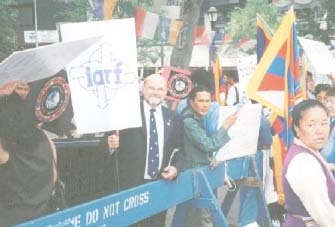
It was excellent that this indeed was the message which the Secretary General gave in his speech. In fact tributes to the Dalai Lama flowed from the platform, and, as your General Secretary, I both attended the Summit and the protest demonstration outside in the U.N. Plaza. For this I had to create a portable IARF banner (see photo).
The Summit itself was a rather indigestible series of speeches, and at times the organisation was overwhelmed by its task and the religious egos to be satisfied. That was sad, but the way it was.
Some wise things were said, particularly by the First Nations Peoples who gave the symbolic and actual news that "the ice is melting in the North". "The task of religions is not to rule but to challenge power" (Rabbi Rosen) and, "if I use one finger to point out the culprit, still three fingers (in my hand) are pointing at me."(Ven. Sobita).
The ceremony was opened with nine Shinto drums whose volume nearly burst the UN Assembly Hall at the seams, and closed at the Waldorf-Astoria Hotel with the "Sons of Thunder" brass band marching through the audience. The message of religious freedom and effective inter-religious co-operation together and with the U.N., was not so loud or clear.
Andrew C. Clark.
The IARF International Secretariat at Oxford would like to welcome Margaret Paton, our new Office Administrator.
Margaret started work for the IARF at the beginning of September. Prior to that she was lecturing in Information Technology at Kidderminster College. She gained experience in administration as Head of Student Systems for the University of Wolverhampton where she worked after taking her M Sc IT at that university in 1990.
Between 1974 and 1990 Margaret was a part time teacher of economics and computer studies and a full time mother. Before her first child was born in 1974 she had worked for OXFAM as Field Secretary for South East Asia and Eastern India, this work involved some travel to all the countries in the area. After her gaining first degree in Economics and Sociology in 1968 she spent two years teaching in Tanzania.
In 1976 with husband Jim and young daughter the family went to Kwazulu in South Africa where Jim worked as doctor and Margaret ran a sewing co-operative. Their son was born while they were there.
After the family returned from South Africa a second daughter was born and another daughter joined the family as a foster child. They are all now adults.
The current staff working at the Secretariat in Oxford are: Margaret Paton (Office Administrator) Andrew Clark ( IARF General Secretary), Ramola Sundram (Programme Co-ordinator with specific responsibility for young adult programmes), Dinah Mayo (Finance Manager), Neil Farrow (for special projects) and Simon Rhodes (volunteer )
IARF WORLD
Text : IARF Staff and Members, and Photos: Yuji Inokuma,Tim Brandes and Jael Bharat
Typesetting and Design: IARF Staff
Publication dates: January/July
Copy deadline: 15 April/15 October
Permission to reproduce articles and IARF staff photos is granted provided credit is given.

|
Advocacy | United Nations |History | Programs | Publications | Members | Links | Email |
Copyright 1999 © International Association for Religious Freedom
2 Market Street, Oxford OX1 3EF, United Kingdom
Tel. 44 (0)1865 202 744, Fax 44 (0)1865 202-746