|
NGO with UN consultative status supporting interfaith cooperation 100 years of advocacy and dialogue for liberty and equality |
iarf |
International Association for Religious Freedom
|
NGO with UN consultative status supporting interfaith cooperation 100 years of advocacy and dialogue for liberty and equality |
iarf |
_________________________________________________________________
IARF World
No. 1, 1999 - ISSN 1028-2955

Report on the IARF Preparatory Conference
IARF European Conference at Bad Boll
North America
- IARF Endorses End to War
- Students Go Online
- Calendar of Events
Young Adults
- 1999 Summer Program
- 1998 Program at Bad Boll
United Nations
- General Secretary Speaks on Religious Freedom
- Intervention in Geneva on Minority Rights
- Human Rights Advocacy for Pandits
1999 Congress in Vancouver: July 29 to August 3
The 30th IARF Congress will be held this coming summer at the University of British Columbia in Vancouver, Canada.
The first IARF Congress was held in 1901 in London. Three more Congresses were held before World War I and six more between the two world wars. Since 1949 there have been nineteen IARF Congresses. The IARF will celebrate its centenary with the 30th Congress in 1999.
What is it like to attend an IARF Congress? There are devotions in different religious traditions each day. Study groups address challenging topics, and circle groups allow participants to share their own faith in small group discussion. The evenings are filled with cultural events, and an interfaith service provides a spiritual focus for the entire Congress.
The theme of the 30th IARF Congress is "Creating an Earth Community: A Religious Imperative." How are people of faith from different religious traditions to protect the earth's environment and its diverse cultures? How can religious visions guide us toward greater peace and justice? How might we have the courage to live more simply so that others can simply live?
Before the Congress participants may join a tour to beautiful Vancouver Island or travel to the Congress by train or bus through the Canadian Rockies. After the Congress participants may journey through the Inside Passage by luxury cruise ship to Alaska or visit Queen Charlotte Islands, home of the Haida Nation. For all the details of these tours turn to pages 6 and 7.
The US dollar is still strong against the Canadian dollar, so now is the time to register to visit Canada at the end of July. Don't miss the challenge of the 30th IARF Congress and the beauty of Vancouver. 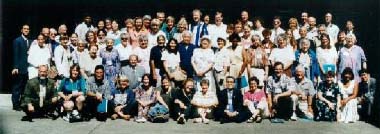
Participants at the IARF Preparatory Conference held in Vancouver, Canada in July 1998.
Report on the IARF Preparatory Conference
Rev. Harold Rosen, Chairman, Vancouver Congress Planning Committee
On a sunny weekend in mid-July of this year, 100 multifaith enthusiasts gathered in Vancouver, Canada, for the IARF Preparatory Conference focusing on "Creating an Earth Community." Our venue was the University of British Columbia, site of the 1999 Congress. Local planners had envisioned the "prep-con" as a mini-version of the Congress as a whole, featuring similar program elements: keynote addresses, international guests, workshops, cultural enrichment, circle groups and multifaith devotions. Four IARF staff members enriched our proceedings, including Bob Traer (who delivered a very thoughtful and articulate keynote address on the "Earth Community"), Helen Wüscher, Yukimasa Hagiwara and Will Baker. Warm greetings were brought by IARF president, the Rev. Yukitaka Yamamoto; the Rev. Norio Sakai, leader of the Rissho Kosei-kai Buddhists; and the Rev. Daijiro Ai of Ittoen. Yuji Inokuma made an outstanding contribution as the organizer of the Japanese delegation, and all the Japanese delighted other participants with their warmth and wisdom.
Other notable contributions came from Ellen Campbell, Canadian representative on the IARF Council; the Rev. Pat Hoertdoerfer of the Unitarian Universalist Association; the Rev. Sydney Morris of Vancouver, who gave an inspiring keynote and coordinated the multifaith worship service; Steven Shrybman, an environmental lawyer, who delivered a provocative keynote speech; Sister Kiran of the Brahma Kumaris World Spiritual University, and Dr. Satyen Banerjee of the Bengali Cultural Society, both of whom enriched our workshops and devotions; Joyce Poley, a Universalist singer and composer who led our enjoyable evening of cultural enrichment; and Janet Evans, a creative administrator who assisted with arrangements.
The event was clearly a success in that some wonderful networking took place, important issues were explored, there were inspiring presentations, and enthusiasm for the 1999 Congress was generated. The goals of the prep-con were to give participants hope for the prospects of fashioning an "Earth Community;" to deepen their commitment to interfaith cooperation; to nurture some international and interfaith relationships; to provide significant learning about the IARF, other faith communities, and the imperative tasks of our day; and to generate program ideas and resources in preparation for the 1999 Congress. All of this happened, to the delight of the local committee.
Though 49 of the participants had Unitarian backgrounds, there was still a feeling of "diversity" because 40 from other faith communities had high-profile roles. Our proceedings were enriched by 14 Buddhists, 7 Shintos, 6 Christians, 3 Pagans, 2 Universalists, 2 Brahma Kumaris, a Jew, a Muslim, a Sikh, a Zoroastrian, a Hindu, a Bahai, and 11 unaffiliated participants. Among the 100 participants were 14 Japanese, 9 Americans, 2 from England, 1 from Korea, and 74 Canadians.
The workshops were all well-received, and they explored some of the important sub-themes of the upcoming Congress: "Young Adult Visions," "Preserving Freedom," "Revering Nature," "Sharing Wealth," and "Nurturing Spirit." Many ideas for possible Congress workshops were generated at these spirited gatherings. We also learned how to improve our circle groups and translation process, and gained some valuable experience for on-site registration, education about the IARF, and home visits. Overall, the most appreciated event at the prep-con proved to be the closing multifaith worship service in the Great Hall of the First Nations House of Learning. It was a highly satisfying ending for a weekend packed with dialogue and new experience. The cultural and spiritual depths of the traditions represented were shown to us with dignity and grace. A reverential mood was established as a diverse array of scriptures and rituals lifted our spirits. We were given lifelong memories and a glimpse of the "Earth Community," showing us that deep respect for humanity's spiritual legacy, as well as stewardship of the Earth, are real possibilities in the new millennium.
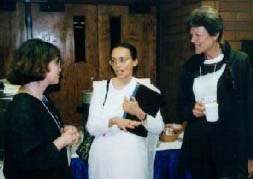
Rev. Sydney Morris, UUA Minister in Vancouver, Sister Kiran, Brahma Kumaris World Spiritual University, and Rev. Pat Hoertdoerfer of the UUA staff in Boston.
IARF European Conference at Bad Boll
Rev. Peronne Boddaert
As in the recent past, the IARF European conference held on July 1 to 5, 1998 in Germany was organized jointly with the Evangelical Academy in Bad Boll. Again it was a pleasure to be cooperating with our German colleagues. Besides, the location of Bad Boll is wonderful. Before the main conference began young adults from the IARF and the International Religious Fellowship held a gathering that was titled: "Youth and Religion in Europe-A Market of Possibilities?" You will read more about this in the Young Adult section in this newsletter.
On July 3, a study-day was held intended for Liberal Protestants in Europe. Rev. David Steers lectured on "The Unifying Role of the Holy Spirit," and Rev. Eric Cossee spoke about "Liberal Protestants on Reconciliation in Past and Present."
That evening the main conference began. It addressed the question: "Religious Diversity in Europe-Treasure or Barrier?" More than 80 people from different European countries took part. Also an Egyptian and Israeli were present and offered helpful comments.
At the conference there was reflection and dialogue both on the religious historical realities and current challenges of the European continent. Topics that were touched upon the previous year were discussed in greater depth. What spiritual and ethical forces are there within the religious diversity in Europe? Especially the lively lecture of the excommunicated Roman Catholic Bishop Jacques Gaillot gave fresh inspiration and encouragement. There were workshops on religious philosophical answers to the political development in Europe, and the philosophical thoughts of Guardini and Marcel were helpful. Religious answers to economic globalization were formulated in another workshop. A third workshop concerning European spirituality was led by Dr. Tirmiziou Diallo, a theologian from Frankfurt.
Also a lot of informal exchange was done and new friends were made. A variety of mediations offered the framework for these days. The presence of a group from Ghana in Bad Boll gave extra dimensions to the European gathering!
The closing panel discussion formulated conclusions concerning the further realization of European interfaith activity and the promotion of religious freedom. Results of the Bad Boll conference will be followed up at the 1999 IARF Congress in Vancouver.
Do you have an idea for a new IARF logo? Some members have suggested there should be a change to mark the new century. So, we are inviting suggestions. Every logo proposed will be submitted to the next IARF Council, and it will decide whether to change or to continue with the present logo. Please send suggestions to the Secretariat by 1 June 1998.
IARF IN EUROPE
Rapenburg 103, 1011 TW
Amsterdam, The Netherlands
Tel 20 626 0077 Fax 20 626 0087
Email peronne@wirehub.nl
IARF IN NORTH AMERICA
IARF IN SOUTHEAST ASIA
IARF IN SOUTH ASIA
IARF INTERNATIONAL SECRETARIAT
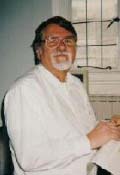
The IARF wishes Klaus Glindemann a happy retirement, after his 18 years of service working with the finances of the Association.
Southeast Asia: IARF Interfaith Activities in the Philippines
An IARF conference was held August 25-27, 1997 in Dauin, Negros Oriental. It was the first IARF conference to be held outside of Metro Manila, in the Philippines, since the IARF Conference held in Dumaguete City in 1989. This made it possible for a greater number of IARF members in the Philippines to participate, as many are unable to cover the costs of traveling to Metro Manila. Some highlights of this conference were:
The governor of Negros Oriental, who delivered the keynote address, affirmed his belief and the Filipino belief in the Almighty God, Giver and Sustainer of All Life and called for an evaluation of our maturity and responsibility as stewards of the gifts that have been entrusted to us. He praised church leaders present for their dedication and commitment toward the development of communities in such ways that people could live the "fullness of life," saying that caring for our environment was living in community with God, and living in community with God was an abundant life.
The closing worship consisted of a very moving candle ceremony that illustrated the interconnectedness of the people to God and the environment.
A comment on this conference was "There was never a religious conference that we left happily except for the IARF conference. I have been to (other) religious meetings, and conflicts, disagreements, and disputes were always present. I always left these meetings with a heavy heart. But the IARF-Philippines Conference was different. It was very good. I was very happy, and inspired to help better my environment, community, and life. My perception was reoriented to the intrinsic thrust of keeping my environment sound and clean in order to live an abundant life."
On May 25-27, 1998 the IARF sponsored a conference in Mindanao. It brought together Christians and Muslims for the first time in such an event and also elicited an overwhelmingly positive response. The island of Mindanao is the southernmost in the Philippines. It is predominantly Muslim, having largely escaped colonization by the Spaniards. Like the Middle East, it has long been the site of religious conflict, although not on the same scale. With the success of this IARF conference, there are now plans to make interfaith activities such as this something of a tradition in the Philippines. Some of the highlights of the Mindanao conference were:
The guest speaker was a member of the Islamic faith, who in his welcome address stressed that the goal for unity could not be attained when there is no love. He then gave an overview of his faith and corrected the negative image of Muslims that had been perpetuated in the Philippines by the Spaniards during their 350 years of colonial rule. He also commended the IARF for sponsoring such a unique program for unity and emphasized that the meaning of Islam was peace. Therefore, it was quite similar to that of Christianity. As such, he believed in the brotherhood of Muslims and Christians, and that the members of each faith should love each other. His talk inspired a lively dialogue afterward.
Different religious groups led morning and evening devotions during the three-day conference. During the Islamic worship service, special care was taken to explain the stages of worship and afterwards the leaders responded to questions from the participants. Some comments from the participants were: "The happiness we experienced cannot be expressed or fathomed," "The women's voice was really heard," and that "There is joy and happiness in everyone's heart because of the chance given by the IARF for this kind of activity."
These conferences illustrate how the IARF is helping unite religious, government, and non-government organizations to work for common causes, such as poverty alleviation and social integration, including environmental preservation, to uplift the spiritual and socio-economic wellbeing and quality of life of Filipino communities.
They also illustrate how, through interfaith activities, the IARF is helping break down long-standing religious and socio-cultural barriers (and stereotypes), such as those between the Christians and Muslims in the Philippines. The situations above may not quite be analogous to those in other parts of the world, which may be more complex. But this experience shows that where people have a genuine desire for peace and reconciliation among themselves and their communities, they are able to take steps toward attaining those goals.
The IARF in the Philippines also counts among its membership certain indigenous tribes on the island of Mindanao. Their presence has enriched not only the conference in Mindanao but also the IARF as a whole.
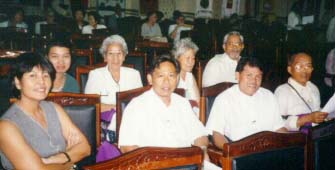
IARF members from the Philippines, shown here at the 1996 Congress at Won Kwang University, include women, youth, church and lay leaders.
South Asia: IARF Young Adult Program in Ladakh
By Rishi Singh
Fa Hien, the great Chinese traveler, who visited Ladakh in 400 CE, called it Ma-La-Pho (Red Land). Its recent name comes from La-Tag, in Tibetan; the Land of the La, the land of the high mountain passes. Dry, stark, remote, harsh in climate, topography and altitude, this country of rocks lies high up on the Indian borders with Tibet, China and Pakistan. It is a land of bare gravel slopes, sandy plains, not a tree or even a blade of grass. The river is only glimpsed, a thousand feet below the road.
The bus creaked and wheezed its way slowly up the vast winding pass of Tanglang La (17,582 ft)-second highest pass for motor vehicles after Khardung La (also in the same region)-slowly inching its way with young adults from various parts of India, including Ladakh.
The IARF Coordinating Council for South Asia organized a Young Adult Program from July 23 to 27, 1998 at the Mahabodhi Meditation Center, 8 km. from Leh City. The young adults were selected from various walks of life, religious backgrounds, and different parts of India. The three-day journey to Leh City turned us into a harmonious group.
As soon as we reached the Mahabodhi Meditation Center we were overcome by the silence that no words could convey. It was the silence of snow, rock and water. It was a feeling that most of us had never felt before. In this atmosphere, we were welcomed with deep affection by Ven. Sanghasena and his staff.
The first ray of sunshine... none of us were prepared for that kind of splendor and for the majesty of the mountains.
Those rock faces that the wind and snow had worked over thousands of years into shapes were so unexpected and fantastical that the eye could hardly believe what it was seeing.
On July 24 the Young Adult Program was inaugurated with all the important political, religious and bureaucratic personalities of Ladakh present. In addition, the Ladakh branch of the IARF Chapter in India was formally opened. After lunch the young adults were divided into smaller mixed groups to talk about their religious backgrounds, cultures and hopes. We discussed the challenges before us: illiteracy, the population explosion, lack of liberal attitudes, social tensions, etc.
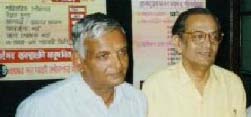
The IARF Chapter in India is growing rapidly thanks to the hard work of Mr. C.N.N. Raju, Chapter Secretary, and Mr. Punyabrata Roychoudhury, Chapter President and a former President of the IARF.
Participants felt that it would help to participate in each other's religious, social and cultural activities. It was also felt there should be ample opportunities to study the major religions of the world and complete freedom to follow a faith of one's own choice. The group also supported interfaith camps, seminars, and workshops.
At the Mahabodhi Meditation Center we began an interfaith garden by planting saplings. Then we proceeded into Leh City, walking to the Shanti Stupa. Many of the citizens of Leh joined as well.
The most fascinating part of the program was the prayers recited every morning during visits to the various shrines of different faiths in the city. On the one main street with two rows of tumbledown shops were all the major religious communities.
On July 27 Dr. Karan Singh, former Union Minister of India and a scholar of international fame, addressed the participants. He stressed his belief in interfaith cooperation and its need in the coming millennium. He also distributed beautiful participation certificates and ate dinner with the participants.
Ladakh is a place where tolerance reigns supreme. Young adults were very fortunate to have experienced the noble ambience of Ladakh under the aegis of the International Association for Religious Freedom.
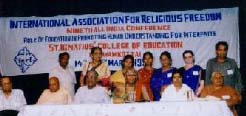
IARF leaders and guests at the Ninth All India Conference sponsored by the IARF Chapter in India in March 1998.
IARF Endorses End to War
The IARF in North America has endorsed a millennial peace initiative that seeks to make war illegal.
The The Hague Appeal for Peace is dedicated to the de-legitimization of war. It seeks to refocus our minds on a vision of the world in which armed conflict in the settlement of disputes is seen as illegitimate and fundamentally unjust. The Appeal will complete the extraordinary sequence of world conferences held over the last decade but will be convened by civil society, not by governments. It will be held in The Hague from May 11 to 16, 1999. The organizing committee for the Appeal is made up of groups from all sectors of civil society that support disarmament, gender equality, ecology, sustainable development, and human rights. Its four program areas are: disarmament, conflict prevention and resolution; international humanitarian and human rights law, and identifying the root causes of war/building a culture of peace. (Reprinted from Peace Matters July 1998 Volume 1, Issue 2.)
Students Go On-Line
By Jacob Weigler
With the increasing use of the Internet by students, business is moving to appeal to this growing segment of users. Thus, the IARF website, http://iarf-religiousfreedom.net, is also changing and will soon be run by and be more attentive to the needs of young people.
This move is being made to expand IARF outreach and visibility to young adults. Using the World Wide Web allows the IARF to reach a much larger audience as well as provide direct access to information on a variety of issues. The IARF web site provides reports and dialogue on religious persecution in Pakistan and new legislation concerning religious freedom in Russia and the United States. The site also contains updates about IARF activities, information on the 1999 IARF Congress, and contact addresses for IARF regional offices. Users can also pull up press releases, biographies, and descriptions of IARF programs, member lists, and copies of the IARF World.
The IARF hopes to expand the website to provide interactive options as well as more space for direct involvement by the electronic community in sending email letters and petitions to world leaders. Come visit the IARF via the Internet at http://iarf-religiousfreedom.net.
IARF in North America welcomes its newest interns, Shilpa Shenoy and Nami Takashi. Shilpa is a sophomore at Columbia University and of Indian descent with a strong interest in young adult activities and civic involvement. She will be active in the planning and implementation of the Young Adult Program at the 1999 IARF Congress. Nami hails from SUNY Purchase and has extensive experience with website development and intercultural affairs. We look forward to working with both of these young women.
Calendar of Events
25 October 1998, New York City
Opening Ceremony, Manhattan Headquarters of Rissho Kosei-kai
5 November 1998, New York City
IARF General Secretary addresses UN Session
19 November 1998, Worldwide
Day of Freedom of Religion or Belief
3 to 13 December 1998, Israel/Jordan
Human Rights Tour
10 December 1998, New York City
Commemoration of the Universal Declaration of Human Rights by the UN General Assembly
10 December 1998, New York City
Human Rights Day Concert
11 May to 16 May 1999, The Hague
The Hague Appeal for Peace
26 July to 29 July 1999, Vancouver
IARF Congress Young Adult Program
29 July to 3 August 1999, Vancouver
IARF Triennial World Congress
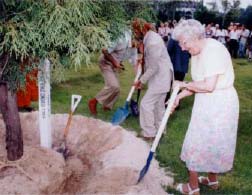
At the 1996 Congress participants planted a tree at Won Kwang University in Korea to commemorate the occasion. Mrs. Natalie Gulbrandsen, a former President of the IARF, was happy to help.
East Asia: Concern for the Environment
By Gene Reeves
100 years ago almost no one thought about the environment, at least not as we do today. For the most part, the natural environment was something to be conquered and brought under human control.
People, in the West especially, were enjoying the fruits of the industrial revolution, the process in which the power of animals was replaced by machinery and the power stored in gas, coal, and oil. For the most part, human work moved from farms to cities. We thought, in those days, that science and technology could produce unlimited, unending progress, "onward and upward forever."
In the West, attitudes toward nature were rooted in a hierarchical view of the world. At the peak of the pyramid was God, far above everything else. Well below was Western civilization, the Christian civilization with its special mission to "save" the rest of the world by converting it to the Christian religion and making it subservient to itself. Below Western civilization was the rest of humanity, the "colonies" in Africa, Asia and Latin America.
While slavery, which made some people less than human, was largely abolished in the first half of the 19th century, colonialism would endure into the middle of the 20th. Well below all humanity in this hierarchical scheme was the rest of nature, as something to be used and exploited by humanity, especially by "modern" civilization.
Much of what has happened in this century could not even be imagined 100 years ago. The human population, has soared to unimagined heights. Once living mainly on the edges of dangerous jungles, facing dangerous oceans, under impenetrable skies, human beings came to have dominion over the earth, conquer prairies, the very earth itself. Today vast numbers of people live in places where they should not, resulting in enormous destruction of human life through floods, earthquakes and other natural disasters, which remind us that nature has not been entirely conquered.
Along with this vast increase in human populations has come an even more vast growth in the consumption of natural resources, an increase driven both by growth in population and so-called "standards of living." Not only are there more mouths to feed and consumers of all sorts of things, but among developed and developing nations at least, each individual is directly or indirectly responsible for consuming ever-larger quantities of what nature has to offer.
As part of the same cycle, the growth in pollution of all kinds staggers the imagination-the world has become more of a garbage dump, with the air, the waters, the ground contaminated with the wastes of production and consumption. Some progress has been made in cleaning the air and the waters, but the problem remains of what to do with such enormous, and growing quantities of waste and pollution. And not only is the quantity growing, but the dangerous quality of much of it as well. Nuclear waste and other kinds of chemical wastes are nearly impossible to dispose of.
Finally, there is the growing disruption of natural weather systems, particularly to global warming. We don't know yet how serious this is, but the destruction of the earth's ozone protection layer and the world's forests, and the rapidly growing quantities of carbon dioxide spewed into the earth's atmosphere could result in some terrible changes. Tokyo, for example, could easily become a sea.
So here we are in the late 1990s with a lot of "progress" behind us and a lot of problems with the natural environment facing us? What will happen in the 21st century? Of course, we don't and can't know, but some things can be seen quite clearly. For example, we know that much of what has been happening during the past century cannot continue. The resources of the earth, amount of food that can be produced, and the amount of pollution that can be endured are all limited. The places on the earth where people can live safely are limited. These problems are not going to go away easily, but there will be massive changes.
We humans will reform our ways on earth or face massive breakdowns of environmental and economic systems. Without inspired leadership, disaster, it seems to me, is the more likely road ahead. It is entirely possible that 100 years from now, especially if it is another 100 years of doing what we have been doing with the environment, the earth will be largely or wholly uninhabited by humans.
The earth will survive. Life, at least in its "lower" forms of bacteria and fungi and perhaps even cockroaches, will survive. But it is entirely possible that you and I are members of one of the last generations of humans in the world. And let's not fool ourselves about living on other planets or in spaceships. If we cannot learn to live in this fantastically rich and generous environment, we surely can't live in an environment that is much less friendly to human life.
What's needed then, is inspired leadership-a leadership which is, at least in its depths, religious. What is required is a religious leadership, which can lead us to a healthier, more sustainable, relationship between humanity and nature. (Excerpt from a talk given to the IARF Japan Chapter and reprinted from the IARF Japan Chapter Newsletter, Volume 34, 1998).

Rev. Yukitaka Yamamoto (center), President of the IARF, and Rev. Norio Sakai (right), Chairman of the Board of Rissho Kosei-kai are shown here with Rev. Jun Yamamoto of Tsubaki Grand Shrine(left).
Young Adults
The 1999 IARF Young Adult Program from 26 to 29 July at the University of British Columbia in Vancouver, Canada
By Ramola Sundram
The theme of the conference will be "Building Tomorrow's Community: Different Faiths, One World."
If you are 18 to 35 years old, interested in meeting young people from different faith traditions, keen to share experiences and ideas, eager to develop a vision of the future, and willing to work as part of a team, we invite you to join us in our program and help make it a success. You may never have been to an event like this, or may be taking part in one again. (The 1996 YAP in South Korea brought together 120 young people from 20 countries.)
The cost of this program will be C$120.00 for registration only or C$255.00 including accommodations and breakfast.
The full participation of young adults at the triennial IARF World Congress to follow from July 29 to August 3, 1999 is also being warmly welcomed.
The cost of the Congress is C$ 65.00 per day for registration and two meals (breakfast and lunch) or C$ 175.00 for the whole Congress. Accommodations are C$45.00 per day. A limited number of sponsorships are available, but priority will be given to young adults who are active in IARF member groups or in IARF chapters.
For more information, or to receive registration and sponsorship application forms, please contact your Regional Coordinator or the International Secretariat. For addresses, see page 3.
1998 IARF Young Adult Conference in Bad Boll, Germany
By Ramola Sundram
The IARF Young Adult Conference held in Bad Boll, Germany from July 1 to 3, 1998 brought together young people from a number of countries, including the Netherlands, England, Germany, Russia, Romania, Egypt and Israel. Aimar Saarits from Estonia even hitchhiked to Bad Boll, which shows his commitment! Lectures and workshops were given on the subject of religious diversity. The latter were particularly helpful and interesting, as we were able to share experiences of interfaith activity and also the difficulties encountered.
There were several points that came out of one very productive meeting. We want to form a vibrant team of young adults in Europe committed to interfaith dialogue. It is vital to place emphasis on dialogue-based meetings, where the issues addressed are of genuine interest to young adults and reflect their concerns and aspirations.
We hope to have the participation of more young people from a greater diversity of faith traditions and that the majority will have the support of an organization or faith community. It is essential that young people from IARF member groups in Europe take an active role in this project. At present, we are increasing our network of contacts.
We invite anyone interested to send contact names and ideas to Ramola Sundram (International Secretariat) or to Peronne Boddaert (IARF in Europe). For addresses, see page 3.
The International Association for Religious Freedom was founded in 1900. The IARF has general consultative status at the United Nations and supports religious freedom through interfaith cooperation.
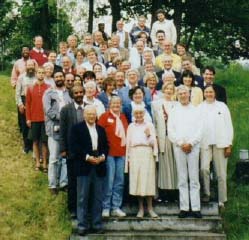
Several young adults participated in the European IARF Conference at Bad Boll, Germany. (Photo by E. H. Berkhoff)
IARF General Secretary Joins Special Rapporteur for UN Address
By Will Baker
IARF General Secretary Rev. Robert Traer and UN Special Rapporteur on Religious Intolerance Professor Abdelfattah Amor addressed UN officials and NGO leaders on November 5, 1998. The theme was "Freedom of Religion or Belief: Hopes and Realities" in commemoration of the 50th Anniversary of the Universal Declaration of Human Rights and the Fifth Annual Day for Freedom of Religion or Belief.
The NGO community receives weekly briefings from the UN Secretariat, mission staff and outside organizations. These briefings often evolve into global movements or General Assembly resolutions. By spotlighting concern about the enforcement of freedom of religion or belief, the United Nations Department of Public Information (DPI) recognized the critical nature of this issue in today's world.
The presentations were followed by a multi-religious service for the United Nations held at the Church Center.
Sue Nichols, an IARF representative to the UN and chair of the program committee of the Committee on Freedom of Religion or Belief, is to be commended for her leadership in planning the events.
Letter from Geneva during the 50th Session of the Sub-Commission on Prevention of Discrimination and Protection of Minorities
By Ramola Sundram
September 24, 1998: This morning, I walked up to Gate 40 (that shows the size!) and met Dr. Rossi (our IARF representative at the UN, Geneva) and his wife in Room 17. I felt privileged to be in this famous room, strangely familiar to me, as I had seen it in pictures. There we all were, the representatives of the Non-Governmental Organizations seated towards the back of the room, behind the delegates of the member states.
Dr. Rossi spoke just before the end of the morning session. He thanked the Sub-Commission and various United Nations' bodies for their efforts to achieve religious freedom. He pointed out that there continue to be states opposed to an essential dimension of the freedom of religion: the freedom to change one's religion.
"At the dawn of the 21st century," he argued, "it is unacceptable that Member States of the United Nations adopt or maintain legislation that even includes the death penalty for those who change their religion."
He also asserted that any group professing a religion different from that of the majority should be considered a religious minority under national and international law, even if it shares the ethnic, linguistic or other characteristics of the majority. Dr. Rossi then drew attention to the plight of several religious minorities. He spoke of the Bahai community in Iran, which continues to be persecuted and of the 1,500 members of the Hindu Pandit minority who have been killed in Jammu and Kashmir.
Dr. Rossi expressed concern that there is also evidence of growing intolerance in Europe. In 1997 a Parliamentary Commission in Belgium identified 189 churches, religious movements and organizations as "sects". There has been an outcry from Bahais, Evangelical churches, Mormons, and Buddhists who complain of discrimination and slander and maintain that their religions are authentic faiths, respectful of the law and human rights.
Because of my visit to Geneva, I am convinced that NGOs have a vital part to play at the United Nations, and of course that includes the IARF! According to someone who has been attending these sessions for years, NGOs are listened to, and States certainly don't like being criticized.
NGOs are often most effective when working together and can be a real force for change. The work of the IARF for human rights must continue!
Human Rights Advocacy
By Rev. Peronne Boddaert
Dr. Gianfranco Rossi, IARF representative at the UN in Geneva invited me as IARF European Coordinator to observe the UN proceedings at the 54th session of the Commission on Human Rights. I was there during the days on which religious freedom was the central issue (from March 31 to April 2, 1998).

During my stay I was pleased to meet with Prof. Pandita, representative of the Hindu Pandits in Kashmir. Dr. Rossi intervened on behalf of this peaceful religious minority that has been persecuted by terrorists for more than ten years.
On my way to the IARF youth camp in Leh Ladakh, India, I visited some of the Pandit camps in Jammu and saw the awful conditions there. It should be a continuous task for the UN, helped by organizations like IARF, to intervene on cases concerning religious freedom. In addition, the IARF should work to help stop and prevent ethnic cleansing.
Dr. Gianfranco Rossi, the IARF representative to the Commission and Subcommission on Human Rights in Geneva, shown here with his wife, Mrs. Carmela Rossi.
July 18-24
July 23-28
July 24-28
July 26-28
July 25-29
July 26-29 IARF Young Adult Program
July 29 to August 3 IARF Congress
Details on registration form
August 4-5
Fraser Valley Tour C$ 280.00 (US$ 182.00)
August 4-11
August 5-12
IARF WORLD
Text and Photos: IARF Staff
Typesetting and Design: IARF Staff
Publication dates: January/July
Copy deadline: 15 April/15 October
Permission to reproduce articles and IARF staff photos is granted provided credit is given.

|
Advocacy | United Nations |History | Programs | Publications | Members | Links | Email |
Copyright 1999 © International Association for Religious Freedom
2 Market Street, Oxford OX1 3EF, United Kingdom
Tel. 44 (0)1865 202 744, Fax 44 (0)1865 202-746