I
love horses but the two breeds that I like best are the Arabian and the
Thoroughbred. I have some information below on those two breeds that
you might find interesting. After that I have a glossary of terms
associated with "horsey" things. Hope you enjoy.
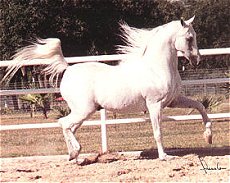
The Bedouin tribes of the desert, believing the horse to be a gift from God, told many romantic tales of the Arabian's beginnings. One such legend claims God fashioned the desert south wind into a creature who "shall fly without wings". No matter how the horse came to the desert, Bedouins took them as prized members of their households. Individual horses were selected for the gentle, affectionate nature, the striking look and proud spirit the breed is known for today. The Arabian was also bred to withstand long treks across the desert and the tribal wars which sometimes followed such trips. The Bedouins developed horses with strength, courage and stamina required for survival, and for the speed and responsiveness needed to win the tribal skirmishes. All in all, the Arabian Horse developed a significant list of attributes!
When Europeans sought to improve their saddle horses, Arabians were imported to cross with native strains. The standard procedure was to use purebred Arabians, especially stallions, to improve stock. The Byerly Turk, Darley Arabian and Godolphin Arabian are conspicuous in English Thoroughbred pedigrees. Similar improvement plans took place in France, Germany, Spain, Poland, Hungary, and Russia. Today, Arabians are found throughout the world and the blood of Arabians flows in all breeds of light horses.
Ancient Bedouin breeders were careful to record bloodlines and jealously guarded the purity of their Arabians. As a result, even though centuries have passed, today's Arabian cannot be mistaken for any other breed. Whether ridden English or western, shown in park classes or used for trail riding, Arabians have the same basic distinctive appearance.
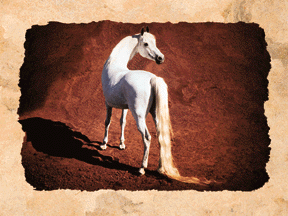
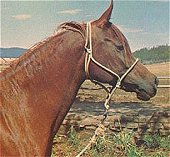
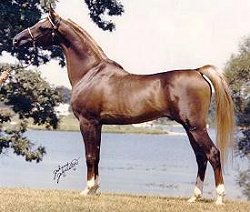
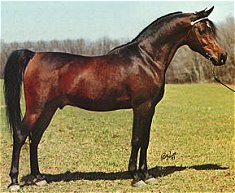
The Arabian's head has a characteristic dished profile with a prominent eye, large nostrils and small teacup muzzle. His gracefully arched neck rises out of a long sloping shoulder and broad chest. A short, strong back and high tail carriage complete the picture.
Arabians come in grey, chestnut, bay and roan and an occasional solid black. Although some individuals will vary, most are between 14.2 and 15.2 hands in height and weigh between 800 and 1,000 pounds.
The
photograph and information contained on this page is provided courtesy
of Arabian Horse Trust, 12000 Zuni Street, Westminster, CO 80234-2300.
Phone: (303) 450-4710.
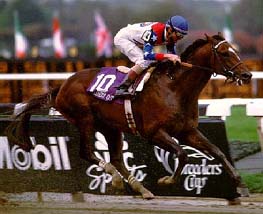
So began a selective breeding process which has been going on for more than 300 years, breeding the best stallions to the best mares, with the proof of superiority and excellence being established on the race track. Key to this selective breeding process is the integrity of the breed's records. In early days, Thoroughbred breeding records were sparse and frequently incomplete, it being the custom, among other things, not to name a horse until it had proved outstanding ability. It was left to James Weatherby, through his own research and by consolidation of a number of privately kept pedigree records, to publish the first volume of the General Stud Book.
He did this in 1791, listing the pedigrees of 387 mares, each of which could be traced back to Eclipse, a direct descendent of the Darley Arabian; Matchem, a grandson of the Godolphin Arabian; and Herod, whose great great grand sire was the Byerly Turk. The General Stud Book is still published in England by Weatherby and Sons, Secretaries to the English Jockey Club.
Several years later, as racing proliferated in the fast expanding continent of North America, the need for a pedigree registry of American bred Thoroughbreds, similar to the General Stud Book, became apparent. Col. Sanders D. Bruce, a Kentuckian who had spent almost a lifetime researching the pedigrees of American Thoroughbreds, published the first volume of The American StudBook in 1873. Bruce closely followed the pattern of the first General Stud Book, producing six volumes of the register until 1896, when the project was taken over by The Jockey Club.
Integrity of The American Stud Book is the foundation on which all Thoroughbred racing in North America depends. Without assurance, beyond all reasonable doubt, of the identity of every Thoroughbred which competes, or which is bred with a view to continuing the breed, the sport of racing as it is known today, could not exist. Nor would there be any possibility of measuring results of the centuries old quest to improve the Thoroughbred.
When The Jockey Club published its first volume of the studbook the foal crop was about 3,000. By 1986 it exceeded 51,000. The Jockey Club embraced new computer technology to meet the registration challenges posed by such large numbers. Today, The Jockey Club manages one of the most sophisticated computer operations in the country. Its database holds the names of more than 1.8 million horses on a master pedigree file, names that trace back to the late 1800's. The system also handles daily results of every Thoroughbred race in North America, as well as processing electronically transmitted pedigree and racing data from England, Ireland, France and other leading Thoroughbred racing countries around the world.
Further giant strides in improvement of the integrity of the Stud Book came in 1977, when The Jockey Club, taking advantage of medical science advances, took the first steps of an extensive blood typing program. Today every Thoroughbred foal registered in The American StudBook, and its sire and dam, is blood typed to insure parentage verification.
Although there are records of horse racing on Long Island as far back as 1665, the introduction of organized Thoroughbred racing to North America is traditionally credited to Governor Samuel Ogle of Maryland, who first staged a Thoroughbred race "in the English style" at Annapolis in 1745.
As America developed so did Thoroughbred racing, spreading across the nation from coast to coast until today the volume of racing in America far outweighs that of any other country in the world. American bloodlines, too, have come to be respected in the four corners of the earth.
What began as a pastime and sporting amusement for the wealthy has now become a worldwide multi-million dollar industry whose economic impact is widely felt at regional and national levels. From license fees and direct taxes on pari-mutuel handle Thoroughbred racing generates nearly $500 million in government revenue each year. But this is relatively minor in comparison to the overall urban and rural economic contribution made by the wide and varied infrastructure of the racing and breeding industry as a whole. A recent estimate, for example, put the industry's contribution to the economy of New York State alone at more than $1.8 billion each year.
Responding to the aberration of mid-1980's astronomic yearling prices which were fueled by European and Middle East racing interests, the annual North American Thoroughbred foal crop peaked at 51,293 in 1986. The decade was to show an overall production increase of 65% on the aggregate crops of the 1970's. But adjustments were inevitable and the foal crop has decreased each year since that high point. There are indications, however, that this necessary adjustment has more than served its purpose and that a rationalized and more stable breeding industry can once again look forward to controlled growth.
The
Thoroughbred is one of the most brilliant and versatile horses bred in
the world today. Noted for its ability to carry speed over extended distances,
the Thoroughbred is also a popular choice among horsemen in many disciplines
beyond the race track, including hunting, jumping, eventing and polo. The
Thoroughbred has been used to create new breeds of horses and to upgrade
others. The key to the Thoroughbred's greatness is its speed and endurance,
for which it has been bred for over 300 years.
The
Thoroughbred Foundation Stallions
The
Thoroughbred originated in Great Britain and its genetic origin is Arabian.
The "foundation" stallions of the breed were: the Beyerly Turk, the Darley
Arabian and the Godolphin Arabian. They were bred to native sprinting mares
-- very probably Scottish Galloways -- and the resultant foals were the
first Thoroughbreds per se.
The
Byerly Turk
At
the siege of Buda, Captain Byerley captured a horse from the Turks which
would carry his name into history. The horse became known as the Byerley
Turk and was the first of the three foundation stallions to come to Britain.
Reputedly ridden at the Battle of the Boyne in 1690 by Captain Byerley,
this horse distinguished himself as a sire although he was not bred to
many mares. In spite of his name, he was probably an Arab. The Byerley
Turk founded a line of Thoroughbreds, the most distinguished of which was
Herod, who was foaled in 1758, and proved to be a very successful sire
himself.
The
Darley Arabian
The
second of the three foundation stallions to be imported to England was
the Darley Arabian. He was foaled in 1700 and bought by Thomas Darley in
Aleppo (Syria) in 1704. The horse was shipped to Yorkshire, England where
he was bred to numerous mares. The most successful matings were with Betty
Leeds, which resulted in two very important colts: Flying Childers and
Bartlet's Childers. Through the Childers line, the Darley Arabian was the
great-great-grandsire of Eclipse who gained the description "Eclipse first,
the rest nowhere." The Darley Arabian is the most important of the three
foundation stallions in terms on his influence of the Thoroughbred breed.
The
Godolphin Arabian
The
last of the foundation stallions to come to England was a horse foaled
in Yemen. After being shipped to Syria and then to Tunis, he was given
to the King of France as a gift. One story tells of the horse pulling a
lowly water cart in Paris. The carthorse was admired and bought by an Englishman
named Edward Coke, who brought him to England. The second Earl of Godolphin
acquired the horse and bred him to several distinguished mares. Mated to
Roxana, he sired Lath, the greatest racehorse in England after Flying Childers:
and another mating of these two produced Cade, the sire of the great Matchem
who carried on the line of the Godolphin Arabian. In 1850 it was remarked
that "the blood of the Godolphin Arabian is in every stable in England."
Offspring of the Foundation Stallions
Keeping in mind the fact that the foundation stallions were Oriental horses, it should be noted that the descendants of these sires were the first actual Thoroughbreds. They were the progenitors of the breed, as we know it today. The foundation sires stand at the beginning of the Thoroughbred bloodline, but a number of generations were required to create horses which could consistently pass on the distinguishing characteristics of the Thoroughbred horse. Out of some 200 Oriental horses imported to England between 1660 and 1750, only the direct descendants of these three foundation stallions contributed to the breed's greatness.
Herod
The
offspring which fixed the influence of the Byerley Turk as a foundation
sire was named Herod who was foaled in 1758. He was owned by the Duke of
Cumberland, the third son of King George II, who was an important breeder
of horses at Newmarket and in Hanover. Although Herod was not an outstanding
racehorse, he did prove to be a superlative sire. His descendants were
extremely important in the development of the Thoroughbred throughout Europe
and America. Among the most notable descendants of Herod were Diomed (winner
of the first Epsom Derby in 1780), Sir Archie, the Flying Dutchman, and
Epinard.
Eclipse
1764
was the year of a great eclipse and this astronomical event became the
name of the horse that was a star in the history of the Thoroughbred. Eclipse,
as we know him, was by Marske, out of Spiletta and was bred for the Duke
of Cumberland. He began racing in 1769 at age five, when he ran away from
his competition in his first race at Epsom. It was at this race that the
famous Denis O'Kelly remarked, "Eclipse first, the rest nowhere." Eclipse
won 18 races in his career and he was never whipped or spurred. He went
on to a distinguished career at stud, siring Pot-8-O's who passed on his
influence to such descendants as American Eclipse, Hyperion, Kelso, and
Sea Bird. The list of Eclipse's distinguished descendants is virtually
endless, and he is the reason for the predominance of the Darley Arabian
line over the lines of the other two foundation stallions.
Matchem
Most
racehorses are noted for their speed, but the speed often comes at the
price of an excitable temperament, and even viciousness. The horse Matchem
foaled in 1748 was the grandson of the Godolphin Arabian. Besides speed,
he supplied an excellent disposition to his descendants. The horse Snap
was compared to the gentle Matchem: "Snap for speed and Matchem for truth
and daylight." (Snap was a grandson of the Darley Arabian.) When we consider
Matchem's blood heirs, we find many even-tempered yet fast horses. Matchem's
influence was not as widespread as his famous peers, but his offspring
had a particular influence on American horses. The owner's son, Edward
Fenwick, who immigrated to South Carolina in 1755, brought ten of Matchem's
descendants to America. Brutus, one of Matchem's sons, dominated racing
in South Carolina for some time.
Breed
Characteristics
The
Thoroughbred stands a little over 16 hands on average and its appearance
reveals its Arabian ancestry. A refined head with widely spaced, intelligent
eyes sits on a neck which is somewhat longer and lighter than in other
breeds. The withers are high and well defined, leading to an evenly curved
back. The shoulder is deep, well muscled and extremely sloped while the
heart girth is deep and relatively narrow. The legs are clean and long
with pronounced tendons and move smoothly in unison through one plane.
The bone structure of the upper hind leg makes room for long, strong muscling.
The thighbone is long and the angle it makes with the hipbone is wide.
The powerful muscling of the hip and thigh continues to the gaskin that
is set low. Coat colors in Thoroughbreds may be bay, dark bay, chestnut,
black or gray; roans are seen only rarely. White markings are frequently
seen on both the face and legs.
Significant
American Thoroughbreds
Bulle
Rock
An
event of central importance in the history of American horse racing was
the importation of Bulle Rock to Virginia in 1730 by Samuel Gist. A son
of the Darley Arabian, Bulle Rock is remembered as the first Thoroughbred
to reach American shores. He was 21 years old when he arrived, and had
been a successful racehorse in Britain in his youth. By 1800, Bulle Rock
was followed by a succession of 338 other imported equine Thoroughbreds.
Monkey,
Janus and Fearnought
Of
the 63 identifiable Thoroughbred imports before the Revolution, the most
important were Monkey, Janus and Fearnought. Monkey was imported in 1747
at the age of 22 and sired some 300 colts in Virginia. Janus was imported
as a ten-year-old by Mordecai Booth in 1756 and had a profound influence
on the Quarter Horse. John Baylor imported Fearnought in 1764 as a nine-year-old.
Fearnought had a stud fee that was five times the amount charged for other
good sires, and he was the most important Thoroughbred sire in America
until Diomed was imported after the Revolution.
Diomed
Among
the most important horses imported after the Revolution was Diomed, foaled
in 1777. He was the winner of the first Epson Derby in England in 1780.
A great winner in his youth, Diomed's career later floundered. An American,
Colonel John Hoomes bought him, in 1798. Diomed had a reputation in England
as "a bad foal-getter. " But Mount Airy's John Tayloe, II put a number
of his mares to Diomed, and he liked the results. Diomed sired some of
the most famous horses in American turf history. Diomed sired Haynie's
Marie,the undefeated Ball's Florizel, Potomac, Duroc, and greatest of all,
Sir Archie, who became a singularly important influence in American Thoroughbred
history. He sired the line that extended to Timolean, Boston and Lexington.
Sir
Archie
Described
as the equine "hero of heroes," one of the great native Thoroughbreds of
America was Sir Archie. The horse was originally named Robert Burns, but
John Tayloe, III changed his name to Sir Archie in honor of his friend
who owned a half interest in the colt, Captain Archibald Randolph. William
Ransom Johnson, "the Napoleon of the Turf," once owned Sir Archie and described
him as "the best horse I ever saw." After no more challengers could be
found, Sir Archie's racing career ended and he went to stud. In 23 years
at stud, from 1810 to 1833, he sired such magnificent horses as Timolean,
Sir Charles, Henry, and Lady Lightfoot. Sir Archie was also the great grandsire
of Lexington. One authority claimed that Sir Archie "filled the hemisphere
with his blood."
Messenger
In
May of 1788, another Thoroughbred was imported from England who put his
stamp on the future of American racing. This horse was Messenger, who first
stood at stud in Philadelphia. After having been sold to Henry Astor of
New York and later to Cornelius Van Ranst, he sired a number of superior
racehorses. His greatest descendant was his great-grandson, known as Rysdyk's
Hambeltonian who became the foundation sire of the Standardbreds.
Twentieth
Century Champions
Colin
A
true rarity in racing, an unbeaten horse, Colin won all his 15 starts in
1907 and 1908, including the Belmont Stakes.
Exterminator
Beloved
under the nickname "Old Bones," Exterminator originally was purchased as
a workmate for Sun Briar, but wound up defeating the other horse in the
1917 Kentucky Derby. Exterminator won 50 of 100 races over eight seasons.
Man
o' War
Although
he last raced in 1920, Man o' War is still often regarded as the greatest
of American race horses. He won 20 of 21 starts, often in record times
and by commanding margins, and later became a great tourist attraction
as a stallion.
Equipoise
Nicknamed
"The Chocolate Soldier" for his rich coat color and extraordinary handsomeness,
Equipoise raced through the age of seven in the 1930s, winning 29 of 51
races, often carrying top weights in handicap races.
Count
Fleet
The
Triple Crown winner of 1943, Count Fleet won the Belmont Stakes by 25 lengths
in the final race of his career.
Citation
Winner
of 19 races in 20 starts as a three-year-old in 1948, Citation followed
Whirlaway as the second Triple Crown winner for the famed Calumet Farm.
At six, he became the first Thoroughbred to reach $1 million in career
race earnings.
Native
Dancer
Early
in the television era, the flashy "Gray Ghost" became a public idol. He
won 21 of 22 starts, losing only to Dark Star in the 1953 Kentucky Derby.
Kelso
The
only horse in history to be voted Horse of the Year five times, Kelso,
reigned from 1960 through 1964. He was a great weight carrier and won five
runnings of The Jockey Club Gold Cup, then raced at two miles.
Secretariat
In
1973, Secretariat became the first horse in a quarter-century to win the
Triple Crown. His climactic moment was his 31-length victory in world record
time in the Belmont Stakes. "Big Red's" image graced the covers of Time
and Newsweek, as well as Sports Illustrated.
Affirmed
In
racing's greatest ongoing rivalry, Affirmed and Alydar waged war through
1977 and 1978. Affirmed won seven of their 10 meetings, including all three
Triple Crown races, but most were extraordinarily close finishes.
Cigar
During
one phase of his career, over three seasons, 1994-96, Allen Paulson's Cigar
won 16 consecutive races, matching the modern record of Citation. He traveled
to Dubai to win the first running of the Dubai Cup, and his career earnings
were within $100 of $10 million.