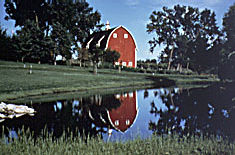
Oh, yea, by-the-way, not everyone in Iowa lives on a farm. My Mom just thought the farm motif was cute. You're not helping to diffuse the stereotype that all Iowans are hicks, Mom.
Black Hawk War Following the Black Hawk War - a conflict that ended in 1832 near present day New Albin - the Sauk and Fox were forced to make their first land cessions west of the Mississippi. The United States government gave the Sauk and Fox a small amount of cash, 40 barrels of salt, 40 barrels of tobacco and some blacksmithing services in exchange for the fertile Mississippi Valley lands of modern-day eastern Iowa. The tribes were ordered out of the area a year later.
Today, the Mesquaki (Fox) Settlement is an area of land around Tama in central Iowa that's governed and owned communally be descendants of the two tribes. The area is not a reservation; the land was purchased back from the government in 1856. Early State Government After white settlement began with the Black Hawk Purchase, Iowa became part of Michigan Territory. When Michigan achieved statehood in 1836, Iowa then became a part of Wisconsin Territory. Finally, two years later, Iowa Territory was carved out of the area of Wisconsin Territory west of the Mississippi River. The first Iowa Territory legislature met in Burlington before a territorial capital city was finally selected in Johnson County. In Iowa City, the government seat was established in a grand structure known today as Old Capital. Built in the early 1940's, Old Capital served as the last capital of Iowa Territory and the first capital of the state. This building serves as a "centerpiece" to the campus of the University of Iowa. Under the 1857 Iowa constitution, the seat of state government was moved to Des Moines, a more central location. Here is a picture of the capital in Des Moines (left) The Governor of Iowa lives in "Terrace Hill" (right) FUN FACTS Education Iowa educated youth have led the nation in SAT and ACT scores for the past two decades. Iowa has three state universities, 62 public and private colleges and 15 community colleges on 28 campuses. Geography and Climate Iowa is centrally located in the heart of North America, a welcoming place to stop and visit. With the Missouri River on the western boundary and the Mississippi River on the east, Iowa is the only state bordered by two navigable rivers. Iowa's four distinct seasons provide a wide range of temperature variation through the year - a perfect place to celebrate summertime sunshine and winter wonders. Industry The largest source of personal income for Iowans is manufacturing, followed by services, retail/wholesale trade and government. 24% of America's pork and 4% of the nation's grained beef are raised in Iowa. Iowa ranks #1 in the nation in grain harvested. Agriculture Producing food, fuel, clothing, and medicine for the world, agriculture is a leading industry in Iowa, a state with more than 100,000 farms. One Iowa farm family grows enough food and fiber to feed 279 people, one fourth of whom live overseas. In the United States, Iowa ranks: first in beef and pork production, first in corn production, first in soybean pro duction, first in grain production. Population The 1994 estimated population of Iowa is 2,830,000. Iowa ranks 30th in population and 23rd in land area. Statehood Iowa became the 29th state on December 28, 1846. Nickname - The Hawkeye State The nickname was adopted early in the state's history. Two Iowa promoters from Burlington are believed to have popularized the name which quite probably came from the great Indian chief Blackhawk. State Tree - Oak The oak was designated as the official state tree in 1961. The Iowa General Assembly chose the oak because it is abundant in the state and serves as shelter, food, and nesting cover for many animals and birds. It is difficult to find a tract of natural woodland in Iowa that does not have in it at least one species of oak. No other group of trees is more important to people and wildlife. Acorns, the nuts of oak trees, are a dietary staple of many animals and birds. Deer, wild turkeys, pheasants, quail, wood ducks, raccoons, squirrels, chipmunks, bluejays, nuthatches, grackles, and several kinds of woodpeckers are a few of the species that depend on acorns for a significant portion of their diet. State Rock - Geode The Iowa General Assembly designated the geode as the official state rock in 1967. Because Iowa is well known of the presence of the geode, it was chosen as the official rock in an effort to promote tourism in the state. Legislators who favored making the geode the state rock pointed out that it is among the rarest and most beautiful of rocks and that Iowa in known worldwide because of the large number found in the state. Other rocks considered for official status were limestone and fossil coral. In Latin, the word geode means earth like. Geodes are shaped like the earth and average about 4 inches in diameter. Geodes are found in limestone formations and have a hard outer shell. When carefully broken open, a sparkling lining of mineral crystals, most often quartz and calcite, is revealed. Geologists attribute the crystal growth to the percolation of groundwater in the geologic past. Southeastern Iowa is one of the state's best geode collecting areas. Geode State Park in Henry County is named for the occurrence of the geode. State Flag and Motto Iowa was almost 75 years old before the state flag was adopted by the General Assembly. Creation of the state flag had been suggested for years by patriotic organizations, but no action was taken until World War I, when Iowa National Guardsmen stationed along the Mexican border suggested a state flag was needed to designate their unit. This prompted the state's Daughter's of the American Revolution (DAR) to design a flag in 1917. The Iowa General Assembly officially adopted the design in 1921. The state flag consists of 3 vertical stripes - blue, white, and red. The blue stands for loyalty, justice, and truth; the white for purity, and the red for courage. On the white center strip is and eagle carrying in its beak blue streamers inscribed with the state motto: "Our liberties we prize, and our rights we will maintain." The word "Iowa" is in red just below the streamers. All schools must fly the state flag on school days. The flag may also be flown on the sites of public buildings. When displayed with the Untied States flag, the state flag must be flown below the national emblem. State Bird - American Goldfinch The Iowa General Assembly designated the American Goldfinch, also known as the eastern goldfinch and the wild canary, of the official state bird in 1933. It was chosen as the state bird because it is commonly found in Iowa and often stays through the winter. Seeds from dandelions, sunflowers, sunflowers, ragweed, and evening primrose are the main source of food for the American Goldfinch (carduelis tristis). In late July or early August, goldfinches build their nests from plant materials and line them with thistledown. The pale blue-white eggs of the bird hatch after two weeks and then, following two to three more weeks, the young birds leave the nest. The top of a male's head is topped with black and their bright yellow body also has black wings and tail. The female has a dull olive-yellow body with a brown tail and wings. The male goldfinch acquires the same plumage color as the females in the winter months. FUN FACTS The geographic center of the state is in Story County. Sabula is Iowa's only town on an island. Eskimo Pies, the popular ice cream treats, were invented in Onwaw in 1920 There are 99 counties in Iowa. Dubuque is the states oldest city. The first public high school in Iowa was in the community of Tipton. Davenport was the site of the first bridge to cross the Mississippi into Iowa. Besides Paris, France, Cedar Rapids is the only other city in the world that has it's government buildings on an island in the center of the city. West Okoboji is the state's deepest natural lake with a depth of 136 feet. The largest Amish community west of the Mississippi River is near the town of Kalona. There are currently 6 covered bridges in Madison County - the most ever was 19. Jerry Mathers, who played "The Beav" on television's Leave It To Beaver, is a Sioux City native. Johnny Carson of late night television fame was born in Corning, Iowa Film star John Wayne was born in Winterset, Iowa. (trivia compiled by Janice Stock, Alan beck, Kevin Beck, Rutledge Hill Press) Nashville TN, 1996. Back To WonderChild's Main Page Back to Shutterbug's Main Page Get Your Free Home Page At
Geography and Climate Iowa is centrally located in the heart of North America, a welcoming place to stop and visit. With the Missouri River on the western boundary and the Mississippi River on the east, Iowa is the only state bordered by two navigable rivers. Iowa's four distinct seasons provide a wide range of temperature variation through the year - a perfect place to celebrate summertime sunshine and winter wonders.
Industry The largest source of personal income for Iowans is manufacturing, followed by services, retail/wholesale trade and government. 24% of America's pork and 4% of the nation's grained beef are raised in Iowa. Iowa ranks #1 in the nation in grain harvested.
Agriculture Producing food, fuel, clothing, and medicine for the world, agriculture is a leading industry in Iowa, a state with more than 100,000 farms. One Iowa farm family grows enough food and fiber to feed 279 people, one fourth of whom live overseas.
In the United States, Iowa ranks: first in beef and pork production, first in corn production, first in soybean pro duction, first in grain production.
Population The 1994 estimated population of Iowa is 2,830,000. Iowa ranks 30th in population and 23rd in land area.
Statehood Iowa became the 29th state on December 28, 1846.
Nickname - The Hawkeye State The nickname was adopted early in the state's history. Two Iowa promoters from Burlington are believed to have popularized the name which quite probably came from the great Indian chief Blackhawk.
State Tree - Oak The oak was designated as the official state tree in 1961. The Iowa General Assembly chose the oak because it is abundant in the state and serves as shelter, food, and nesting cover for many animals and birds. It is difficult to find a tract of natural woodland in Iowa that does not have in it at least one species of oak. No other group of trees is more important to people and wildlife. Acorns, the nuts of oak trees, are a dietary staple of many animals and birds. Deer, wild turkeys, pheasants, quail, wood ducks, raccoons, squirrels, chipmunks, bluejays, nuthatches, grackles, and several kinds of woodpeckers are a few of the species that depend on acorns for a significant portion of their diet.
State Rock - Geode The Iowa General Assembly designated the geode as the official state rock in 1967. Because Iowa is well known of the presence of the geode, it was chosen as the official rock in an effort to promote tourism in the state. Legislators who favored making the geode the state rock pointed out that it is among the rarest and most beautiful of rocks and that Iowa in known worldwide because of the large number found in the state. Other rocks considered for official status were limestone and fossil coral. In Latin, the word geode means earth like. Geodes are shaped like the earth and average about 4 inches in diameter. Geodes are found in limestone formations and have a hard outer shell. When carefully broken open, a sparkling lining of mineral crystals, most often quartz and calcite, is revealed. Geologists attribute the crystal growth to the percolation of groundwater in the geologic past. Southeastern Iowa is one of the state's best geode collecting areas. Geode State Park in Henry County is named for the occurrence of the geode.
State Flag and Motto Iowa was almost 75 years old before the state flag was adopted by the General Assembly. Creation of the state flag had been suggested for years by patriotic organizations, but no action was taken until World War I, when Iowa National Guardsmen stationed along the Mexican border suggested a state flag was needed to designate their unit. This prompted the state's Daughter's of the American Revolution (DAR) to design a flag in 1917. The Iowa General Assembly officially adopted the design in 1921. The state flag consists of 3 vertical stripes - blue, white, and red. The blue stands for loyalty, justice, and truth; the white for purity, and the red for courage. On the white center strip is and eagle carrying in its beak blue streamers inscribed with the state motto: "Our liberties we prize, and our rights we will maintain." The word "Iowa" is in red just below the streamers. All schools must fly the state flag on school days. The flag may also be flown on the sites of public buildings. When displayed with the Untied States flag, the state flag must be flown below the national emblem.
State Bird - American Goldfinch The Iowa General Assembly designated the American Goldfinch, also known as the eastern goldfinch and the wild canary, of the official state bird in 1933. It was chosen as the state bird because it is commonly found in Iowa and often stays through the winter. Seeds from dandelions, sunflowers, sunflowers, ragweed, and evening primrose are the main source of food for the American Goldfinch (carduelis tristis). In late July or early August, goldfinches build their nests from plant materials and line them with thistledown. The pale blue-white eggs of the bird hatch after two weeks and then, following two to three more weeks, the young birds leave the nest. The top of a male's head is topped with black and their bright yellow body also has black wings and tail. The female has a dull olive-yellow body with a brown tail and wings. The male goldfinch acquires the same plumage color as the females in the winter months.