What
is Marine Biology?
Photo by WHOI photographer, Tom Kleindinst
From marine viruses to the blue whale, the smallest to the largest living
creatures in the world are all studied within the realm of marine biology.
But it goes beyond investigating individual plants and animals, for marine
biology entails the study of the interactions of all the marine community's
living organisms to each other and their surrounding environment. This
is
ultimately what the marine biologist is trying to investigate and understand.
The extent of our knowledge is very wide, yet we haven't scratched the
surface with respect to knowing how all of our marine systems interact
and
affect each other. Nor do we have a complete understanding as to what role
and/or impact human activities are having on these dynamic systems.
Within the village of Woods Hole, Massachusetts, known world-wide as a
center for marine research, there is much activity in the field of marine
biology. Some of the specific areas of marine biological research taking
place at the Woods Hole Oceanographic Institution, in the Biology Department
include investigations on organisms ranging in size from microscopic
zooplankton and phytoplankton to whales; pollution, such as nutrient inputs,
toxic wastes and compounds; marine biotechnology; fisheries and aquaculture;
and red tide.
At the Marine Biological Laboratory (MBL), research focuses on the following
sub fields of biology: cell and developmental biology, microbiology,
molecular evolution, neurobiology, and sensory physiology. MBL investigators
study marine organisms--such as sea urchins, squid, horseshoe crabs,
dogfish, toadfish, sea lugs, and sea sponges--primarily because they are
relatively simple systems to study. As such, they make good models for
investigating some of the basic biological processes that are common to
all
life forms, including humans. MBL researchers work with marine animals
to
solve some of today's important medical puzzles, such as: How do tumor
cells
grow? What is the brain's role in vision? How do sperm and egg cells
communicate? Where does alcohol have its effect on nerve cells? What goes
wrong in the nerve cells of Alzheimer's patients?
The MBL is home to the marine resources center, one of the world's most
advanced facilities for maintaining and cultivating marine organisms. One
of
the offerings of the marine resources center is a marine animal supply
service. Through this service marine organisms from waters in and around
Woods Hole can be purchased for scientific research purposes.
Other areas of marine biological research taking place at the various
scientific institutions in Woods Hole include:
1. Marine mammal acoustics (I think this is
SO cool)
2. Sharks and other cartilaginous fishes
3. Red tide events
4. Chemosensory biology and behavioral ecology of lobsters and hermit crabs
5. Coral reef fishes
6. Tidepools
7. Study of recently discovered organisms in hydrothermal vent communities
WHOI Sea Grant Home 
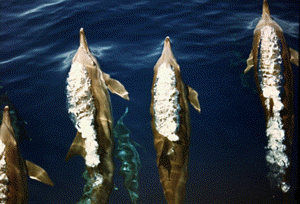
Delphinus
delphis, also known as the "saddleback" or "common dolphin."
Photo
by William A. Watkins. Courtesy of Woods Hole Oceanographic Institution.
Preliminary
research focused on whether or not these creatures could "talk."
Most
people are aware of the high intelligence of these creatures. Could they
be
using
it to communicate with each other much like we use language?
Peter
Tyack, a researcher at Wood's Hole Oceanographic Institution (currently
working
at Stanford University), doesn't think so--at least not yet. He says a
lot
more research has to be done before we can make such a determination. So
far,
most research has not investigated the most important aspects of
language--is
it cognitive and "aware," or is it simply a learned response for
survival?
Says Tyack, "It may make no more sense to compare these [animal] songs
to
language than to compare the marks on a peacock's tail to some strange
hieroglyphic
writing." Instead, scientists are now looking at marine mammal
vocalizations
as an indicator of behavior, and even for recognition of each
other.
First,
a primer on some of the different types of whales. Whales, dolphins and
porpoises
all belong to the taxonomic order Cetacea. All cetaceans more than
several
meters in length (such as the humpback) are called "whales." But the
toothed
whales such as the sperm, killer and pilot whales are much more closely
related
to dolphins and porpoises than to the baleen whales. Dolphins, porpoises
and
toothed whales are all classified together as odontocetes. As the name
indicates,
all odontocetes have teeth. Baleen whales do not have teeth, but
instead
use baleen to filter small prey from sea water. Baleen whales also have
two
external blowholes while odontocetes have only one. Beyond these physical
differences,
scientists have uncovered striking differences between the two
groups
in terms of life history and social organization. This appears to be
reflected
in their communication.
Marine
mammals "vocalize" in a variety of ways, each of them suited to a
particular
behavior or situation. Dolphins, for instance, exhibit two main types
of
vocalization: clicks (~80K) and whistles (~120K). The "clicks"
are used in
echolocation
to find food. Each individual dolphin also has a series of whistles
(like
a Morse code) distinct from any other member of the group called a
"signature
whistle." This signature whistle distinguishes an individual,
providing
a way for dolphins to recognize and bond with others.
Marine
mammals are also very adept at imitating sounds. Hoover, a harbor seal
at
the
New England Aquarium, imitated human speech well enough to have a
recognizable
New England accent. Logosi, a beluga whale at the Vancouver
Aquarium,
was able to imitate his own name. And when one dolphin of the Sarasota
community,
Nicklo, was carried onto a raft to be measured and recorded, it
imitated
another's signature whistle. That of Granny--the oldest dolphin in the
group,
and perhaps the one most familiar with this new situation or most able
to
help
her.
Some
studies have shown that male dolphins might be better at imitating sounds
than
female dolphins. The signature whistles and their imitations of two captive
bottlenose
dolphins named Scotty and Spray at Sealand, a marine park in
Brewster,
Mass. were compared. Not only does a male calf in the wild tend to
learn
his signature whistle by imitating his mother, but also the imitations
of
adult
males appear more precise than those of adult females. The captive male
Scotty
produced more frequent and more accurate imitations than did the female
Spray.
Signature
whistles also differ between the sexes. Female dolphins generally
develop
whistles very different from their mothers, while male dolphin signature
whistles
tend to be very similar to that of the mother. Again, this relates to
social
behavior, as odontocete groups are typically formed of females with their
young,
sometimes spanning several generations. If females had signature whistles
very
similar to their mothers, the members of the group would have difficulty
distinguishing
between the two. Males, on the other hand, leave their natal
group
when they mature and form juvenile groups, which may also contain juvenile
females
in some species. In many toothed whale species, adult males may
associate
with female groups for only a few days at a time. They tend to leave
the
well defined population boundaries for periods of several months.
Like
other toothed whale species, sperm whales also form very stable groups.
They
produce individually specific sounds--but these are very different from
the
whistles
formed by dolphins. Their specific sound takes the form of a short
series
of clicks, called codas (~180K). Also like dolphins and their signature
whistles,
sperm whales can mimic the codas of others.
Killer
whale family groups, called pods, are the most long-lasting of the
odontocete
groups. Individuals around Vancouver Island, British Columbia have
been
identified as members of about 30 groups for over 13 years. These groups
seem
to be made up of related individuals. With low birth and death rates, group
composition
often does not change for several years. Killer whale groups are so
stable,
they have been found to produce a dialect for a sound specific to their
group.
Each killer whale group has a different repertoire of calls, and
apparently
each individual within the group produces each call. "Each pod has
about
a dozen...calls that they use over and over," said John Ford in a recent
televised
interview. Ford is the premiere scientist studying killer whale pods
in
Puget Sound. He has found that pods "share" calls, such as when the "L
pod"
uses
a variation of a "J pod" call.
Although
killer whales have not yet been found to produce an individual
signature
whistle, scientists in British Vancouver have found differences in
dialect
between transient killer whales (who roam the seas) and whales that stay
close
to shore or in one particular area.
Baleen
whales, on the other hand, are solitary animals. The most stable bond is
between
a female and her calf, and this lasts less than one year. Humpback
whales
off Newfoundland feed in groups that are seldom stable for more than a
few
hours. They have several methods for breeding access. They may join in
large
groups
to fight for access to one female. Or, if a male is alone, it may produce
a
long, complicated vocal display called a song (~800K). The song consists
of a
series
of notes and lasts up to 20 minutes before repeating. Since humpback song
is
sung by males primarily during breeding season, it is presumed to be a
song
of
seduction. Humpback songs also change gradually throughout the singing
season.
Sounds may change in pitch, duration and timbre. Specific sounds may
disappear
from the song entirely, and new sounds may appear. Over a twenty year
period,
entire songs are slowly transformed. In contrast, signature whistles of
dolphins
are stable over periods of many years. Tyack compares this change to
the
sexual appeal of a bird with a large repertoire of songs.
How do they hear that?
Sound
travels through water a lot differently than it does through air. Because
water
is relatively more dense, sound travels through it very easily. So easily,
in
fact, that it moves five times faster (at a temp of 20 degrees Celsius,
sound
travels
through ocean water at 1,450 m/s as compared to 334 m/s in the
atmosphere).
Velocity also increases with increasing salinity and temperature.
Although
pressure increases steadily from the surface of the ocean to the
bottom,
the generally dropping temperature below the thermocline (the buffer
zone
between the upper layer of water and the frigid ocean below) more than
offsets
this. Because of this, an area of low-velocity sound transmission exists
at
the base of the thermocline. The refraction of sound waves then causes
sound
to
be trapped in the zone, called a SOFAR (sound fixing and ranging) channel.
Marine
mammals may use this phenomena to a much greater extent than we presently
realize
as a means of long-distance communication. Other animals in the ocean
also
take advantage of this phenomena to transmit sound.
Not
only does sound travel farther and faster (with plenty of interference
and
refraction),
it also travels in all directions! The way that we may identify the
direction
of sound in air is completely lost when we enter the ocean. Instead,
we
hear sounds within our own heads. Marine mammal's "ears" are thus very
different
from ours.
Because
the ocean environment (and the tissue from which sounds are emitted)
change
the vocalizations, the sounds that marine mammals hear may be very
different
from how we interpret sound.
"Whatever
these animals use sound for, the ocean environment is so different
from
the air that we speak. It's highly unlikely that they structure language
the
way we do," says Kirt Fristrup, a WHOI research specialist. "It's under
question
whether or not 'voice' exists underwater. It could very well be that
pressure
in the water actually masks any difference in the (voice-making)
apparatus--in
the tissue that's producing the sound. Animals may not have
'voice'
or individualistic sounds...It's probably misleading to expect that the
quality
of marine mammal sound is anything like the quality of human voice."
Instead,
Fristrup says, the mammals identify through those "learned codes" or
"learned
sequences" of signature whistles and codas. "So that the signature
whistle
pattern that an animal actually learns and uses it to distinguish. So
the
pattern carries the identity rather than the sound."
How
did we hear that?
In
a relatively short period of time, scientists have learned much about the
vocalizations
of marine mammals. They must rely on many technologies to track
and
record marine mammals. Their tools include radio tags, acoustic tags (with
transponders),
satellite tags, hydrophones, and vocalights (developed by Tyack).
Scientists
can get an even more detailed look at marine mammal sounds using
visual
representations of sound called spectrograms.
Hydrophones
are simply microphones equipped to record underwater. Because it is
difficult
underwater to tell from what direction a sound is coming from, four
different
narrow-beam hydrophones (to pick up sound only in certain directions)
are
usually placed in the water at the same time.
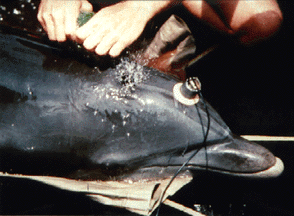
The
different types of tags are simply used to track the movement of animals
during
their dives, when they can't be seen visually or over longer time periods
when
the scientist cannot be physically in the area. Radio tags use radio waves
for
transmission, but these radio waves get scrambled underwater. Acoustic
tags
are
linked to receivers, or transponders, that receive information. But
scientists
must be on site to make recordings. Satellite tags don't require
scientists
to be on site, but they don't provide as precise location data. And
even
when a group of scientists has located and isolated marine mammals, it
is
still
difficult to tell which animal is making which noise. That's why Peter
Tyack
developed the vocalight. This light, when attached to an animal, lights
up
when
that animal makes a noise. Because each light is different, and observer
simply
calls out the color that was lit up to find out which animal was
vocalizing.
Their
search for the role of sound in the everyday lives of marine mammals is
getting
clearer with new technologies, as species and even individuals are
identified.
And scientists get even closer to the meaning and purpose behind
these
otherworldly calls.
"In
humans, the ability to learn sounds is the key to the development of
languages,"
says Ford. Killer whales, with their ability to learn each others
calls,
have hinted at that possibility. Though not quite there yet, "They must
be
on some point toward that road of a true language...And dialect is a good
indicator
that they are progressing toward that state."
For
Further Reading:
Tyack, Peter L. "Animal Language Research Needs a Broader Comparative and
Evolutionary Framework." Roitblat and Nachtigall, eds. Language and
Communication. Lawrence Erlbaum Press: 115-152
Tyack, Peter L. "Population Biology, Social Behavior and Communication
in
Whales and Dolphins." Trends in Ecology and Evolution. December 1986:
144-150.
Watkins, William A. and Douglas Wartzok. "Sensory Biophysics of Marine
Mammals." Marine Mammal Science July 1985: 219-260.