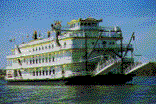
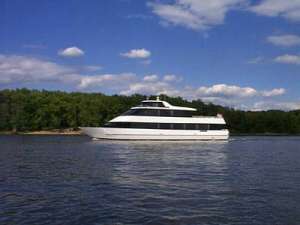
The Mississippi has often been associated with commerce as the barges and tugs move grain and other things north and south along it's waterways. It is also known for paddle boats escorting people in the olden days (ever seen the movie Maverick)? Today we occasionally see restored paddle boats taking folks on tours, or gambling boats parked along it's shores. You may also see huge private cruisers as they travel from one place to another.
My family from several generations back have "grown up on the river". There have been tragedies in that river. The one thing I have been taught that is an absolute necessity when thinking about, playing in, watching that great moving water is respect.
I am lucky because my Grandpa has a boat and both my Mom and Dad and all my aunts and uncles love this river. They talk about respecting the Mississippi too. I guess that's where I learned it, huh? I have gotten to enjoy "playing" in this vast body of water, boating, jet skiing, hanging out on a sandbar, watching the relatives ski (I haven't learned that yet), swimming, or just going for a cruise. I love it!!
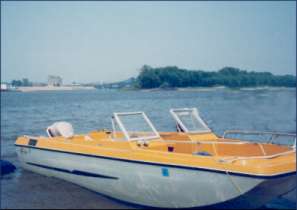
There are a system of locks and dams that allow the Mississippi to become like a giant stairway from the cities of Minneapolis down to St. Louis. The river descends about 400 feet. There are 29 dams along this stretch of river and these serve to hold back water. They start numbering at the north end. There is a dam very close to where we boat on the Mississippi called Lock and Dam 13.
At each dam there is a navigation "lock". These locks run on the idea that water runs downhill. The water levels in the locks are raised and lowered by water flowing through underground tunnels and a valve system. They don't use a pump system.
It's kind of interesting to watch how a lock and dam work especially when it involves a tugboat and it's load of 5-6 barges. It's even more fun to "lock through" a dam which means taking your boat from a lower to higher part of the river.
As you come up to the locks, all boats check with the Lockmaster to see what the status of the lock is. There are only a certain number of water craft that can fit in a lock. There can only be 1 towboat and a maximum of 15 barges but the Lockmaster can create any combination of barges and boats like Grandpa's that will fit in the lock. The boats have to wait for a green light (like a traffic signal) to enter the lock. At times there are all kinds of boats kind of just milling around below the lock waiting for that green signal. The wait can sometimes be long if the Lockmaster knows a towboat and barges are approaching and will want to lock through.
When the light goes green, the boats enter the lock. To keep smaller boats like Grandpas' from bouncing all over, there are ropes on the side of the lock. We hang on to those ropes to stay in one place. Next, the lock door is closed behind us. When the water inside the lock becomes the same level as the water outside the lock, the Lockmaster opens the other gate and everyone goes on their way. We usually go UP river through the lock. The area that you enter when you go north up the river after locking is called a "pool".
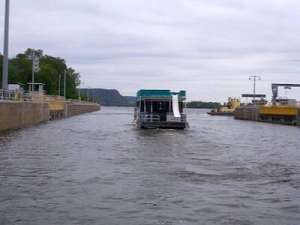
River pools are created when the water flows slowly and accumulates, They can be natural pools due to sediment buildup OR they can be made when a dam is built. There was an original thought that the creation of these pools by dams would allow ships to travel easier on the north part of the Mississippi. Each pool has three parts; upper, middle, and lower. Each of these parts is different and supports different wildlife and plant life.
The lower pool above the lock and dam I know is very, very wide. It looks like a giant lake.
My Mom thought this was interesting so she put it in here. See what you think.
There are 38 different species of fresh water muscles found in the upper Mississippi. The names are really ridiculous: washboard, pigtoe, pimpleback, deertoe, three-horned warty back. The Upper Mississippi is supposed to have the highest concentration in the world. Around the 1900's (about the time I think my Mom and Dad were born), 2.8 million pounds were taken out near LaCrosse, WI per year. Muscatine, Iowa was in the top running for industry leader.
They wanted all these shells for buttons and belt buckles which were then shipped to clothing merchants worldwide.
In the late 1800's and early 1900's there were tent cities set up on shore. Folks would find mussel "Beds" and many hundreds of people would work them. Folks could make $10-$12 dollars a WEEK. Sometimes the entire family would spend the summer dragging long strings with baited hooks attached at intervals along the river bottom. These were called "clam rigs". They were attached to a pole which was used to direct the movement of the rig along the bottom. The mussels would go for the bait and get caught on the hooks.
After they were caught they were put in boiling water which would open their shell. The meat would be scraped out and the shells would be sorted by size and type and put into sacks. They then went to the button factory.
At the factory, disks were cut out of the shells, like cutting cookies from dough. These disks were again sorted by size and color. White was the most common, followed by pink, with the black ebony being the most prized.
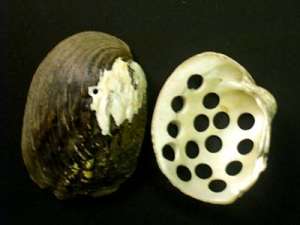
They were then ground to get a standard thickness, since natural shells aren't the same. The last 3 steps were to create an indentation, cut the holes, and polish.
The Wisconsin Pearl Button Company in LaCrosse was the best equipped and largest factory in the United States. It also bought salt water shells to make buttons. Because there wasn't the knowledge of preservation, people over harvested the mussels and the factories closed.
My Mom remembers my great grandma Gert, who was born before the turn of the century had a green bag of loose buttons. I wonder if they came from clams in the Mississippi?
You can still find those kind of clams on the beach and on the floor of the Mississippi and once in awhile you might be lucky enough to find a shell with the holes drilled for buttons from long ago.
