The
Marshal Vauban WebsiteThe
Marshal Vauban Website
The
Marshal Vauban WebsiteThe
Marshal Vauban WebsiteMaintained by : Chris Jones of Altofts, Wakefield, U.K. © September 1997
This page created : 28 September 1997
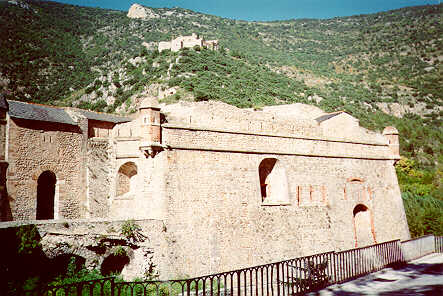 Villefranche-de-Conflent is
one of the most interesting of all the many sites fortified by
Vauban. In many respects it was a unique project.
[Click on image right to see a view of the town from Fort Liberia - seen here in the middle distance behind the Dauphin Bastion]
Villefranche-de-Conflent is
one of the most interesting of all the many sites fortified by
Vauban. In many respects it was a unique project.
[Click on image right to see a view of the town from Fort Liberia - seen here in the middle distance behind the Dauphin Bastion]
The town stands at the confluence of the rivers Cady & Têt and nestles at the foot of steep-sided mountains. Immediately to the south of the town the slopes have a generous covering of trees, to the north the face of Mt Belloc is bare and rock-strewn. However, all the surrounding mountain-sides gave excellent vantage points for rebel Miquelet snipers to pick-off the townspeople below.
Accordingly, when Vauban was charged with devising a scheme to upgrade Villefranche's medieval defences he found the town's unusual situation posed some difficult questions. Exhibiting his characteristic genius for tailoring fortress design to the needs of each site - rather, like most of his contemporaries, being a slave to convention - he hit upon some novel solutions.
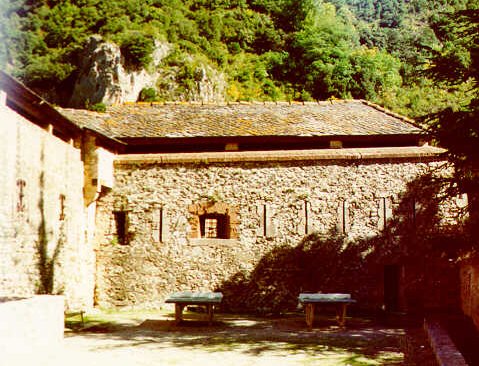 First Vauban strengthened and then heightened the existing walls.
The old medieval parapet became gallery within the body of the
walls. This had firing slits and due to the gallery being completely enclosed within the walls allowed defending troops to deploy musketry
fire with only the remotest likelihood of being hit by enemy snipers.
To the top of the walls, above the wide and expansive new parapet known as
the watch path, he added an immensely strong sloping roof, composed
primarily of sturdy timbers [see image right; Corneilla bastion viewed from within the "fausse braye"]. So once again, apart from artillery
shot, the defenders atop the wall had little to fear from enemy
fire.
First Vauban strengthened and then heightened the existing walls.
The old medieval parapet became gallery within the body of the
walls. This had firing slits and due to the gallery being completely enclosed within the walls allowed defending troops to deploy musketry
fire with only the remotest likelihood of being hit by enemy snipers.
To the top of the walls, above the wide and expansive new parapet known as
the watch path, he added an immensely strong sloping roof, composed
primarily of sturdy timbers [see image right; Corneilla bastion viewed from within the "fausse braye"]. So once again, apart from artillery
shot, the defenders atop the wall had little to fear from enemy
fire.
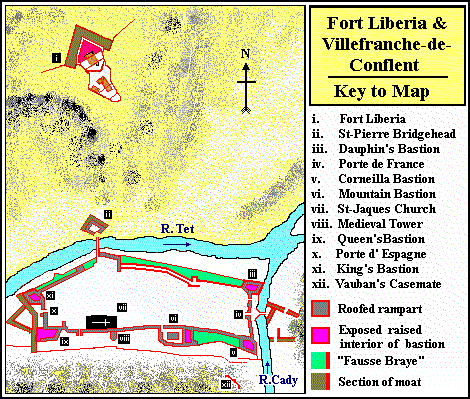 After razing some of the medieval towers adjoining the town
walls, Vauban added six bastions [see diagram; NB I count
the fortifications comprising the St. Pierre bridgehead as a bastion].
After razing some of the medieval towers adjoining the town
walls, Vauban added six bastions [see diagram; NB I count
the fortifications comprising the St. Pierre bridgehead as a bastion].
The Mountain bastion - from the topography of the site the one least likely to face enemy artillery fire - houses Villefranche's powder magazine. It is shown on the map to the left here. As one would expect the magazine was an entirely free-standing construction.
The Queen's Bastion is particularly interesting. Although not roofed over like the others, it's parapet wall rises so extraordinarily high above the level of the cannon embrasures as to effectively provide the bastion's occupants with overhead protection.
In front of the main walls, connecting the capitols of three pairs
of bastions [i.e. Kings & St Pierre, St Pierre & Dauphin,
and Corneilla & Mountain], Vauban built additional walls.
These are of large stone construction, about 8 feet high, and
loopholed for infantry defence. The openings in the wall between
the Corneilla and Mountain bastions are so acutely angled as to
permit the defenders to fire out along the face of the wall, rather
than perpendicular to it.
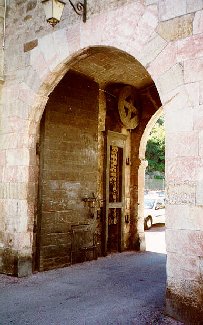 Vauban also added outworks in front of both the Porte de France
& Porte d'Espagne. These however no longer exist. The two gateways named
were also refurbished during Louis XVI's reign as monumental
gateways. However, the machinery for raising the drawbridge at
the Porte d'Espagne is well preserved and can be seen in the picture
on the left here [which also shows off the pleasant pink Conflent marble used in the construction of parts of the walls].
Vauban also added outworks in front of both the Porte de France
& Porte d'Espagne. These however no longer exist. The two gateways named
were also refurbished during Louis XVI's reign as monumental
gateways. However, the machinery for raising the drawbridge at
the Porte d'Espagne is well preserved and can be seen in the picture
on the left here [which also shows off the pleasant pink Conflent marble used in the construction of parts of the walls].
There was another small scale outwork, designed by Vauban, which does still exist. Within the mountain to the South of the town, opposite the aptly named Mountain bastion, are to be found numerous natural limestone caverns. A broad stairway of 124 steps was cut into the mountain to allow access to a significant cavern system - the Cova Bastera - which is about 75 - 100 foot above the valley floor. Working along these caverns it proved possible to reach a small opening overlooking the southern approaches to the Porte de France. Vauban planned to have this converted into a casemate for two artillery pieces that could command the road below them. This work was carried out after Vauban's death, along with the construction of a powder magazine which he had sketched plans for [replaced by a later magazine built in 1838]. Finally, to ensure the gunners were secure from the rear, a series of intricate loopholed doorways were constructed at strategic points along the cavern. Added impetus for this work was provided by the Conspiracy of Villefranche which occurred between Vauban's first and second visits. The rebels used the caverns as a launch pad for their attack on the town - see the "Villefranche-de-Conflent Timeline" further down this page.
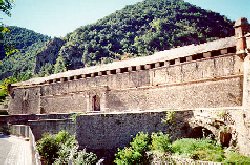
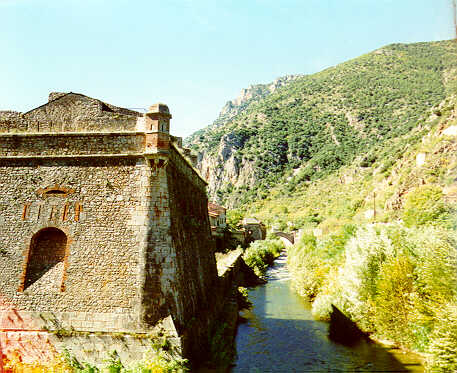
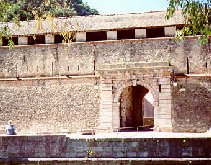 Above Left: The Front de Paris The Corneilla bastion is at the extreme left of the picture. Above Centre: The Dauphin bastion & looking upstream [westwards], along the river Tet, towards the St. Pierre bridgehead. The foot of Mt. Belloc is seen to the right. Above Right: The Porte de Paris. The line of the old, medieval, parapet can be made out - level with the top of the gate. You can also see some of the firing slits cut into the gallery formed around the old parapet.
In addition to the town walls, bastions and outworks, Vauban also constructed a detached fort up on Mount Belloc. This was achieved in order both to dominate the town [in the event of it's loss to the enemy or any repeat of the Conspiracy of Villefreanche] and to deny to any enemy the opportunity to do likewise. This very impressive detached work is called Fort Liberia [hereinafter termed "the fort"].
The fort [click left to see schematic diagram] is located on a rather steeply sloped part of the mountain. And in order that it is not dominated from the surrounding ground it is executed on three levels [a fourth was added later at the lower end of the fort]. The fort is therefore significantly higher at it's top end than the lower.
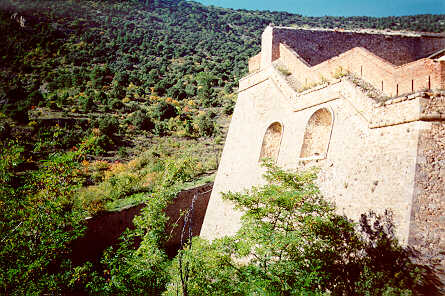 The upper two sections of the fort are shaped like a large broad-beamed ship, with pointed prow & stern. The top section is surrounded by a deep
moat. The image on the left shows the exterior of the middle part, the moat & counterscarp are just visible beyond.
There is no covered way or glacis extending from
the counterscarp [further evidence Vauban was no slave
to convention] but it does have a counterscarp gallery allowing
the defenders to deliver reverse cross-fire
back into the moat. Access to the gallery
is gained, ingeniously, via caponniers which truncate each end
of the moat and which themselves allow fire to be delivered along the
foot of the walls that form the middle & lower portions of the fort.
The upper two sections of the fort are shaped like a large broad-beamed ship, with pointed prow & stern. The top section is surrounded by a deep
moat. The image on the left shows the exterior of the middle part, the moat & counterscarp are just visible beyond.
There is no covered way or glacis extending from
the counterscarp [further evidence Vauban was no slave
to convention] but it does have a counterscarp gallery allowing
the defenders to deliver reverse cross-fire
back into the moat. Access to the gallery
is gained, ingeniously, via caponniers which truncate each end
of the moat and which themselves allow fire to be delivered along the
foot of the walls that form the middle & lower portions of the fort.
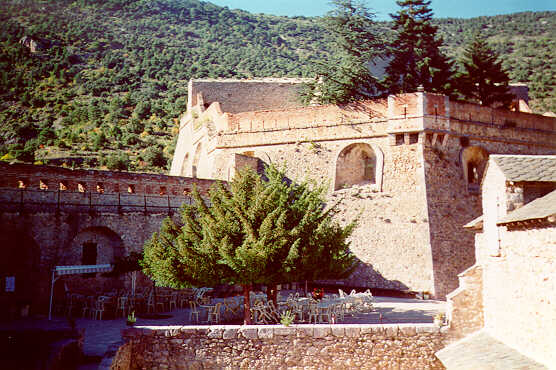 The fort was bisected at a number of points by high, broad, dividing
walls [only one of these remain - it can be seen clearly in the images above and to the right]. These would allow the defenders
an additional opportunity of containing any enemy encroachment. Just as importantly these buttress type affairs - which were a common feature of Vauban's work
- provided something of a remedy to the deadly ricochet fire
which Vauban himself had invented [whereby a battery would be cited
so as to fire right down the line of a rampart; the charges in
the guns being reduced so as to cause their shot to bounce along it's entire length,
smashing everything in the way].
The fort was bisected at a number of points by high, broad, dividing
walls [only one of these remain - it can be seen clearly in the images above and to the right]. These would allow the defenders
an additional opportunity of containing any enemy encroachment. Just as importantly these buttress type affairs - which were a common feature of Vauban's work
- provided something of a remedy to the deadly ricochet fire
which Vauban himself had invented [whereby a battery would be cited
so as to fire right down the line of a rampart; the charges in
the guns being reduced so as to cause their shot to bounce along it's entire length,
smashing everything in the way].
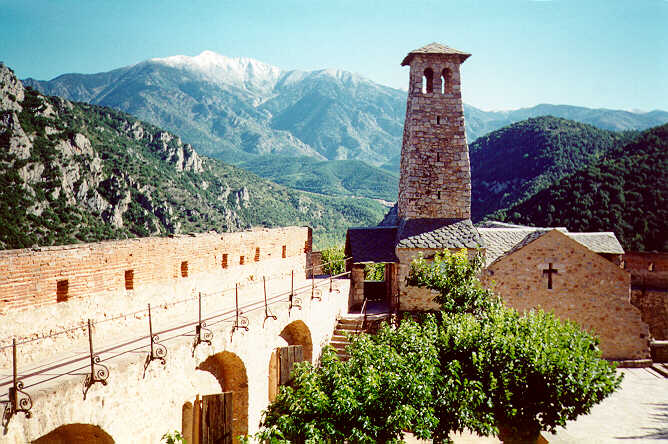 The fort boasted barrack accommodation for up to 100
men - which included ample quarters for the commander of the place and his officers - a
bakery, a sizeable water cistern, and even it's own chapel [seen here on the left in a photograph taken from the wall which divides the middle and lower portions of the fort, looking down at the lower part and off towards the very impressive Mount Canigou in the distance].
The fort boasted barrack accommodation for up to 100
men - which included ample quarters for the commander of the place and his officers - a
bakery, a sizeable water cistern, and even it's own chapel [seen here on the left in a photograph taken from the wall which divides the middle and lower portions of the fort, looking down at the lower part and off towards the very impressive Mount Canigou in the distance].
Vauban was in the habit of designing the buildings that stood within his fortifications in such a way as to remain in keeping with the architecture of the region. Those he designed for Fort Liberia are no exception. They would certainly not offend the aesthetic sensitivities of the Catalans.
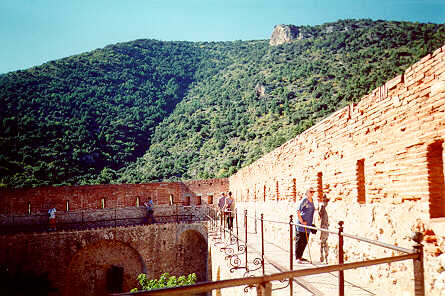 The artillery complement for the fort comprised two 12 pounder cannon
[where poundage equals the weight of iron shot the gun fired],
two 8pdrs and six 4pdrs. Each was supplied with 200 rounds
of shot. There were numerous embrasures cut into the fort's walls, from which the guns could fire. These were set level with the floor of the fort as the parapets were wide enough for soldiers only. The image on the right shows the parapet at the very top of the fort ["the prow" as I have termed it]. It can be seen there is no space to mount cannon. Just discernable below are some of the cannon embrasures. These were closed-off with wooden doors when the guns were not being fired.
The artillery complement for the fort comprised two 12 pounder cannon
[where poundage equals the weight of iron shot the gun fired],
two 8pdrs and six 4pdrs. Each was supplied with 200 rounds
of shot. There were numerous embrasures cut into the fort's walls, from which the guns could fire. These were set level with the floor of the fort as the parapets were wide enough for soldiers only. The image on the right shows the parapet at the very top of the fort ["the prow" as I have termed it]. It can be seen there is no space to mount cannon. Just discernable below are some of the cannon embrasures. These were closed-off with wooden doors when the guns were not being fired.
 The fort's magazine held some 12,000 pounds of powder and a
sufficient quantity of lead to make all the pistol & musket shot the garrison would require. As stated earlier, each gun was provided with 200 rounds of ammunition. This would have been predominantly solid shot, although there would have been a significant amount of grape shot as well.
The fort's magazine held some 12,000 pounds of powder and a
sufficient quantity of lead to make all the pistol & musket shot the garrison would require. As stated earlier, each gun was provided with 200 rounds of ammunition. This would have been predominantly solid shot, although there would have been a significant amount of grape shot as well.
The fort was also provided with a quantity of tar [?], and there was a crane for use in mounting cannons on their gun carriages. Finally, the garrison was also equipped with some 36 wall pieces [large calibre wall-mounted muskets] - i.e. in addition to the soldiers' personal weapons.
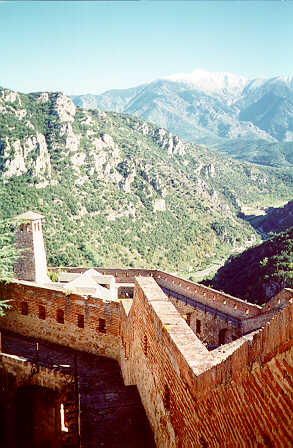
Left: View from middle section of the fort. Just visible in the bottom left of the image is the gateway leading to the lower part of the fort. Very near here also, and within the middle portion of the fort, are the staircases that lead down to the capponiers traversing the moat.
1090   Villefranche-de-Conflent is founded by Guillaume Raymond, Count of Cerdagne.

1117   Authority over Villefranche passes to the Counts of Barcelona.

1276   Creation of the Kingdom of Majorca [destined to be short-lived].  It's capital
       is Perpignan & it's rule extends over Villefranche.

1344   End of the Kingdom of Majorca.  Villefranche passes to the Kingdom of Aragon.

1463   Villefranche becomes French for the first time, under Louis XI.

1493   Guardianship of Villefranche passes to the Kingdom of Castille.

1613   Wars of Religion - Villefranche & Perpignan on opposing sides.

1654   Villefranche suffers a six-day siege after which it is captured and then
       sacked by the French.

1659   Under the Treaty of the Pyrénées the province of Catalunia is partitioned.
       France takes possession of the portion North of the Pyrénées - which includes
       Villefranche - and Spain the portion to the South.

1661   The French & Spanish hold a conference at Céret to properly delineate their
       mutual border on the Pyrénées.

1662   Secret talks between Louis XIV and the Spanish Government, the purpose being
       to negotiate an exchange of territory - Spain to acquire Roussillon, & France
       the Spanish Netherlands [Belgium].  Nothing comes of the talks.

1663   Renewed hostilities with Spain.

1667   French under Douvrier repulse Spanish raid at Bellegarde.

1669   Vauban makes his first tour of Roussillon; he visits Perpignan, Collioure,
       Bellegarde & Villefranche - the last named having recently been designated a
       permanent garrison for French troops [projected at 500 in peacetime, 1,500 to
       2,000 in times of trouble].  Vauban sets about improving the medieval
       defences of Villefranche, also drawing up plans to build a detached fort a
       short distance to the north of Villefranche, up on Mount Belloc, to occupy
       the heights that dominate the town.

1674   As part of a struggle lasting until 1719, some of the inhabitants of
       Villefranche and the surrounding region rebel against the French Crown.  They
       seek to be re-united with their Spanish brethren.  In the "Conspiracy of
       Villefranche", timed to coincide with a Spanish raid on Bellegarde, Inés de
       Llar, a young woman of one of the leading pro-Spanish families seeks to
       subvert the town's garrison by using her feminine wiles on the commander De
       Parlan de Saignes.  While de Saignes is unmoved by her advances the town
       nevertheless falls to a rebel assault and the garrison is massacred.
       However, before the rebels can consolidate their gains the crown regains
       control of the town.  Inés de Llar escapes to Spain but many of her
       co-conspirators are captured, tried and executed.  The unfortunates tortured
       remains are quartered & exposed on the town walls in iron cages as an example
       to other would-be rebels.

1679   Vauban's second tour of Roussillon, this time as Commissaire général des
       Fortifications.

1680   Vauban makes a third voyage to Roussillon, accompanied by the Chief Minister
       Louvois. They visit all the important sites of the region including
       Villefranche.

1681   Villefranche seemed to some to become secondary to the defence of France with
       the inauguration of the fortress of Mont Louis.  However, and if any evidence
       were needed of Villefranche's continued importance, construction of Vauban's
       detached fort up on Mt Belloc is commenced.

1687   Vauban makes his last tour of Roussillon.

1707   Vauban dies in Paris.

1793   With the defences in a poor state and with an weak garrison, Villefranche
       falls after offering only very limited resistance to an invading Spanish
       force.  Later the same year the town is retaken by the French under the
       command of the Sans Culotte General Dagobert

1850   Three year's work begins to link the town's defences with Fort Liberia up on
       Mt Belloc.  Some 70% of the distance between the two is covered by
       subterranean works, including the "stairway of a thousand steps" [734
       actually].  An "Intermediary Battery" is also constructed on the mountain,
       halfway between town & fort.

1890   Villefranche ceases to be a garrison town of the French Army

1918   The last detachment of the French Army vacates Fort Liberia.