Home Previous Next
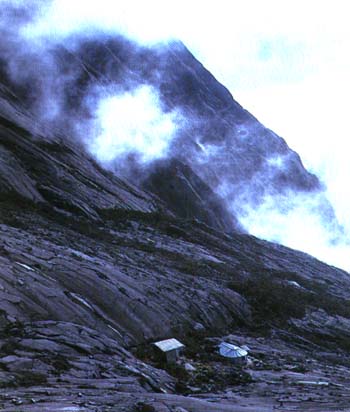 From Panar Laban the path follows another gully up to Sayat-Sayat, named after the abundant 'sayat-sayat' or Leptospermum bushes. At 3,810m (12,500ft) this is the highest place on the mountain where one can stay. A lovely white-flowered orchid, the Mountain Necklace Orchid (Coelogyne papillosa), covers the rock crevices like drifts of snow when in full bloom in November. 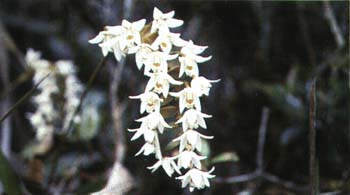 |
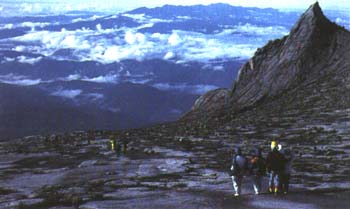 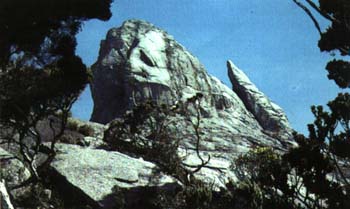 Beyond Sayat-Sayat begins the Summit Plateau itself - a vast expanse of grey granitic slopes. Granite is a rock composed of various minerals which differ in their resistance to erosion and weathering. The result is a distinctive rough pitted surface. speckled with white, grey and black. Cairns mark the trail that leads slowly upwards between South Peak and St. John's Peak on the left and the Donkey's Ears and the Ugly Sisters on the right. The Summit itself. Low's Peak, is not visible until the upper part of the Summit Plateau is reached. The geological history of Mt. Kinabalu, goes back some 9 million years when the granite core was solidifying beneath the earth's crust. Less than one million years ago this granite massif was forced upwards through the crust and is now exposed as the result of the removal, by erosion, of thousands of feet of overlying sand and mudstane rocks. During the Ice-Age, 10,000 to 100,000 years ago, the summit area was covered by a shining cap of ice, with a major glacier flowing north down Low's Gully and minor glaciers to the east, south and west, gradually smoothing out the Summit Plateau except for the jagged peaks that stood out above the ice |