visit my homepage ...

 Click here for the German version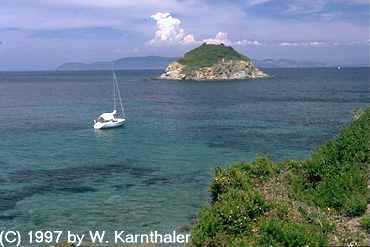
Cavo
Just 17 miles long and 11 miles wide, Elba could be considered the little sister of Corsica and Sardinia, but it is just as interesting as those two islands. Elba's mountains and hills, the cliffs surrounding its sand and gravel bays, and its small picturesque villages make Elba much more similar to Corsica than to Sardinia. You could call Elba "Little Corsica", but in view of the number of tourists, this fact isn't quite accurate. In high summer Elba is completely booked out.
W hen it comes to scuba diving, opportunities in Elba are comparable to those in Corsica or Sardinia, with an underwater world almost as rich and varied as those of the neighbouring islands. Besides enormous red stony corals and red, yellow and white Sea Fans Elba has a wide variety of typically mediterranean animals - and plants. I can vouch for this myself, having chartered a vessel and done a lot of diving on my own off the island.
A peninsula called Lacona, in the south of Elba. is an ideal base for scuba diving. There are lots of exciting sites within a few nautical miles, including Capo di Stella, Isola Gemini, Isola Corbelli, Capo di Fonza, Sc. di Triglia (the "Madonna") and the wreck of Pomonte.
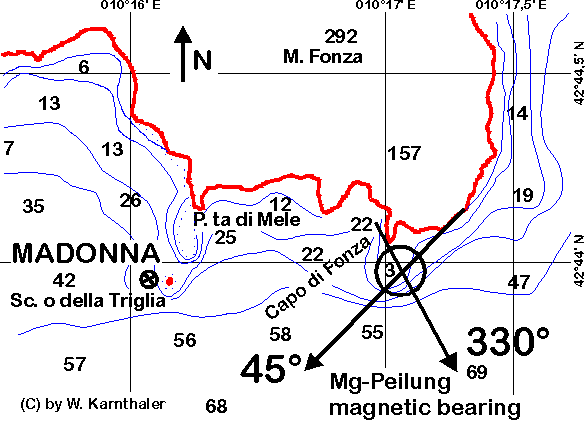
| Capo di Fonza
reef in front of the cape: 42° 43,97N, 010° 17,06E |
chart with bearing |
anchorage instructions: on top of
the reef
depth: 100 feet, decreasing down
to the ground at 150 feet
diving: surrounding the reef, starting
in NE. A cave with an opening to the top of the reef can be found in the
NE. Red corals are in some small caves, tube worms and yellow Sea Fans
can be found too.
| Sc. di Triglia (die "Madonna")
the big rock: 42° 43,93N, 010° 16,14E |
chart |
anchorage instructions: if the current
isn't too bad 30 feet north of the big rock.
depth: 60 feet
diving: starting at the anchorage
instructions with bearing 270°, 150 feet distance to the Madonna. You
can find the Madonna at the coordinates 42° 43,93N, 010° 16,11E.
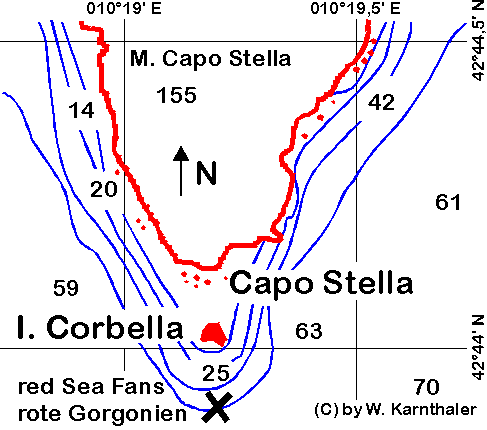
| Capo di Stella/ Isola Corbella
Isola Corbella: 42° 44,02N, 010° 19,19E |
chart |
anchorage instructions: at a depth
of 15 feet in a small bay E of the rock
depth: 135 feet
diving: at shallow depth in south
direction to the drop off, following to the ground. You can see there huge
Sea Fans (6 feet) and if you are lucky you may also catch sight of ST.
Petersfish.
| Isola Corbelli
coordinates: 42° 42,78N, 010° 21,67E |
chart |
anchorage instructions: at a depth
of 15 feet in a distance of approximately 50 feet E of the big rock
depth: 75 feet
diving: along the compass bearing
of 300°. At this place you can find many small animals such as Sea
slugs.
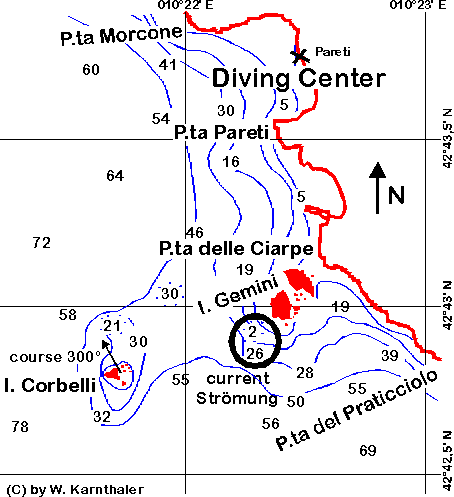
| Isola Gemini
coordinates: 42° 43,00N, 010° 22,39E |
chart |
anchorage instructions: SW of the
Isola Gemini in front of a reef which rises out of the water (42° 42,92N,
010° 22,28E), at a depth of 36 feet.
depth: 60 feet
diving: surrounding the small reef
starting from NE or SW. Attention! Normally this place is predominant by
a strong current. Choose the direction of surrounding the reef in that
way you are able going back to the boat easy, because you will be blown
off course! Many fish can be seen there.
Diving Centers nearby these diving venues:
|
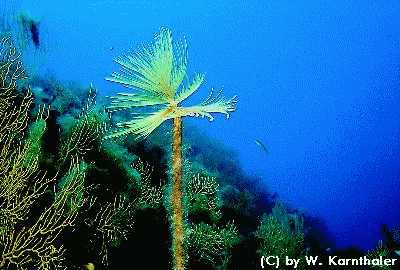
a tube worm called "Spirographis spallanzanii" in a depth of 90 feet
Yellow Sea Fan (Eunicella cavolinii)


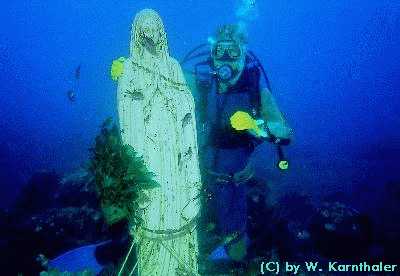
MADONNA and ME
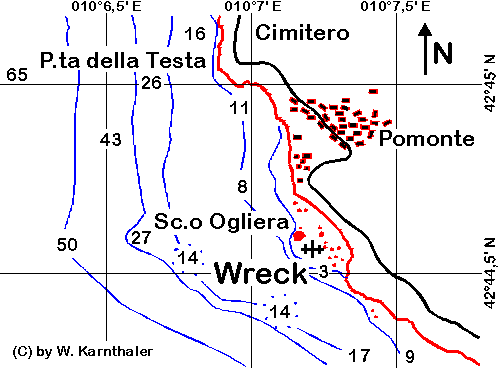
T he wreck of Pomonte (42° 44,58N,
010° 07,20E) lies about 60 feet from a rock in shallow waters near
the village of Pomonte. The maximum diving depth is 40 feet. As it is in
such shallow water the site is ideal for long dives and underwater photography.
The Italians favour this so-called "Relitto" for snorkeling, and I found
it a great place to take underwater photos.
click here for a chart
The Wreck of Pomonte

© 1996 by W.Karnthaler. All Rights Reserved..
No part of this publication may be reproduced, stored
or printed without the permission of the author.
 Get your own Free Home Page
 more information
about:
more information
about: