Special
Notes On Species
This page deals
with birds on a species to species basis. Special needs,
information, and caring strategies are offered to give you a
better idea of what it is that you can do for your bird. I have
listed information for the most common species that are found by
visitors to my site. If your species is not here and you wish to
find out more about it, feel free to emailme.
To review what
is meant by the term "Hard Pen Time",
it is simply the amount of time, after the bird has fledged,
where they must be kept before release. It does not mean you have
to have a 'pen' of some sort. Once the bird has made his first
real flying attempt, count that as day "One" of the
'hard pen time'. Set him up in a cage, aviary, or his own room,
and use this time to promote as many natural skills and behaviors
as you can.
------------------------------------------------------
Please select
the species that interests you from the box below.
------------------------------------------------------
| Hard Pen Time: 2-3
weeks Basic Adult Diet: Seeds, grain, nuts,
fruits and some vegetable matter, insects.
|
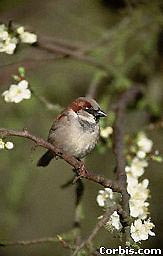 |
There are few
extraordinary needs for this resilient and hardy species. When
released, be sure to provide food at a familiar place in your
yard for a couple of weeks. They quickly lose their tameness.
Starling
Hard Pen Time: 3
weeks
Basic
Adult Diet: Seeds, grains, berries and other fruit, insects.
Young starlings
have an almost insatiable appetite. They can also be very loud
and demanding. Once they have fledged, they are intensely
curious. Watch for their safety.
They usually
require that you steadily provide them with food (fruits,
vegetables, bread products, etc) for several weeks after they
have been released. A little formula can be given during the
first few days as a treat.
Blue Jay, Crow
Hard
Pen Time: 1-2 months
Basic Adult Diet: Nuts, grains, fruits
and some vegetable matter, insects.
|
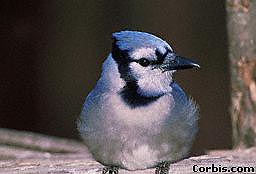 |
Blue Jays and
Crows are very social, resourceful, and intelligent birds. They
often live in family groups within a specified territory. It is
in these family groups that young jays and crows learn much of
what they need to know to survive.
These species tend
to have extreme difficulties coping on their own when handraised,
and this can be a deadly state of affairs. Not only must they
have others from which to learn about survival from, but there is
also the fact that when young birds of this group are released
and they meet other members of their own kind, they are often
attacked outright as intruders of the territory. These attacks
can occasionally be fatal, but more commonly, the local wild
group will prevent the birds from returning to its human
caretakers, possibly the only source of food, shelter, and yes,
comfort, the young bird knows.
Jays and crows
definitely need to become familiar with your backyard before they
are released. Even a makeshift aviary will serve this purpose,
and they should be left in it for most of the day at first, and
eventually spend the nights in them as well. Make sure the aviary
is protected from full sunlight, as well as any harsh weather. If
you do not have or cannot make an aviary, bring them outdoors in
a cage often, but remember to alternate this with flying practice
indoors.
These birds must
be released very slowly, and they are the only group in which I
recommend a prolonged care period during release. These birds
should never simply be let go without subsequent and continued
supervision. If after the first day of release, the bird returns
in an agitated state, you may return him to his familiar home
(aviary or in the house, as the case may be) for the night, and
feed him if necessary. And this can be repeated for some time if
it is needed.
Jays and crows
that have been handraised with siblings, while still vulnerable
to the attacks of others of their kind, are somewhat better able
to cope due to the fact that they have each other for support.
Professional rehabilitators, by virtue of raising so many birds,
can house them with others of their kind, providing them with a
surrogate family.
It is not
impossible for these birds to return regularly for up to year,
expecting food and comfort from you. Provide a well-stocked
feeder for them. You may maintain a relationship with them, but
remember that you are supposed to be promoting their independence
as well.
Care must be taken
that they are released well before the cold season so that they
have adequate time to prepare for it. Blue jays are said to
sometimes migrate, though the ones around my place do not
(Quebec). It is likely that a handraised jay will not migrate and
will continue to return to your feeder. If he is otherwise in
good health, the cold will not harm him.
Hard
Pen Time: 3 weeks
Basic Adult Diet: Grains, nuts, fruits
and some vegetable matter, insects.
|
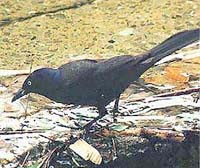 |
A generally hardy
bird, but needs to be raised on a good diet since they are even
more prone than other birds to nutritional disorders. Because of
this, the Macleod's Passerine Diet is even more strongly recommended. Make
sure that the bird is getting enough food, since this species is
less vocal than other nestlings. Often returns for handouts once
released.
If grackles are
given a substandard diet, their feather condition becomes
inadequate for them to survive outdoors. The feathers produced
are weak, and do not intermesh properly. This hinders flying
ability and reduces the insulating properties of the plumage. The
damage is often not visible, and only disappears during the next
molt, if the cause(s) of the damage has been removed.
For a similar
reason, grackles should not be touched by human hands. The oils
from our hands erodes the protective waxes and oils on their
feathers quickly, again robbing them of their flight and
insulating properties until the next molt. Gloves are recommended
for handling the bird when necessary.
Hard
Pen Time: 3 weeks
Basic Adult Diet: Seed, grains, corn.
|
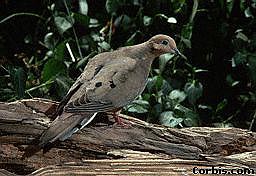 |
Please see the 'Recipes' page for special notes on feeding and
diet. Though commonly thought of as "gentle" birds,
when hand raised these birds can sometimes become aggressively
demanding. The wing joints are hard and knobby, and they can
deliver very strong blows by slapping with their wings. Caution
is recommended since these blows could dislocate a finger.
During the hard
pen time, provide shelves as well as thick branches for the birds
to roost on. They prefer these to regular perches. They will
often roost on the ground as well.
Doves and pigeons
are well-known carriers of Trichomoniasis, a
parasitical disease which is contagious to other birds, and
perhaps(?) to humans. Any lesions, inflammation, or 'slime', in
or around the mouth, nose, or beak, is suspect. The disease is
fatal if untreated.
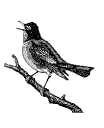 |
| Robin |
Hard Pen Time: 3
weeks
Basic
Adult Diet: Berries and other fruit, worms, insects.
Robins are fairly
easy to raise (for a wild bird), and revert to their wild state
quickly after release. Should be offered one or 2 small garden
caught earthworms each day during the hard pen time to become
familiar with them. Do not use "fishing worms" from
fishing supply stores, as these are often treated with growth
hormones, and are too big anyway.
***
Please note - Robins are believed to be carriers of the West Nile
Virus. They do not die from it. Extreme caution is recommended
when dealing with these birds, as they can easily transmit the
virus to a person.
House Finch
Hard Pen Time: 3
weeks
Basic
Adult Diet: Seeds, grains, fruits and some vegetable matter,
insects.
Finches are
generally timid birds, so keep stress levels down. (quiet room,
no visitors, etc.) Compared to other species, they can take a
long time to become free feeding once fledged. DO NOT release a
finch until you are sure that it can eat seeds, etc. on its own,
and is completely weaned from the formula. Provide a feeder in
your yard for a sure source of food.
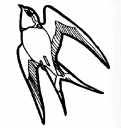 |
| Swallow |
Hard Pen Time: 1-1
1/2 weeks
Basic
Adult Diet: Flying insects.
Swallows should be
released once they are capable of sustained flight. (usually
about one week or so after they have fledged) Since they need a
large area to practice their flying skills, unless you have a
very large aviary (10 feet cubed), swallows should be given a
safe room to fly in. Make sure to remove any objects which could
fall or otherwise injure the bird should he knock into them, and
cover the windows with dark drapes. (flying into windows often
kills them)
A tight rope with
a diameter of around 1/4" should be hung high in the room,
from wall to wall. This will provide a roosting spot. Should a
swallow fall to the ground, he will not be able to regain his
flight without your assistance.
Swallows need to
be fed formula until they are released. Their adult diet consists
of flying insects, which you will not be able to provide in
sufficient quantity. Be assured however that once released, he
will instinctively know how to catch such insects on his own.
Swallows often
return for handouts for a couple of weeks after release. Be sure
to provide a tight cord to land on, which should be about 5 feet
above the ground, and at least 10 feet long.
Chimney
Swift
Hard Pen Time: 1
week
Basic
Adult Diet: Flying insects.
Chimney swifts are
excellent climbers, and should be returned to the chimney. Place
them on the "wall" of the chimney, somewhere above the
flue. Make sure they have a good grip. Check every few hours to
make sure they are no longer there, which means they will have
begun their journey back home. DO NOT simply place them in the
fireplace. They need to have a good vertical
grip to move and climb.
If nestlings
continually fall out of the chimney, this could suggest a health
problem with the birds, or a problem with the chimney itself.
Chimney swifts can
be prevented from nesting in the chimney by using special
screenings that are sold for this purpose. Or you could foster
their survival by simply deciding not to use the fireplace
between April and September. This is also not a good time to have
the chimney cleaned.
If nonetheless you
find yourself having to care for a swift yourself, they require
that some special needs be taken into consideration.
Nestling chimney
swifts need the option to roost horizontally or vertically (more
often the latter). A wooden box is necessary, and the wood must
be very rough so that they can get an adequate grip. Line the box
with cloth, making sure the whole bottom is covered. Place a
heating pad under (not in) the box, and adjust the setting so
that it will keep a temperature between 85-90 degrees F. inside
the box. (Measure the temperature by placing a thermometer at the
bottom of the box) Chimney swifts are very sensitive to cold.
To prevent
escapes, the box should be covered with a screen. A thick dark
towel must be placed over the whole setup, leaving an inch or so
for air.
Once fledged,
unless you have a very large aviary (10 feet squared or more),
swifts should be allowed to fly free in an enclosed room during
the whole of the hard pen time. Provide vertical perches such as
pieces of rough wood hanging from the wall. Chimney tubes or
similar are also recommended. Their flight is very energetic and
fast, so make sure there are no obvious dangers. Remove objects
which could fall, and cover the windows with dark shades (flying
straight into windows will often kill them) Chimney swifts that
land on the ground cannot take off again, and will require your
assistance to become airborne.
Chimney swifts
will need to be fed formula until they are released. Their
natural adult diet is flying insects, which you will not be able
to provide in sufficient quantity. However, once free, they
instinctively know how to catch their food.
The main point of
the hard pen time for swifts is to build stamina before they take
their first flight out of the chimney. Before the wings are
anywhere near ready for flight, the babies hang onto the wall and
flap their wings until they are exhausted. Once they have
fledged, it's very important for them to practice short hops (in
the chimney they would go from one side to another) in order to
get good at controlling landings. When they have fledged, they
have to be very careful about coming back into the chimney so
they don't hurt themselves or another bird. It is also vital that
they can "near-hover" before they are released, meaning
not quite hover but dang close to it. Once they can do this, you
can release them.
Chimney swifts
often return for handouts, so make sure to provide a vertical
perching spot where you can feed him if necessary.
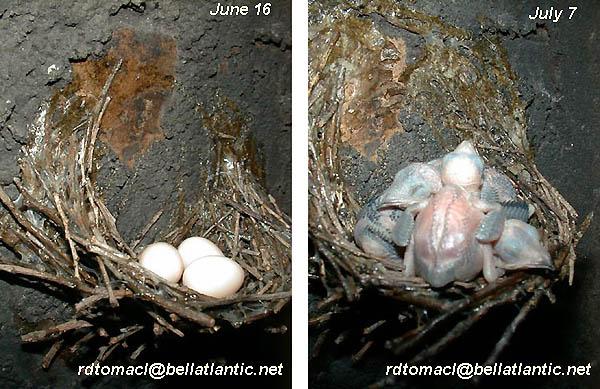 |
| Picture of chimney swifts taken a few
weeks apart to show the development of the chicks over
time. Note the nest, which is made out of twigs and
sticks, cemented together and onto the interior of the
chimney with the parents' saliva. |
Mocking bird
Hard
Pen Time: 3 weeks
Basic Adult Diet: Insects, larvae, fruit.
|
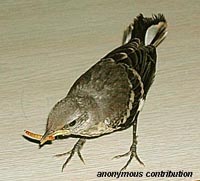 |
Generally a hardy
bird, but can be very prone to nutritional disorders when hand
raised. Of particular importance for these birds are Thiamin,
Calcium, and Phosphorus,
and an appropriate amount of protein in their diet. The
Macleod's
Passerine Diet is even more strongly recommended for these birds
because of these factors. If you are unable to find the
ingredients for the Macleod's diet, use the alternative recipe
listed on my "Recipes" page, and ask a vet for supplements.
Mealworms should also be added liberally to any diet/recipe used.
Fruit should be avoided during the nestling stage, and should
only be a small supplement thereafter, no more than 1/3 of the
total diet by weight.
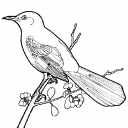 |
| Cat bird
|
Hard Pen Time: 3
weeks
Basic
Adult Diet: Insects and larvae.
Cat birds usually
lose their tameness soon after they learn to feed on their own.
They are very energetic and free willed birds, and are very
sneaky with their escape attempts. If the bird becomes too
frantic trying to escape, it is best to release him to avoid him
injuring himself, even if the hard pen time is not yet over.
------------------------------------------------------
| |
Click this box to go to
the next page,
|
|
Has this page been helpful? Why not fill
out my survey, and let me know how I can improve it?
(click
here) |
-------------------------------------
This website is not intended
to replace the expert care that is only available by professional
rehabilitators. The use of this website is only intended for
those where the option of bringing an orphaned bird to a
rehabilitator is not possible. By raising a wild bird yourself,
you greatly diminish it's chances for survival. Please check this
link for a rehabilitation center in your community:
http://www.tc.umn.edu/~devo0028/contact.htm. If none are listed
near you, call a local animal shelter, veterinarian, or wildlife
office/agent for information on local rescue centers. Thank you.
-------------------------------
Last updated:05/10/2006