
Texas has
more symbols than any other state and
WE ARE PROUD OF IT!!!
|
|
Click On Photos to See Enlarged View

Native Pepper:
CHILTEPIN

Chiltepin Chile Peppers
America's first protected chile pepper
Look how big ~ next to a ruler Click
to enlarge photo
Click
to enlarge photo
The chiltepin, called the "mother of all peppers," is thought to be the oldest known of the Capsicum genus, as well as the hottest wild variety in the Americas even hotter than the habanero. They grow on the rocky surfaces of steep slopes and are difficult to find because they are usually protected by other shrubbery.
Cooks in northern Mexico regularly use chiltepins. Chiltepins can be found on spice racks in supermarkets and Hispanic grocery stores throughout the Southwest. I did find a place on the web to buy them ~ It is in Tucson, Az ~ see below.
Native Seeds/SEARCH
Tucson, AZ
520-622-5561
www.nativeseeds.org
Botanists believe that these wild chiles are the closest surviving variety to the earliest forms of chiles which developed in Bolivia and southern Brazil long before mankind arrived in the New World. The small size of their fruits were perfect for dissemination by birds, and the wild chiles spread all over South and Central America and up to what is now the United States border millennia before the domesticated varieties arrived. In fact, Dr. Eshbaugh ,a botanist from Miami University of Ohio ,believes they have the widest distribution of any chile variety, ranging from Peru north to the Caribbean, Florida, and Louisiana and west to Arizona.
There is a wide variation in pod shapes, from tiny ones the size and shape of BBs to elongated pods a half inch long. By contrast, domesticated Piquins have much longer pods, up to three inches. The Chiltepins most prized in Mexico are spherical and measure five to eight millimeters in diameter. They are among the hottest chiles on earth, measuring up to 100,000 Scoville Units and a 9 on the heat scale.
The word "Chiltepin" is believed to be derived from the Aztec language (Nahuatl) combination word "chilli" + "tecpintl," meaning "flea chile," an allusion to its sharp bite. That word was altered to "chiltecpin," then to the Spanish "chiltepín," and finally Anglicized to "chilipiquin," as the plant is known in Texas. Its botanical name is Capsicum annuum var. aviculare.
Although the Chiltepin plant's average height is about four feet, there are reports of individual bushes growing ten feet tall, living twenty-five to thirty years, and having stems as big around as a man's wrist. Chiltepins are resistant to frost but lose their leaves in cold winter weather. New growth will sprout from the base of the plant if it is frozen back.
Chiltepins are one of the few crops in the world which are
harvested in the wild rather than cultivated. (Others are mushrooms, piñon nuts,
Brazil nuts, and some wild rice.) This fact has led to concern for the
preservation of the Chiltepin bushes because the harvesters often pull up entire
plants or break off branches. It is believed that the Chiltepin population
is diminishing because of over harvesting and overgrazing. In Arizona, a
Chiltepin reserve has been established near Tumacacori at Rock Corral Canyon in
the Coronado National Forest. Native Seeds/SEARCH has been granted a special use
permit from the National Forest Service to initiate permanent marking and
mapping of plants, ecological studies, and a management plan proposal.
RETURN TO TOP

State Pepper -
Jalapeno
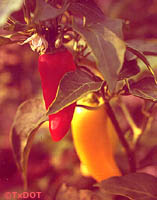
Species Name: Capsicum annuum
var annuum Linné
Color: Bright to dark green, ripening to
bright red
Average Size :2 – 3" long, 1 1/2" diameter
Shape: Cylindrical, tapering to a rounded end
Description: Thick fleshed, the red, ripe jalapeño
is sweeter than the immature green. Smoke-dried it becomes a chipotle.
Fresh jalapeños can vary in heat, according to growing season, soil
conditions and state of maturity.
Scoville
Heat Units: 3,500 – 4,500 (jalapeño)
Most Commonly Grown In : Vera Cruz,
Oaxaca, Chihuahua, Texas and other parts of the Southwest
Interesting Facts: Probably the best known chile in
North America, it is the most popular. It originated in Mexico and was named for
the city of Jalapa in the state of Veracruz. In Mexico, only the pickled form is
called "jalapeño", other names (above) are used when referring to fresh or dried
forms of the pepper. The jalapeño was the first pepper to be taken into outer
space on an early manned space flight. The flesh is too thick to air dry
satisfactorily, so they are smoked in an oven similar to a Chinese oven and then
called a chipotle. 'Chipotle' is the common spelling for the original word, 'chilpotle',
which is a Nahuatl word meaning 'smoked chile'. It is sold dried or pickled (adobado
- in vinegar) in cans. Chipotles are a lott hotter than fresh jalapeños because
the amount of capsaicin always increases with maturity.
Musical Instrument: GUITAR
Nickname: The Lone Star State

State Plant - Prickly Pear Cactus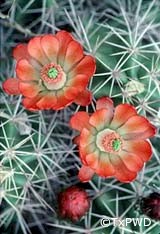
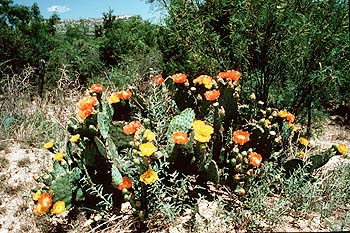
A native perennial with sharp spines, the pads are actually leaves, which store water and are edible. In addition, the reddish, round fruit that appears at the tops of the pads are also edible. Can reach 5 feet.
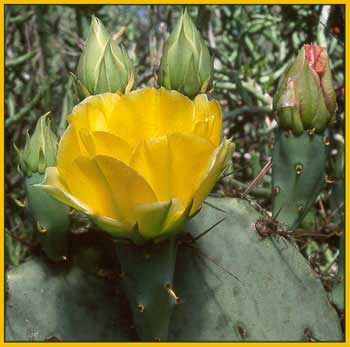
USE. The cactus pear can be used in many ways in diverse sectors,
utilizing different parts of the plant. In the food sector, besides consumption
of the fresh fruit, jams, alcoholic and soft drinks, syrups, candied fruit and
flour can be produced from the plant and oil extracted from the seeds. The young
cladodes are eaten as a vegetable (only in Mexico) or made into other products.
For cattle feed, it is mostly used fresh, but it can also be ensiled so as to
utilize cuttings from processes using the plant in other ways. The different
parts of the plant are also used in industry (dyes, mucilage, pectins, organic
fertilizer, biogas), in the pharmaceutical sector (in the treatment of diabetes,
obesity, inflammation, etc) and in the cosmetics industry. In addition,
Opuntiae are used as ornamental plants
Cactus
Pear Recipes
PRICKLY
PEAR CACTUS WINE
The State Bush -Crape Myrtle- Lagerstroemia indica
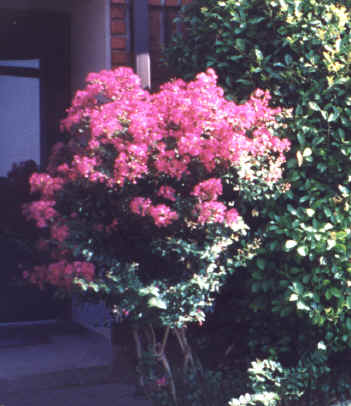
Shrub
- A plant that is usually smaller than a ttree and generally has multiple
branches originating at or near the ground.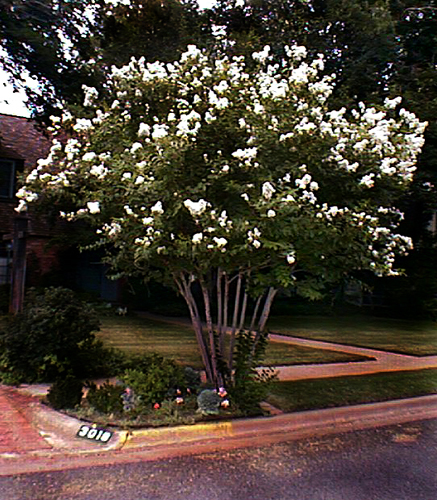 Flowers
Up close ~ Click to see larger
Flowers
Up close ~ Click to see larger
State Shell - The lightning
whelk 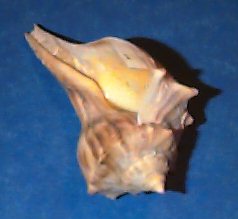
Whelks are mollusks. The Latin "mollis" means soft. The shells aren't soft, but the animal that lives inside is. Not all mollusks have shells. Think of the octopus, squid and even the slug. Conversely, all animals with shells are not mollusks, such as crabs, barnacles and shrimp. All mollusks have soft bodies.
The Lightning Whelk is also called the Left-handed Whelk and has been scientifically named Busycon sinistrum. Sinistrum is Latin for left. It grows to about one foot in length though 15 inches has been recorded. The fawn colored shell is thick and strong yet gracefully shaped with lightning-like streaks of violet-brown. After the shell reaches eight to nine inches, the colors fade to an overall grayish white. Females are generally larger than males, so the record setters are probably of the former gender. They are fairly common, except for right-handed specimens.
Lightning Whelks live in sandy shallows from below the tide mark to deeper waters. These predatory carnivores bury themselves just under the surface of the sand where tender mollusks they like to eat are easy to find. Clams, scallops and oysters are favorites. The whelk attacks its prey in two ways. Either it grabs the bivalve with its big foot and pounds it apart on its own strong shell, or it inserts the outer lip of its own shell between the valves to force them apart.
Beginning in spring, strands of whelk egg capsules wash ashore. These capsules
are formed in the pore of the foot of the female whelk. She buries herself in
the sand for this production. One end of the strand is attached to rocks, old
shells or algae. Expect 50 to 175 capsules on a strand and 20 to 100 eggs in a
capsule. The last few capsules on the unattached end are usually void of eggs.
Most eggs will never hatch, but will serve as food for the single individual
that does. Whelks emerge as tiny images of the adults.
Strong summer storms often wash large shells ashore. It's always a lovely surprise to find a small beauty with its violet-brown coloring intact. If you should find a live whelk, please put it back in the water where it belongs. Should you be lucky enough to find a right-handed Lightning Whelk, it might just be your day to play the lottery!
Mexican free-tailed bat
was designated the
state flying mammal
by the 74th Legislature in 1995.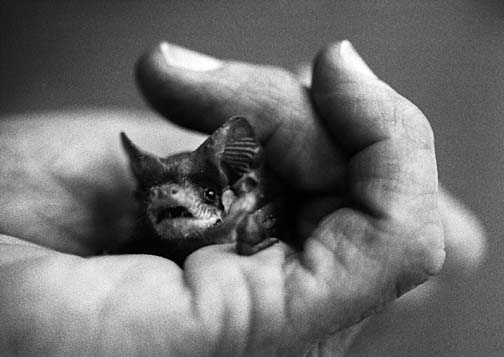
 Dallas
Morning News file photo
Dallas
Morning News file photo
The free-tail bat gets its name from the long, mouse-like tail that extends below the wing membrane.
The Mexican free-tailed bat (Tadarida brasiliensis) is a medium sized bat. Their bodies are about 9 centimeters in length, and they weigh about 15 grams. Their ears are wide and set apart to help them find prey with echolocation.
Echolocation is the use of ultra-high frequency sounds for navigation. Bats and dolphins are able to use sound to "see".
In bats, the sounds are made and sent out by their noses. The sounds bounce off things in their surroundings like insects or branches. The reflected sounds, or echos, are picked up by the bats sensitive ears.
Bats can tell how far something is by how long it takes the sounds to return to them.
You can easily see if a bat uses echolocation. These bats will have large ears and leaf-shaped structures around their nose.
Its fur color varies from dark brown to gray.
Mexican free-tailed bats live in caves in the southern United States, Mexico, Central America, the West Indies, central Chile and Argentina. Their colonies are the largest congregations of mammals in the world! The largest colony is found at Bracken Cave, north of San Antonio, Texas, with nearly 20 million bats. The bats of Bracken Cave can eat up to 250 tons of insects per night!
 When baby free-tail bats are born, their mothers leave them behind in the
cave while they go out to hunt insects. You would expect that a bat-mother would
have trouble locating her own baby (called a pup) among millions of other noisy
pups. But it only takes her a few minutes to do so. She remembers where she left
her pup, and recognizes its "cry" and smell.
When baby free-tail bats are born, their mothers leave them behind in the
cave while they go out to hunt insects. You would expect that a bat-mother would
have trouble locating her own baby (called a pup) among millions of other noisy
pups. But it only takes her a few minutes to do so. She remembers where she left
her pup, and recognizes its "cry" and smell.
This species is very important for the control of pest-insect populations. But its populations have fallen because of the use of pesticides and the destruction of their roosting caves.
In the northeastern Mexican state of Nuevo Leon, La Boca Cave once contained the largest bat population in the world. Over the last 10 years, 95% of the caves bats have been lost. To save the bats that remain, an environmental education program was started in the area. Bat Conservation International and the Program for Conservation of Mexican and North American Migratory Bats are working to help to restore the bats of La Boca Cave.
Mexican free-tailed bats sometimes fly up to two miles high to feed or to catch tail-winds that carry them over long distances at speeds of more than 60 miles per hour.
Mother Mexican free-tailed bats find and nurse their own young, even in huge colonies where many millions of babies cluster at up to 500 per square foot.
Nearly 1,000 kinds of bats account for almost a quarter of all mammal species, and most are highly beneficial.
The 20 million Mexican free-tails from Bracken Cave, Texas eat approximately 200 tons of insects nightly.
Petrified palmwood, found in Texas principally in counties near the Texas Gulf Coast, was designated the official state stone by the 61st Legislature in March 1969.
Common Name: Petrified Palmwood
Scientific Name: Palmoxylon sp.
Time Period: Oligocene
|
Six states and one province have adopted petrified wood as an official symbol. Four designated certain varieties. |
Some states named petrified wood the official fossil, others the official rock or stone. Yet some petrified wood is considered a semi-precious stone.
Water may soak into dead wood. As the wood rots, it’s replaced by minerals that are dissolved in the water. Eventually, the wood disappears but is replaced by minerals that look like wood!
Texas designated petrified palmwood the official state stone in 1969, later adopting a state dinosaur. (See the Resolution.).
Surprisingly little seems to have been written about petrified palmwood. In Texas and Louisiana, it is most common in the Toledo Bend area shared by both states. It was left by trees that grew when the Gulf of Mexico’s shoreline was much farther north
Louisiana’s palmwood was left by trees that grew during the Oligocene Epoch, some thirty million years ago and thirty-five million years after dinosaurs became extinct. Texas’ petrified palmwood is probably about the same age.
Fossils found near fossil palmwood include corals, sponges, and mollusks. That’s because the palms grew along prehistoric beaches. For millions of years, the shoreline has been moving farther south. During the days of the dinosaurs, seas flowed across Texas and north into Canada!
During the Oligocene, the prehistoric whales that represent Alabama and Mississippi as state fossils were beginning to disappear. They were replaced by more modern toothed and baleen whales. On land, ants and termites began to live together in colonies. Rhinoceroses were among the most spectacular of the mammals that inhabited North America. Some lived on land, while others spent much of their time in water, similar to hippopotamuses.
Louisiana’s petrified palmwood represents three known species of trees—Palmoxylon microxylon, Palmoxylon cellulosum, and Palmoxylon lacunosum. Three more species of Palmoxylon are known from Mississippi. A seventh species is found in Texas.
Though the trees that left these fossils have long been extinct, many other kinds of palms are still living. Palms are different from most other trees in that they have no branches and their leaves are all clustered at the top. Modern palms give us such food items as coconuts, bananas, and dates.
State Grass
- Sideoats grama
(Bouteloua curtipendula), a native grass found on many different soils, was
designated by the 62nd Legislature as the state grass of Texas in 1971.
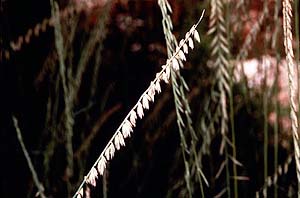 Photo courtesy Texas Dept. of
Transportation
Photo courtesy Texas Dept. of
Transportation
This is a long-lived native grass, widely distributed, but most abundant in the Central and Southern Great Plains. It produces short rhizomes and tends to a bunch-type growth. The leaves are about 6 inches long and under 0.25 inch wide. Flower stems may reach to 3 feet. It produces an abundance of leafy forage well liked by all classes of livestock. Hay of good quality is produced if mowed sufficiently early. It is adapted to wide ranges of soil and climate.
These are the different types of Side-Oats Grama Grass used in Texas
EL RENO SIDEOATS GRAMA is outstanding in leafiness, forage production, and vigor. It is also ranked well in disease resistance, seed production, and winter hardiness. EL RENO SIDEOATS GRAMA is widely used in range seedings and widely adapted in KS, OK, and TX. It is also used for revegetation of disturbed areas. Recommended Seeding Rate for EL RENO SIDEOATS GRAMA:
HASKELL SIDEOATS GRAMA is a prolific seed producer and is adapted as far south as the Rio Grande Valley. HASKELL SIDEOATS GRAMA is highly palatable and is used for range reseeding, revegetation of disturbed areas, pastureland, and hay production. Recommended Seeding Rate for HASKELL SIDEOATS GRAMA
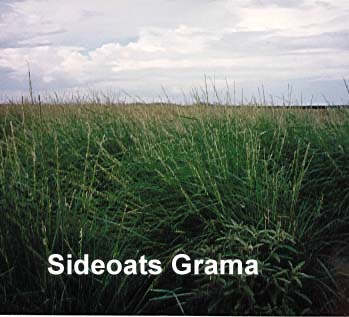
Sideoats Grama (Bouteloua curtipendula var.)
Native perennial warm season bunch grass. Provides good grazing for wildlife and
livestock. Grows 1-3 ' tall with stems growing from strong, scaly rootstocks.
Hairs grow out of small bulb-like spots on the leaf blade edges. The
inflorescence has a zigzag rachis with many spikelets (20-50) twisting around on
one side when ripe.
 Adaptations:
Distributed over much of Eastern and Central U.S.; important range grass in
Texas. Grows in association with Bluestem; less drought resistant than Blue
Grama. Grows on well drained soils, rocky shallow sites. Prefers neutral to
slightly alkaline soils. Not adapted to deep sands.
Adaptations:
Distributed over much of Eastern and Central U.S.; important range grass in
Texas. Grows in association with Bluestem; less drought resistant than Blue
Grama. Grows on well drained soils, rocky shallow sites. Prefers neutral to
slightly alkaline soils. Not adapted to deep sands.
FACTS ABOUT SIDE-OATS GRAMA:
Side-Oats Grama is highly palatable, highly nutritious grass, that is readily
eaten by all classes of livestock.
Side-Oats Grama is a good seed producer.
Seeds and seedheads serve as food for small mammals and songbirds.
Side-Oats Grama is used for seeding abandoned or eroding fields.
Side-Oats Grama has a moderate tolerance of spring flooding and shade.
Side-Oats Grama provides good soil erosion control.
Side-Oats Grama is quick to establish.
VARIETIES:
Butte is a winter hardy, long lived, relatively early maturing variety.
Its best growth is during the long days of summer and the seeds mature as early
as mid-August.
El Reno produces strong leafy plants that are excellent for forage. It
grows rapidly and is noted for its disease resistance and winter hardiness.
Haskell is adapted to most of Texas. It reproduces by rhizomes as well as
seed, is drought tolerant, shows good vigor, and is resistant to seed
shattering. Field planting data showed Haskell to be the best and most
consistent forage producing variety of Side-Oats Grama for central and
southern Texas. Haskell is limited only by moisture, requiring at least 18"
annually.
Kildeer is recommended for use in pasture and range seedings in the
Northern Great Plains. It was released by the SCS in Bismarck, N.D, and it grows
best on well-drained uplands, shallow ridges and rocky areas of varying soil
types.
Niner is one of the most important varieties of Side-Oats Grama of
the southwestern U.S. due to its high palatability and vigorous growth. It is
recommended for use in seed mixes with other species for range reseeding,
roadside plantings or mined-land reclamation. Best performance comes on medium
to heavy textured soils.
Pierre is another variety whose growth is vigorous, leafy and relatively
disease free. It grows well on poor soil and in areas of low annual
precipitation. This variety grows well in South Dakota and adjoining states.
Premier is an upright, leafy type of Side-Oats Grama. It shows
considerable drought tolerance and good forage production. It is recommended for
planting in west-central Texas.
Trailway is a winter hardy, long-lived, late maturing variety. It
requires most of a growing season to produce mature seeds and may fail to
produce seed crops in regions with shorter seasons. It is recommended for upland
planting in eastern and southern Nebraska.
Vaughn plants are recognized by an upright leaf structure and its
bunch-type growth pattern. It is easily established, has good seedling vigor,
and is highly drought tolerant. Vaughn is used in eastern Colorado and New
Mexico.
ESTABLISHMENT / MANAGEMENT
Proper ground preparation is one of the most important considerations when
native grasses are being established. The seed bed should be firm but not solid;
cultivation to kill the roots of cool-season grasses is essential. Planting can
be done by either drilling or broadcasting, and the seed should be covered with
no more than one fourth inch of soil. Avoid planting the seed too deep. Test the
soil for deficiencies and apply needed phosphorus, potassium or lime prior to
seeding. No additional fertilization is required after the stand has been
established. Once the stand is well established, regulate the grazing patterns
to avoid over-grazing. This should be of particular note toward the end of the
growing season as grass grazed too closely weakens the root structure which
holds the food supply through winter. Competing woody shrubs, undesirable weeds
and extensive mulch build-up can be managed by a controlled burn done in the
late winter before the vegetation has begun its spring growth. Always check with
an expert in grass management, such as our personnel at SHARP BROS. SEED CO.
before attempting such a bum for advice as to the proper technique to be used.
Our personnel are trained to listen to your needs, help develop your program for
planting and suggest suitable varieties for your location. With planning and
preparation, your stand of Side-Oats Grama will supply you with a
dependable, warm-season forage crop for years to come.
Uses: Used for range reseeding and pastures, good grass to include in seed
mixtures for grass improvement. Grazed by all types of animals. Decreases with
heavy grazing. Matures seed in spring and fall.
The Texas sweet onion was designated the official state vegetable by the
75th Legislature in 1997.
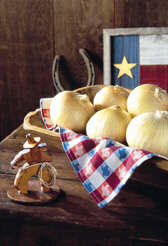
. This variety is the
most widely adaptable short day onion available that will grow from Mexico to
Ohio. It is a later maturing short day onion and the bigger it gets, the sweeter
it is. Very disease resistant, it will store better than other sweet varieties.
Don't be surprised if they get as big as softballs!
Onions are highly recommended for people trying to prevent cardiovascular disease, cancer and infections. Like most vegetables, sweet, yellow onions are fat- and cholesterol-free, and contain very little sodium.
The 4000-Year-Old
Healer
For over 4000 years onions have been used for medical purposes. Egyptians
numbered over 8000 onion-alleviated ailments. The esteemed Greek physician
Hippocrates prescribed onions as a diuretic, wound healer and pneumonia fighter.
During World War II, Russian soldiers applied onions to battle wounds as an
antiseptic. And throughout the ages there have been countless folk remedies that
have ascribed their curative powers to onions, such as putting a sliced onion
under your pillow to fight off insomnia.
What Makes Them So Good for You?
Of all the healthy compounds contained in onions, two stand out: sulfur and
quercetin - both antioxidants. They each have been shown to help neutralize the
free radicals in the body, and protect the membranes of the body's cells from
damage. Quercetin is also found in red wine and tea, but in much lower
quantities. Interestingly, white onions contain very little quercetin, so it's
better to stick with the yellow and red varieties. Most health professionals
recommend eating raw onions for maximum benefit, but cooking makes them more
versatile and doesn't significantly reduce their potency. In fact, unlike sulfur
compounds, quercetin can withstand the heat of cooking. One researcher, Dr.
Leonard Pike, director of the Vegetable Improvement Center at Texas A&M
University, is working on producing onions with even higher levels of quercetin.
Onions And Your Heart
As with garlic, onions help prevent thrombosis and reduce hypertension,
according to the American H eart Association. The juice of one yellow or white
onion a day can raise HDL cholesterol (the good stuff) by 30% over time,
according to Dr. Victor Gurewich of Tufts University. Red onions don't provide
the same effect.
Sweet Onions - The Tasty Way to Better Health
What tastier way to eat healthier than with sweet onions. Because they are
milder and easier to digest, you can consume "sweets" in abundance, thus
obtaining all the many health benefits that these delicious alliums offer. Best
of all, you won't shed any tears in the process.
Texas Sweets - SpringSweets & Texas 1015s
SpringSweets are the first spring sweet onions in the marketplace, debuting in March; the 1015s arrive in mid-April. The 1015, developed in the early 1980s by Dr. Leonard Pike, a professor of horticulture at Texas A & M University, is named for its suggested planting date, October 15. Nicknamed the "million-dollar baby" because of the money spent to develop it.
~This is cute ~ I found this and thought others would get a kick out of this story
Leonard Pike - Texas Sweet Onion King
by Jan Roberts-Dominguez, Onion Expert
In many ways, Dr. Leonard Pike is like a lot of other professors in this
country: too busy to reach very easily by phone on most days, and totally
absorbed in his research.
But this Texas A & M University faculty member has one singular distinction: he
developed one of the nation's most famous sweet onions, the Texas 1015Y.
Because I was curious about the man behind this primo culinary phenomenon that
graces millions of kitchens every year from mid-April through June, I gave him a
call. What's it like to have created this famous onion, I pondered?
"Never did I dream that I'd be known for onions," he chuckled. "You just don't
think of people being known the whole world over because they worked with a
certain type of crop. I've traveled to India, Russia, Germany, France,
Australia, and England. And everybody knows about the 1015."
And Dr. Pike, of course. Which shows you how much people love onions. Especially
Texans. In fact, onions are the Lone Star State's leading vegetable crop. Sales
reach $100 million per year, and the overall impact on the Texas economy has
been estimated to be about $350 million per year.
Pike received his Ph.D. in Horticulture in 1967 from Michigan State University
and came to Texas A&M to work on cucumbers and carrots. At least that's what he
thought at the time.
"But the onion industry people heard that I had worked on onions," said Pike,
"so they called me in one day and said, 'We've got a lot of problems with our
onions, and we'd like to know if you'd be willing to work on onions.' "
Pike said he could do that, but that it would take money and time.
The onion folks said, "How much?"
Pike took a wild guess. They wrote him a check, "And that's how I got started,"
the plant geneticist explained.
Twenty-nine years later, the original 5-year grant they established for his
research is still going strong.
The most famous sweet and juicy result of Pike's research, which was released in
1983, gets its name from its ideal planting date, October 15. Pike went this
route to simplify matters during planting, he explained. "The most confusing
thing to do to a bunch of growers is to release an onion and say, 'Wait a
minute, you gotta plant this one on this date, and this one on this date, and
this one on this date.' because you know that's just asking too much."
Among all of the onion varieties released that year, the 1015 stood out because
of its superior qualities. Aside from its technical pluses, such as disease
resistance, it had a great onion flavor, but, as Pike stated, "wouldn't cause
tears to run and drip off your cheek."
However, growers and shippers felt that it needed a catchier name. A committee
was formed, a "Name The Onion" contest held, and the 1015 suddenly had a new
name. "It was something like the Texas SuperSweet," said Pike.
But the next year, when the crop was coming to market, the growers started
asking the onion buyers how many of the Texas SuperSweets they could sell.
"None," said the buyers. "We want the 1015."
The industry learned a valuable lesson that year and nobody has fiddled with the
name again. If it ain't broke, don't fix it.
© 1999 Jan Roberts-Dominguez
LEARN
All about Sweet onions here ~

History of the Texas Bluebonnet Tartan

The Official Tartan of Texas
Tartan refers to fabric woven into plaid patterns which represent clans,
families or regions in Scotland. A Tartan may be designed to commemorate a
special event or person. In old Scotland, the Tartan was used for dress as well
as a banner or flag. The kilt is made in special Tartan designs. Because a
family or community worked the cloth together, their clothing was made of the
same patterns, and so a person could be recognized by the Tartan plaid that he
wore.
The Texas Bluebonnet Tartan was conceived and designed by June P. McRoberts. She
designed a pattern to represent the state flower, the Bluebonnet, using the
colors and symmetry of the flower itself. She received much help and guidance
from the Scottish Tartan Society Museum in Scotland and later registered the
Bluebonnet Tartan with the STS Museum, the official register for tartans. The
first official recognition of the McRoberts tartan came in 1986 when the
Sesquicentennial Committee of Texas adopted the Bluebonnet Tartan as the
official Sesquicentennial Tartan. In 1989, Texas Representative Schlueter became
aware of the Texas Bluebonnet Tartan and one of his last acts before retiring
was to put forth the motion that the tartan be officially adopted as the State
Tartan. In May 25, 1989, by In-House Concurrence Resolution #242, the Texas
Bluebonnet Tartan became the official State Tartan for the great state of Texas.