|
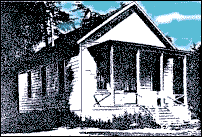 Valencia
Hall is a wood framed structure built approximately 1880, as a meeting hall for
the town of Valencia. The only other remaining evidence of this mill town, the
old Post Office and General Store, which was constructed in 1882. Both of these
buildings served the needs of employees of the F.A. Hihn Valencia Mill. Valencia
Hall is a wood framed structure built approximately 1880, as a meeting hall for
the town of Valencia. The only other remaining evidence of this mill town, the
old Post Office and General Store, which was constructed in 1882. Both of these
buildings served the needs of employees of the F.A. Hihn Valencia Mill.
Construction notes on the Hall
The Hall was built as a one room space which measures approximately 30 feet
by 40 feet. The construction of the building is wood frame using sawn members
connected with square cut nails. The framing method is similar to balloon frame
method except that the studs stop on top of a wood perimeter girder rather than
going down to a mudsill. This method seems to have been used more on buildings
of this period where the site had some slope problems. The girders sit on wood 4"
x 4" posts which sit on a cribbed pad of 2" x 9" x 19"
members which sit on the ground.
 The framing for the floor is 2"
x 14" wood joists at 24" on centers resting on four wood girders two
along the longitudinal perimeter of building and two more, approximately 5.5
feet from the longitudinal walls. The flooring itself is tongue and groove
boards laid 90 degrees to the direction of the joists. The framing for the floor is 2"
x 14" wood joists at 24" on centers resting on four wood girders two
along the longitudinal perimeter of building and two more, approximately 5.5
feet from the longitudinal walls. The flooring itself is tongue and groove
boards laid 90 degrees to the direction of the joists.
The roof structure is a
simple king post type carpenter truss spaced at 32" on center and resting
on the exterior wall. The exterior wall siding is a channel rustic ship lap type
pattern installed horizontally as was the custom in the late 19th century. The
skirting around the perimeter of the building from the floor line to the ground
is a "V" groove type of tongue and groove siding installed vertically.
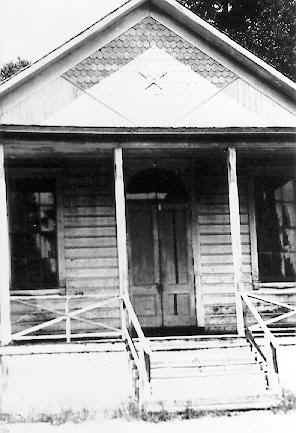
The front gable of the
building is decorated quite uniquely using the fish scale shingles in an area
defined by a symmetrical diamond shape. The center of the diamond contains a
five pointed star design using a series of smaller star shapes installed on top
of each other in a pyramid fashion. To construct the building, several large
redwood trees had to be cut down to clear the site for the new structure. These
stumps (approximately 6) are still remaining under the Hall and provide
additional support for the wooden girders.
Since its construction, the
Hall has undergone minor changes, including: the construction of a small
addition to the rear of the building, a side entry, and the removal of the
original front porch in favor of an entry of different design.
The building is located on a
wooded embankment over 60 feet above a creek bed. The highly unstable condition
of the embankment is endangering the stability and ultimate existence of the
Hall. Stabilization of the embankment with the building in its present, original
location, is not a viable option due to the eroding slope. Due to this
circumstance, the decision was made in the late 1980's to relocate the building
to the County owned property across the street.
Valencia, an important period in Santa Cruz County history
Built by F. A. Hihn in the 1880's, Valencia Hall is associated with a
critical period in the history of Santa Cruz County, one that encompassed the
decline of the influence of Mexico; the ascendancy of American and European
settlers who entered the area following statehood, the division of the ranchos,
large scale timbering and the establishment of small farms and orchards. The
Hall reflects the evolution of the Valencia area, as well, through its
continuous use as a meeting place for those who have been involved in this
development. Valencia Hall was built as a meeting place for the workers of the
Hihn and Valencia Creek Mill.
Mr. Hihn anticipated the
Hall would serve as the center of a community composed of the mill workers and
their families. It stands as a reminder of Mr. Hihn's ambitious plans for the
area, and is one of the few buildings erected by him remaining.
By the turn of the century,
the marketable redwoods were cut and the mill was closed. Because Hihn did not
believe in the traditional company town, he sold lots and small farms to those
who worked in the mill, and gradually the area became largely agricultural and
an apple producing district in the County.
The Valencia Farm Bureau
During this transition, the Hall continued to be used for social events,
meetings, church services and school commencements. In 1921, and at the urging
of the County Farm Advisor Henry Washburn, the residents of the area organized
the Valencia Farm Bureau in the Hall. This organization, an affiliate of the
Santa Cruz County Farm Bureau, from the time of its founding was instrumental in
bringing electricity to the area, organizing a water company, promoting road and
bridge improvements, as well as encouraging improved agricultural methods.
New Some additional background on the Valencia
Farm Bureau provided by Jim Cox (grandson of James Peter Cox, early member
of the VFB, and his wife Daisy).
The Farm Bureau's
arrangement with the Hihn family for use of the Hall continued to be an informal
one, based largely upon the community's accustomed access to the building, until
1932, when the trustees of the Hihn estate required the group to assume all
liability for the building if it was to continue using it. Because of the
residents' proprietary feeling for the building that had been the focal point
for their community for so long, the Farm Bureau incorporated as the Valencia
Farm Center, and the Hall, exclusive of the land on which it stood, was deeded
to it.
The Valencia Farm Center
retained ownership of the Hall until 1976, when it deeded it to the County of
Santa Cruz. The County purchased the land across the street in 1986 to support
the use of the Hall. Although remembered for his accomplishments that influenced
the development of the County, few structures remain to recall Hihn's enterprise
outside the City of Santa Cruz. In Capitola, for example, only the
Superintendent's Office (State Historical Landmark No. 860) from the several
major buildings that comprised Camp Capitola still stands, and in Valencia, the
Hall and Post Office are the only reminder of his involvement with the area that
began with his purchase of land on the Rancho Soquel Augmentation. |