

New and updated informationCheck out new and updated information aboutGSM and 3G / UMTS here: |
The speech signals in a GSM cellular systems are digitally coded. This allows for higher quality and higher capacity at the same time.
In old telephone systems, analog coding is used. This means that the electrical variations induced into the microphone, are transferred directly as electrical signals. The magnitude of the electrical signal is equivalent to the magnitude of the original speech signal.
In modern telephone systems, digital coding is used. The electrical variations induced into the microphone are sampled, and each sample is then converted into a digital code. A sample is taken 8.000 times per second, ie. the sampling rate is 8 kHz (kilo-hertz). Each sample is then converted into an 8 bit value. 8 bits can hold 256 different values, ranging from 00000000 to 11111111.
The principle is illustrated below
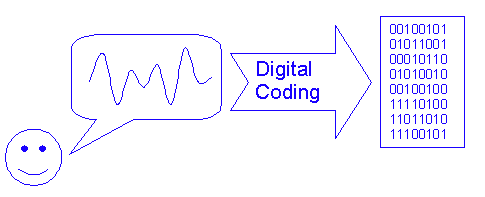
The principle used is just like as the one used in a CD recording. On the old phonograph records, an analog technique is used, whereby the movements of the pick-up is transformed into similar movements in the loud-speaker.
In a CD-player the music is converted to digital signals, that are stored on a digital record.
The digital coding used in normal telephone systems is further enhanced for use by cellular phones. First of all, the signals are compressed. As explained above, the speech is sampled into 8-bit samples 8.000 times per second, resulting in 64 thousand bits per second or 64 kbit/s. Whereas this is full coding is necessary for music, some special algorithms (called RPE - LTP coding which is short for Regular Pulse Excitation - Long Term Prediction) are used to compress the digital signals into only 13 kbit/s. This way, a cellular system can transfer 4 times as many phone calls as a normal telephone system.
The compression described above is the "original" GSM coding called "Full Rate" (FR). Recently two other codings have been added to the GSM system:
The Enhanced Full Rate (EFR) coding uses an even more advanced algorithm: ACELP which is short for Algebraic Code Excited Linear Prediction. Using the EFR a better speech quality is achieved using the same resources.
The Half Rate (HR) coding uses CELP-VSELP coding, which is short for Code Excited Linear Prediction - Vector Sum Excited Linear Prediction. Using this coding the cellular system can transfer 8 times as many phone calls as a normal telephone system.
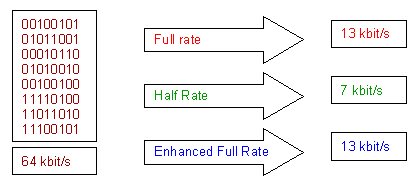
All GSM phones can use the FR coding, but only newer, advanced phones can use the HR and EFR codings. Similarly the GSM radiostations can all use FR coding, but only some can also use HR or EFR. But since all radio station can use FR, any GSM phone can be used with any radio station.
In addition to the compression of the digital signals, the GSM system also includes error correction algorithms. In addition to the speech signnals, some extra digital bits are added to give a form of redundancy in the digital signal.
If some part of the transmission is disturbed by noise, chances are that some of the bits come throught allright, and the remaining bits can then be reconstructed to yield the original signal.
The algorithms are quite complex, but the principle is illustrated here.
If we want to protect TWO bits only, we can add a thid bit as shown in the table. Here the principle is that the number if 1's in the resulting signal is always even. This principle is called even parity.
|
Original signal |
Error correction added |
|
00 |
000 |
|
01 |
011 |
|
10 |
101 |
|
11 |
110 |
If one of the three bits in the signal is missing, it can be reproduced from the two others, by using the principle of even parity. An example of the signal 01 being send is found below:
|
Original signal |
Error correction added |
Noise |
Received signal |
Error corrected |
Final signal |
|
01 |
011 |
None |
011 |
011 |
01 |
|
01 |
011 |
- - X |
01X |
011 |
01 |
|
01 |
011 |
- X - |
0X1 |
011 |
01 |
|
01 |
011 |
X - - |
X11 |
011 |
01 |
The error correction added increases the amount of information to be transferred. As an example, the 13kbit/s FR encoding is increased to 16kbit/s. This is not by chance, but designed so to allow exactly four signals to be transferred in the usual 64 kbit/s channels.
 |
The GSM System for Mobile Communications This is the bible of GSM. A must for everyone working with GSM. From 1992 but still alive. buy it from Amazon.com |
| Or buy other GSM related books here | |
 |
 |
 |
| [ Back to: GSM overview ] | [ home ] | [ Continue to: Controlling the call ] |
Related GSM subjects:
[
Home
| GSM Index
| GSM Players
| GSM Entities
| GSM Phone as radio
| Digital speech coding
| GSM Call Control
| GSM sites
| GSM Radio Network
| GSM Coverage
| GSM Network System
| Buy GSM books
| Buy GSM equipment
| GSM Links
]
| Check this out: |
| [ Books, Music, Videos | Best of Pokemon | MP3 uncovered ] |
| [ Make cheap phonecalls using the internet ] |

 
|
Page created by Henrik Kaare Poulsen.
You can drop me a mail or sign my guestbook Page hosted by Yahoo! GeoCities |
|