|
THE PRINCIPLE
General concept of Activate Technology (AT) is the local concentration of energy.
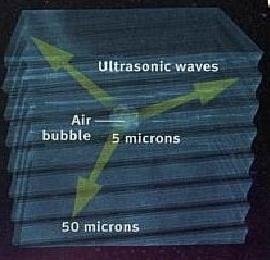
Main action is the generation of bubbles inside a stream of liquid being processed.
Key mechanism is a collapse of bubble, producing a locally concentrated energy.
Major effect is the Sono-Luminescence phenomenon inside the collapsed bubble.
THE SCIENCE
Sono-Luminescence (SL) phenomenon
was discovered in 1933 by two French
Scientists, but first described in an
article by two German physicists 1935.
In 1960 Dr. Peter Jarman from Imperial College of London proposed the most reliable theory of SL phenomenon.
The collapsing bubble generates an imploding shock wave that compresses and heats the gas at the center of the bubble to extremely high temperature.
The spherical implosion effect of the bubble within the SL phenomenon was theoretically studied by Dr. William Moss of the Lawrence Livermore National Laboratory. Dr. Moss's calculations show that a shock wave strengthens as it nears the bubble's center, where the heating is maximum. The atoms and molecules that make up the gas, begin to ionize or break down, forming plasma. The hot gas emits light through a torrential cascade of energy, thereby creating light pulses ( 1 ).
In the early 1990s, Dr. Seth Putterman and colleagues at UCLA carried out more refined measurements of the light. The wavelength of the light extended into the ultraviolet range, indicating temperatures inside the bubble where at least 10,000 degrees C and higher.
Dr. Thomas Matula's at the Applied Physics Laboratory, shows that SL phenomenon may have practical applications in the future, embedded in
a new discipline called Sono-chemistry. The SL phenomenon could be used to take 'snapshots' of fleeting chemical reactions and in waste remediation for destruction of the toxic chemicals ( 1 ).
|
|