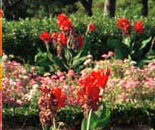
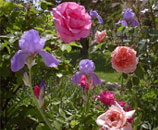
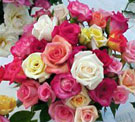
Flowers are very intimately associated with the social and religious activities in India. In social life, flowers are offered to welcome, to felicite and to greet friends or relatives and guests in functions. Flowers are needed in all the religious ceremonies functions including marriages. Garlands and wreaths are offered on dead bodies of martyars and very important persons (VIPs) and national heroes as a gratitude for the work done and sacrifice made by them. Flower is a taken of love and tenderness. They are wanted due to various attractive colours and fragrance. Flowers are also used for extracting essential oils, which are used in perfumes. Many flowers have medicinal values and hence are used in Ayurveda. In India, large number of flowers are grown in different parts according to soils and climate and also likings and preferences of the people for specific type of flowers. Important flowers are rose, marigold, chrysanthemum, jasmine, lily, tuberose, aster, zinia, carnation, gladiolus, galardia etc. Flowers are tender and hence highly perishable. They are generally used in fresh form but they have very short shelf life. This poses great problems in their marketing, particularly lone distance marketing. Therefore, flower cultivation is concentrated in the hinterland of big cities like Mumbai, Pune, Bangalore, Mysore, Chennai, Calcutta, Delhi etc. But with the development of quick transport vehicles and refrigerated or insulated vans, flowers are transported to distant markets including foreign markets. For successful marketing of flowers, well-developed markets and well-organised marketing system is necessary. In the marketing of flowers the aspects involved are –
- Channels of marketing,
2. Costs and margins and price spread and
3. Producer’s share in consumer’s rupee.
The third division contained the equipment for the extraction of floral concretes. It is here that the flowers of tuberose, mimosa, and jasmine were on a commercial scale. There were at least ten large stills in which perforated trays three feet in diameter were stacked 16 deep one on top of the other. The flowers of one tray are kept from squashing the flowers of the lower tray by a raised ring on the center of each tray about 4". Each tray holds about 34 lbs. of jasmine or 82lbs. of mimosa or 68 lbs. of tuberose. Thus an entire still filled with each one of these flowers would equate to 250, 600, and 500lbs respectively. There were a total of ten stills which gave the capacity to process a significant amount of flowers on any one day. In the process of making extracting the fragrant principle from the plant the stills are filled with the single flower and washed three times in a hexane solvent for about 20 minutes each time. The concrete separates out from the solvent when it is later subjected to a gentle steam distillation. Only tiny traces of the solvent remain in a properly made concrete. From 2,200 lbs. of fresh flowers one can expect to obtain about 5.5 lbs of concrete for jasmine, 14 ounces of tuberose and 16.5 lbs. of mimosa. The concrete must be further refined to produce the absolute which is used in the perfume industry so it is easy to see why these products are so precious and costly. But because of their highly concentrated nature only a minute amount of the product is required to have a marked effect on any fragrance desired. The complex nature of these fragrances is such that they are tough to synthesize and that is why the true absolute is still preferred for the most sophisticated perfumes. |