
|






ABOUT US
The Medium and Small Scale Industries Coordinated Action Program (MASICAP) is a program conceptualized y Fr. Georges Piron and pilot tested by the Development Academy of the Philippines in 1973. The program was adapted and expanded as a national program of the Department of Industry in June 1974 by then Industry Secretary Vicente T. Paterno. The program identified projects cum proponents, prepared project feasibility studies for loan applications and followed-up / facilitated loan approvals from financial institutions. The program operated until June 1980 when it folded up because certain conditions key to the program’s successful implementation had changed. By then, it has assisted about 6,000 entrepreneurs in the countryside and trained / graduated about 700 young professionals.
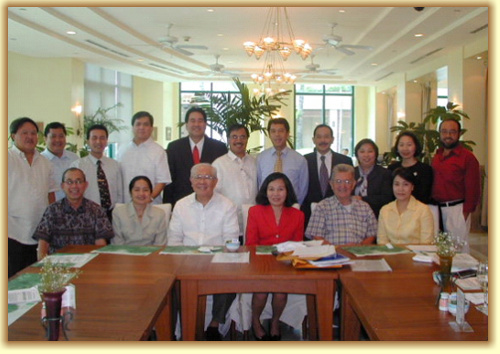
MASICAP II Board of Trustees with Chairman Vicente T. Paterno seated third from the left and Founder Fr. Georges Piron seated second from the right
MASICAP was unique from other government programs in many ways that contributed largely to its exemplary performance in assisting countryside small and medium enterprises.
It recruited honor students on their last year of college from selected schools in the country who volunteered to work for the program and earn academic credits as if they were in school. This arrangement was made possible with the concurrence of the Department of Education. The recruits were trained by the program and have the option to work with the program for a maximum of two years on a yearly contract.
It harnessed and fueled idealism and activism among the youth as industry extension officers by allowing them to challenge government bureaucratic procedures and practices affecting enterprises they assisted and providing them with highly moralistic, simple, participatory and transparent program management.
Field staff were assigned in teams outside of the areas where they were recruited to avoid undue biases and pressures.
The maximum term of two years for the staff ensured renewed enthusiasm to the program by new recruits without losing continuity and experience transfer from those in their second year.
No regular office hours were set but performance was monitored periodically based on quotas agreed upon.
A simple operational system was followed for the field teams to render assistance to projects cum proponents efficiently and effectively.
Camaraderie was sustained with periodic visits, meetings, open communications and mutual respect.
Generally, MASICAP graduates were offered better jobs relative to their batch mates in school because of the training, experience, work ethics and maturity gained from the program. Majority is successful in their careers as government / corporate executives, businesspersons and others.
Though it was difficult for the MASICAP Alumni to end the program, they deliberately disbanded the program in 1980 because the key elements that made MASICAP succeed were threatened.
In summer of 2001 Mr. Vicente T. Paterno expressed his desire to revive the program. The idea was opened up to Alumni and they fully supported it. The program was named MASICAP II and it followed the concepts of MASICAP I except that the structure was totally independent from the national government but will be working closely with its agencies.
On August 2002, the program was revived on a pilot basis under MASICAP MSME Development Foundation, Incorporated. Mr. Vicente Paterno, chairman of the foundation, agreed to lead the efforts on the following conditions:
It would revive as a pilot project, to validate whether the program is still viable under the present environment, and the foundation could still train students of idealism, competence and integrity.
It would be structured so as not to depend for its existence on national government
It would begin small, and its first year would focus on Mindanao SZOPAD areas.

MASICAP MSME Development Foundation Incorporated
Medium and Small scale Industries Coordinated Action Program II (MASICAP II)
Designed by : ED Altares / edaltares@yahoo.com / +63 919 672 6868