
|






CONCEPTS, STRATEGIES AND OPERATING MECHANISMS
1) Funds to support the program are raised mainly from the foundation, and from local government units who are convinced of the workability of the pilot project in their areas.
2) MASICAP
II will harness the sense of idealism, activism and adventurism among the
youth to undertake MSME assistance services by staffing the program with
batches of selected senior college student volunteering to join the
program for a maximum period of two years on a yearly contract. The
Commission on Higher Education (CHED)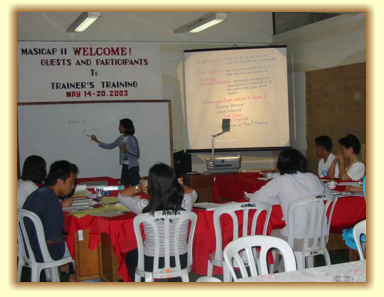 allowed the foundation (under CHED
Memo Order No. 11 Series of 2002) to recruit yearly senior Business
Administration, Commerce or Economics students from participating schools
to be trained and work for the program instead of attending their
remaining academic subjects. The recruited students will remain
enrolled; earn grades from the program and graduate as if they were in
school.
allowed the foundation (under CHED
Memo Order No. 11 Series of 2002) to recruit yearly senior Business
Administration, Commerce or Economics students from participating schools
to be trained and work for the program instead of attending their
remaining academic subjects. The recruited students will remain
enrolled; earn grades from the program and graduate as if they were in
school.
3) Recruitment of senior students increases the probability of getting the top and better-qualified students before they hit the labor market. Recruitment is announced with the help of participating schools. Applicants are briefed about the program prior to interviews conducted to screen and select recruits. Selection is based on the following criteria:
MASICAP II Trainer's Training funded by
UnitedNations Industrial Development Organization (UNIDO)
Must be a regular student on his / her senior year / last semester in Business Administration or commerce major in Accounting, Management, Entrepreneurship or Marketing or Bachelor of Science in Economics.
Must have outstanding academic and moral standing as attested by school authorities, preferably honor students.
Have leadership qualities, good relational skills, positive attitude and missionary spirit.
Willing to be assigned away from residence and place of recruitment to other areas covered by the project.
Should assume the risk of returning to school if unable to satisfactorily complete the initial training program.
4) Recruited students are trained intensively for one month on project feasibility study preparation, delivery of extension services as well as work ethics prior to field assignment to be able to undertake the tasks required by the program. The initial training is being reinforced with on the job coaching by the program management staff and those in their second year with the program.
5) Deliberate field staff turnover after serving two years with the program will allow renewed enthusiasm to the program by new recruits without losing continuity and experience transfer from those in their second year. This will also enable the program to provide training and experience to more students / young professionals. Thus, new batch of students are recruited every year to replace those who automatically graduate from the program after two years except for a few who will be invited to extend their term to manage the program. However, contracts of staff can be terminated at any time.
6)
Recruits are assigned in areas
other than their place of residence and recruitment to avoid undue biases
and pressures.
They are assigned in teams of three to allow for work sharing,
brainstorming and confidence building by
 re-enforcing
each other. A team leader is assigned to coordinate and manage the operations
of the team in a participatory manner. Usually, the old timer is
designated as the team leader to allow for coaching and experience
transfer to the new recruits.
re-enforcing
each other. A team leader is assigned to coordinate and manage the operations
of the team in a participatory manner. Usually, the old timer is
designated as the team leader to allow for coaching and experience
transfer to the new recruits.
7) Adequate allowance / compensation / salary is paid monthly to field staff. This includes transportation and living expenses within the area of assignment to simplify financial administration. Only actual transportation expenses incurred for authorized travels outside the area of assignment will be reimbursed.
Outing in Paradise Island, Davao City
8) Promotion within the organizational structure is made possible by fixing the terms for the Coordinator and Assistant Coordinators and allowing deserving field staff to assume program management positions. This will inherently provide for a reward system and narrowing of age and experience gap between management and field staff.
9) Office hours is not strictly imposed and accounted for to allow for flexibility among field staff to adjust schedules with the proponents’ / entrepreneurs’ available time. However, performance targets are set for each team and are closely monitored during the quarterly meetings participated by all staff and periodic visits of the Coordinator and Assistant Coordinators. The visits allow the teams to discuss their concerns and problems in undertaking their tasks with program management and come up with immediate solutions. The quarterly meetings enable the teams to report their accomplishments thereby fostering peer pressure and healthy competition among teams. It also allows for exchange of experiences and social interaction among staff.
10) Program management is conducted in a participatory manner. Leaders are expected to lead by example and earn respect of field staff. Open communication is maintained and the field staff are encouraged to voice out their ideas and opinions to improve program operations. Camaraderie among staff is likewise encouraged but this does not preclude immediate sanctions to those who deviate from the acceptable moral standards and professional integrity fostered by the program.
11) Missionary spirit and right values are instilled during the training and enhanced by the manner in which the program is implemented. The field staff is oriented to view the job as a mission and device sense of fulfillment when enterprises assisted are actually created / expanded. They are provided with support to challenge bureaucratic procedures and practices impeding the approval of loans or delivery of assistance to enterprises assisted. This is made possible by the project management and foundation officers’ intercessions / dialogues with officers of concerned financial institutions or government agencies.

MASICAP MSME Development Foundation Incorporated
Medium and Small scale Industries Coordinated Action Program II (MASICAP II)
Designed by : ED Altares / edaltares@yahoo.com / +63 919 672 6868