180th
Meeting of the Transvaal Meccano Guild
(Saturday
18th October 2003: Fuschia Room, Jabula Center, Sandringham)
Model report (By Chris Els)
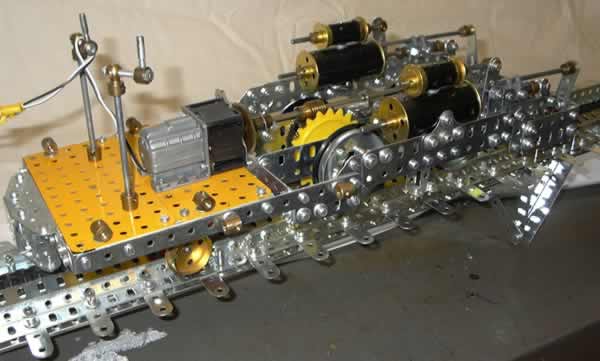
Peter Mathews
Snowdown Railways Locomotive Chassis
Peter
Matthews demonstrated the chassis of his now modified Snowdown Locomotive.
He
was having problems with slop developing in the 19:1 reduction gearbox.
He
added a bearing to it which has helped a lot.
Parts
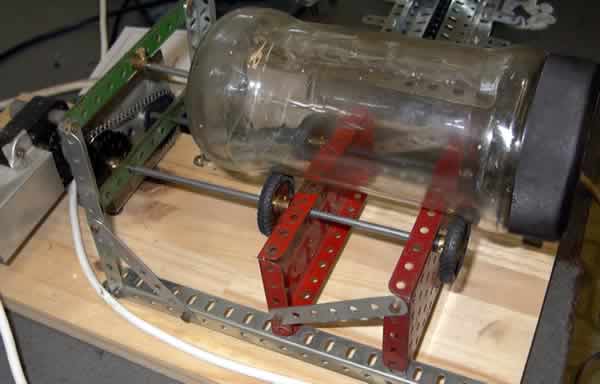
Cleaner / Drum Roller
Peter
recently purchased 2 set 10's. The owner had coated all the parts in Vaseline to
stop rust. The parts have stood for a good
few years and the Vaseline has hardened onto the parts. After
much experimenting, Peter found that Turpentine and rice worked best to clean
the Vaseline off. Peter
showed us a modification he had done to his tumbler. He epoxied an angle girder
inside the jar to help tumble the parts. Without
the strips the parts just rolled around on the bottom of the jar. Once
done, rinse the parts in hot water and leave to dry in the sun. Use
a magnet to pick out all the pieces from the rice. Henry
asked if you can add sugar to taste!
|
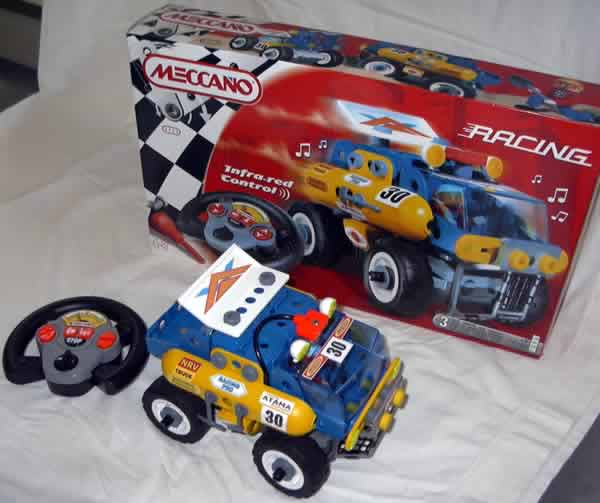
Ross Ballington
Infra Red Control Racing Truck
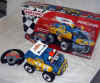
Ross
has been a member for 8 years, and this is the first time he has brought a model
along!
Ross jokingly
told us the reason he bought the model was that the ages on the box is
4-8 years old,
so he
might be able to finish the model.
The
control has 5 sound effects : Engine start, Hooter, Brake effects, a radio and wheel spin
effects.
Dick Anstee
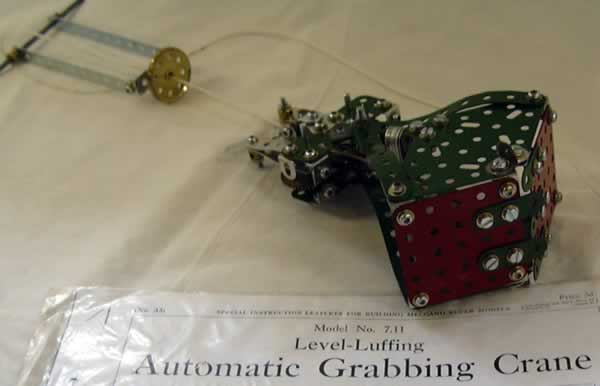
Automatic Level Luffing Grabbing Crane
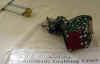
Dick brought the grab
along of the crane he is busy building at the moment.
He explained how the
grab works :
- As the grab reaches
the top of its travel, a knot in the string causes the grab to open thus
emptying its load.
- Pull up some more,
the catch releases and you can lower the grab.
- As the grab hits
bottom, wind it up again and the grab closes around its load and can be raised
up again.
Dick reports a problem working on the
Level luffing mechanism :
The mechanism works fine and the jib is
perfectly balanced.
Once all the sheaves have been strung up,
the mechanism cannot overcome the friction in the sheaves and it binds.
|
Pieter Gouws
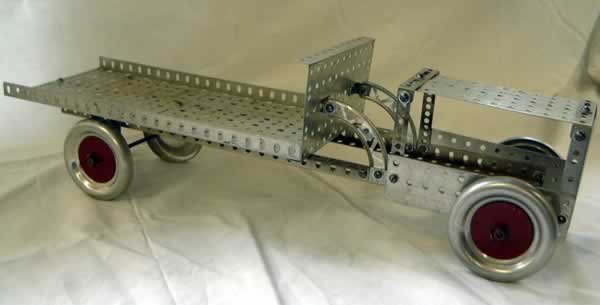
Erector Flatbed Truck
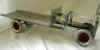
Pieter showed us a
simple flatbed truck built from a 1929 Erector set he owns.
The truck is extremely light due to the Erector parts being mostly
aluminum.
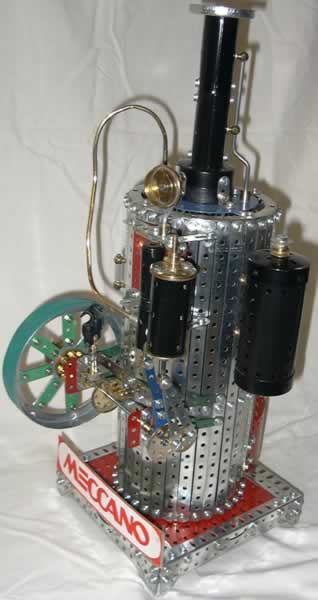
Vertical Steam
Engine
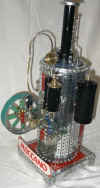
Originally designed by Brian Rowe.
Pieter built it 9 years ago and has
recently stripped it, cleaned all the parts and powder coated some and reassembled
it.
The model runs on a synchronous motor for
extended running at model shows.
Anthony Els
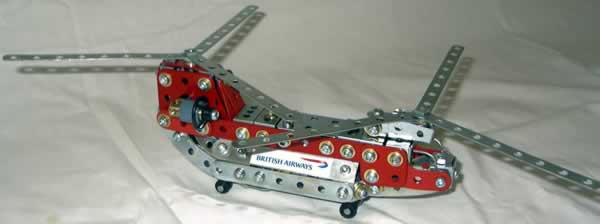
Chinook 47CH
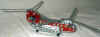
Originally
built by Jan Ringneld (Meccano Gilde Nederland).
Powered
by a 4.5v walkman motor, the blades counter rotate.
The
model is very neat, although Anthony comments that it is very difficult and
finicky modeling at this scale!
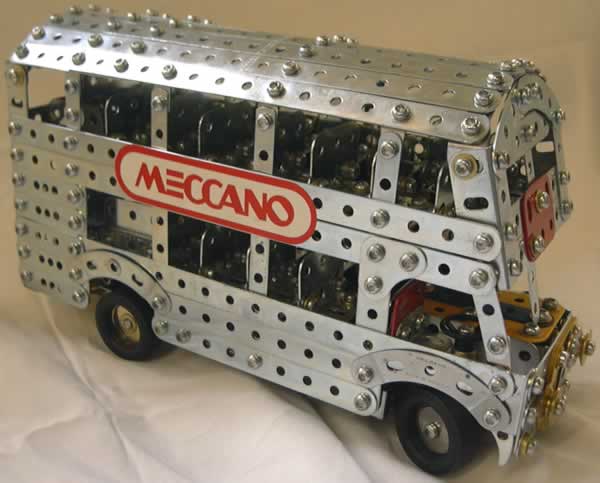
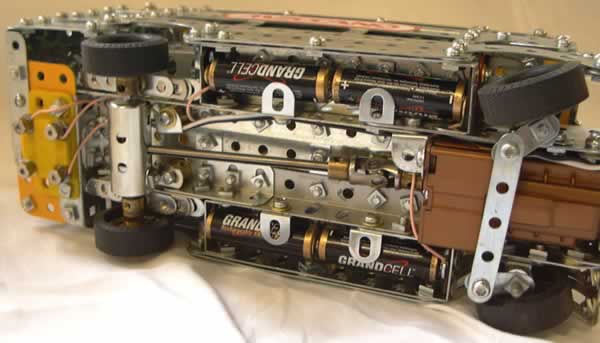
London RT Bus
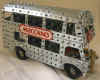
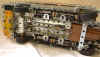
Originally built by
Terry Stuart (Canadian Meccanotes March 2003).
The model is motorized
with a MO motor through a 19:1 reduction gearbox.
Of note is the
miniature "differential". One of the new 19T pinions running on a
triangular shaft engages a
miniature plastic
collet to provide transmission of power from the propshaft to the rear axle.
|
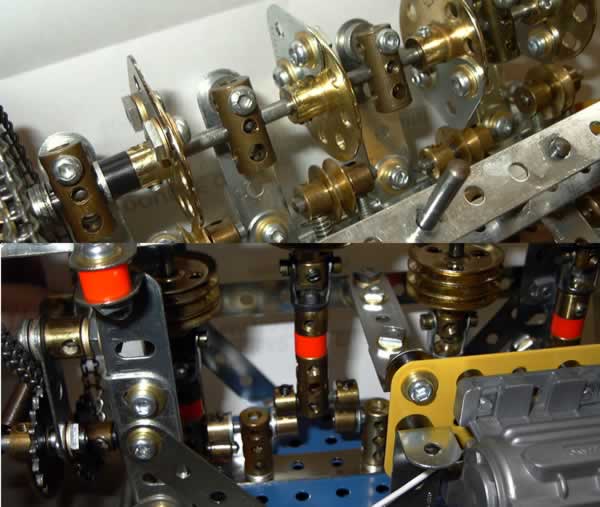
Henry Coppens
Double Overhead Cam 4 Cylinder motor
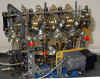
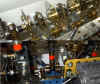

Henry
explained the intricacies of his excellent double overhead cam 4 cylinder
motor.
- 4 Valves per cylinder
- Cams act directly on
the valves
- Cam chain tensioner
- The crank is made up
from 2 collars bolted together.
Note the picture
describing the possible types of cams you can fit to his engine to suit your
needs!
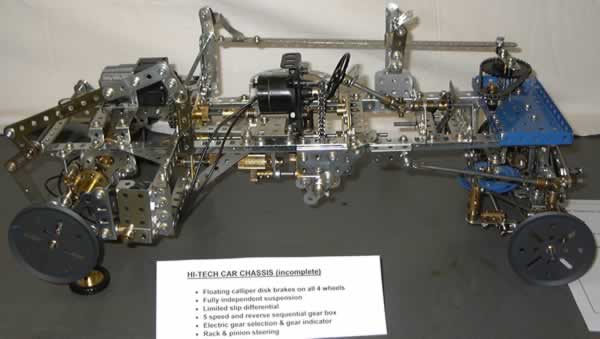
Demo Motor Chassis
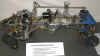
Henry explained how he was looking through
the standard mechanisms manual and the supermodel leaflet of the motor chassis.
He recons that these concepts were out of
date and decided to put together something demonstrating more modern motoring
concepts.
Henry demonstrated the following modern
principals to us.
- Working limited slip differential.
- 5 speed sequential gearbox with reverse
and gear indicator. A sequential gearbox is used in modern racing cars. You have
to go through 2nd gear to get to 3rd etc..
- Electrically driven gear selector.
- Full floating axles
- Fully independent suspension.
- Floating caliper disk brakes on all 4
wheels.
- Clutch.
- Rack and pinion steering
Note the new Exacto 12v motor used to
power the gearbox.
Chris Els
Traveling Gantry Crane
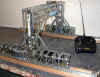
Chris
Els presented his model of the Supermodel #24, the traveling gantry crane.
The
model is fully remote controlled through the use of a 2 channel radio control.
- One
channel is used for the reverse and forward function on the main motor.
- The
second channel is used to change between the function desired : travel, luff and
slew.
This is done using Dave Heathcote's 4 function gearbox as seen at meeting
177.
LED's
on the gearbox light up as each function is engaged to give visual confirmation
from a distance.
|
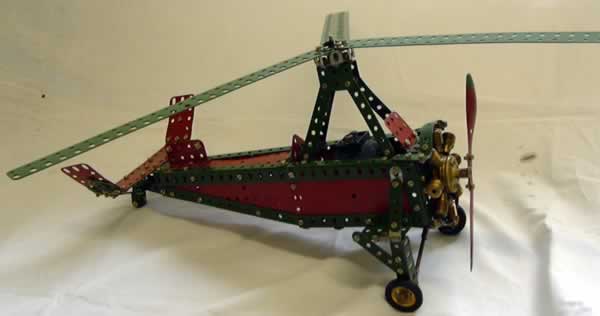
Kobus Kanfer
Autogyro (Autogiro) Copter
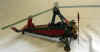
Kobus built this model from pictures of the
original built and patented by a Spaniard Gierva circa 1923.
The original generated forward motion
through the foreword propeller.
As momentum builds up, the top blades
(which are unpowered) begin to spin by wind force.
As the blades spin faster, they provide
the lift needed to keep the aircraft in the air.
The model is powered interestingly
enough by a 20v Cricket ball motor.
Graham Coombe
'A' Frame Beam Engine (Modelplan #63)
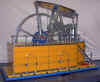
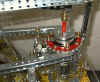
Graham showed us his
rather large 'A' Frame beam engine designed by Philip Web.
The model has all the
usual features of an engine of this type with Flywheel, Governor, Watts linkage,
Valve gear etc.
One feature on the
model was the plastic collet from the plastic Meccano series he used as a guide
for the plastic rod running
in the steam cylinder.
Notice the compact Socket Coupling as well.
The model is very
neatly done in Blue / Zinc / Yellow.
It is powered by a
photostat motor and is very quite.