The Story of the Saree
The Saree is worn in at least 10 to 15 styles throughout the India, though the ways of wearing above used to be common. In Maharashtra and North Karnataka region, wearing a nine yard Saree (without a petticoat -- long underskirt --which was superfluous) was in vogue till 20th century.
Some people think that Indian Saree is influenced by Greek or Roman toga which we see on ancient statues. This is not correct. Saree is essentially Indian and designed to suit local conditions. Cotton was cultivated in India centuries before Alexander the Great landed on the borders of India and Indian cloth (chira or Saree) was a wonder to Greek eyes. In fact, Herodotus and other ancient western historians thought there were cloth-growing trees in India!
Raja Raviverma, the distinguished painter of 19th century, toured the entire sub-continent in search of the ideal female-wear. He wanted the best dress for the various goddesses he was asked and commissioned to paint. He selected the a yard Saree which drapes the body beautifully at the same time exhibiting contours of female anatomy--bust, waist, hips. Most of the female deities he painted are in this style.An old or worn-out Saree is equally utilitarian. Grandmothers used to stitch quilts folding soft and worn-out Sarees and putting bright new cloth on cover, for children which kept them warm. Worn-out thicker Sarees were used as bed covers or blankets in the cradle (as the babies wetted it frequently). For village women, folds of Sarees serve as pouches, bags and haversack to carry grocery and at times babies as well. Some used to make a stand-by cradle out of Saree length for the baby. Tying the ends to a nearby tree. White Sarees could be turned into towels, napkins, diapers etc., even after they are worn out. Dhoti is an abridged version of the Saree sans pallu (the throw of the Saree).
Many Hero-stones (memorials for dead heroes) show the dhoti worn like breeches or shorts with Veeragachche; dagger and other weapons were tucked in dhoti folds.
With globalization, the dress of Indians is also getting westernized. But being most utilitarian, and multi-purpose Saree is still reigning in rural India and for all rituals and ceremonials it shines supreme to this day. Colorful Sarees are worn as pugrees, turbans and tribals haunt invariably women's Sarees in dances. Yakshagana dancers wear Saree designed clothes.
Parts of a Saree
Learning the parts of the Saree is important so you can talk to the vendor in technical terms.
The following picture illustrates the different parts of the Saree. (They are known by different names in different parts of India)
The most common length for a Saree these days is approximately. 5 meters (6 yards). But depending on your body shape and style of wearing the Saree, you can decide on a specific length.
Cholis or Blouse Under Construction
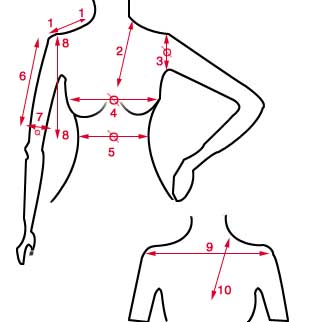
B-10.Cross Back Length
01.Shoulder to Neck *
02. Around Arm hole
03. Around Bust *
04. Around Bottom of blouse*
B-09.Shoulder
.