Warning: Potential Patent Violations (Part I)
Seek and ye shall find. If you happen to be seeking humorous subject matter, sometimes you can find it in the least-obvious places. Like, for example, the U.S. Patent office. I think it takes a certain mind-set to be an inventor; I think takes a slightly different mind-set to be what I'll call a patent inventor. Let me explain the difference. We're all inventors of sorts. Every time you've ever tried a different approach to solving a problem, you've been inventing. "Why don't you try turning that there doohicky there to the left instead of turning the thigamajig to the right?" is the most basic form of invention. Solving a problem (or not, it doesn't really matter if it actually works) by trying a different approach. You've heard the old saying "Necessity is the mother of invention," right? This is a consequence of Darwinism: those that solved their new challenges survived; those that didn't perished.
Yet inventing and patent-filing are very different beasts, indeed. For anyone to care about an invention, it needs to possess two basic attributes: it has to work, and it has to be useful in some way. However, neither of those are among the criteria for being granted a patent. It doesn't have to actually work. It certainly doesn't have to be useful. You just have to (1) file an application before anyone else does, and (2) prove to the satisfaction of the patent office that your filing is sufficiently unique from patents that have been previously granted. I have worked for several companies that placed great value on the quantity of patents awarded to their scientists and engineers. Many scientists and engineers are actually reasonably bright people, and some subset of these recognize that if their employer values patent quantity, it is in their best interests' to file for lots of patents. These people become masters at developing patentable ideas. Not necessarily useful or valuable ideas. Or even good ideas. Patentable ideas. I actually envy these folks; I was never bright enough to pursue patentable ideas; I wasted my time trying to come up with useful and valuable ideas (alright, I'll come clean, I was listed as a co-inventor on a patent application - but it was quite possibly useful). Anyway, to prove my point, I've selected a few U.S. Patents (not exactly randomly) to discuss. These are real patents; look them up if you don't believe me. Please be aware, I am sure several of you reading this have violated one or more of these patents in your lifetime. If so, I suggest you send a royalty to the patent holders immediately to make things right (tell you what, you can just paypal me, I'll forward the payments in aggregate ;-) ).
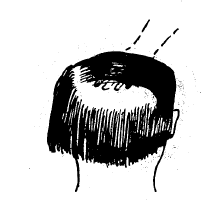
The Fold-over. U.S. Patent #4,022,227, "Method of Concealing Partial Baldness," May 10, 1997, Frank Smith and Donald Smith, inventors.
ABSTRACT: A method to cover partial baldness using only the hair on the person's head. The hair styling requires dividing a person's hair into three sections and carefully folding one section over another.
Hmmm, I've seen plenty of folk trying this (let's face it, you can't miss 'em), and I'll bet not one has ever paid a royalty to the Smiths. How would that royalty be calculated: per head or per hair? Or is that pretty much a wash in this case?
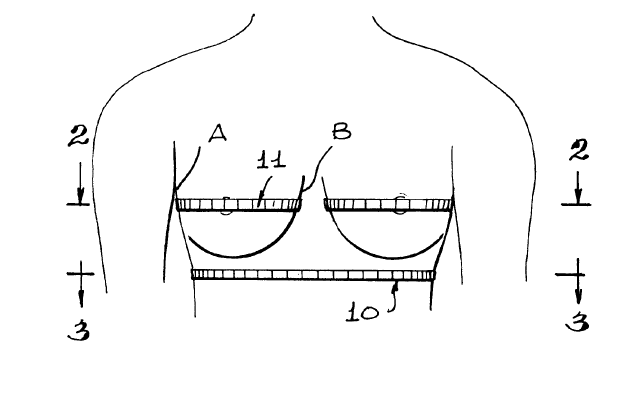
Size Does Matter. U.S. Patent #5,965,809, "Method of Bra Size Determination by Direct Measurement of the Breast," October 12, 1999, Edward Pechter, Inventor.
ABSTRACT: This relates to a direct method of measurement to determine cup size of the breast which includes band size measurement by initially measuring the user's chest or torso circumference with a flexible tape measure immediately below the breasts followed by the step of adding five inches to the measured number and incorporating conventional rounding-off procedures. Next, cup size is determined by directly measuring with the tape the circumference of each unclothed breast from the beginning of the breast mound at one side laterally to the parasternal area medially. Next a measurement conversion is made wherein a measurement of seven inches corresponds to an "A" cup size, eight inches a "B" cup size, nine inches a "C" cup, etc. Each one inch increment determines a cup size.
Eddie, you da' man. Did you come up with this scientifically, or through trial-and-error experimentation: "Huh. That's odd. According to my calculations you're a B, honey; I don't understand why you insist you're a C."
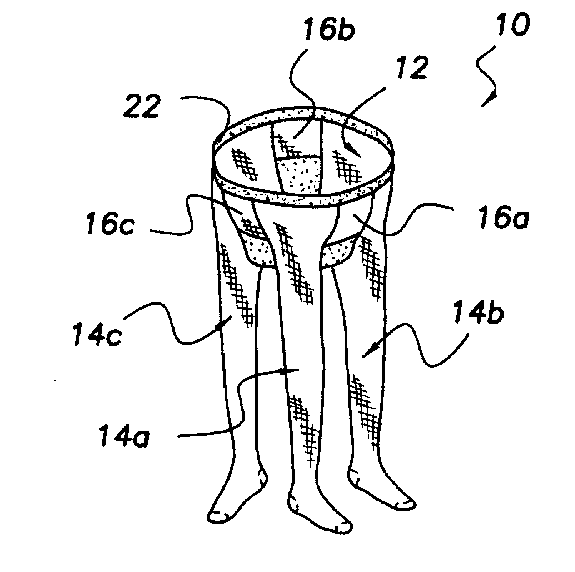
Three for the road. U.S. Patent #5,713,081, "Pantyhose Garment With Spare Leg Portion," February 3, 1998, Annette Pappas & Nita Vaccaro, Inventors.
ABSTRACT: A hosiery item including a panty member having three absorbent crotch members provided therein, each absorbent crotch member having a pocket formed therein; and three leg portions secured to the panty member in such a way such that an absorbent crotch member is positioned between any two leg portions, each leg portion having a leg insertion opening in connection with an interior of the panty member. In use the wearer inserts her legs into two of the leg opening in the conventional fashion of donning a pair of pantyhose. The remaining unused leg portion is then gathered and the toe end tucked into the pocket of one of the absorbent crotch members. If a run or hole develops in one of the leg portions being worn, the leg of the wearer can be easily and rapidly removed from the damaged leg portion and placed in the undamaged leg portion. The damaged leg portion is then gathered, folded and tucked into a pocket of one of the absorbent crotch members as wearer to select and use any two of the three leg portions for use.
(Loooong pause to regain my composure.) Oh my. Ohhh myyy. Proof indeed
that fact is stranger than fiction. Yes the drawing on the right is a scan
of the actual drawing from the patent. Guys, let me tell you what you're
gonna do the first time you have to use her bathroom and you see one of
these babies hangin' over the shower rod. Just remember: if you've already
started, finish, then tuck, then zip and then run away, in that order. You
can hold out that long, it's for your own safety.
You know the bra thing, where purportedly some women can remove their bra
while their shirt is on; it's like,
snap-wiggle-chant-an-incantation-pull-the-bra-out-from-one-sleeve? Do you
figure the same thing could be done with this garment? You know, you're out
to dinner with a date, and she's lookin' a little fidgity: "What'cha doing,
dear?" "Oh, I've got a run in my stocking." Might happen, but I don't have a
clue how she could discreetly do the fold-and-tuck part. Anyway, if these
ever hit the market, and they turn out to be too expensive, Ladies, don't
lose heart - my inventive mind is here to rescue you. Just gather, fold and
tuck a spare pair of pantyhose into the absorbent crotch member of what
you're wearing, and your troubles are long gone.
Email comments/opinions/examples to me.