|
|

|
Kyokushin Legend Visits New Zealand - Interview with Shihan Bobby Lowe 8th Dan.
Over Queens Birthday weekend IKO New Zealand held it’s annual National Full Contact Knockdown Tournament in Dannevirke. Honouring the event was the presence of lifelong practitioner and Kyokushin living legend Shihan Bobby Lowe.
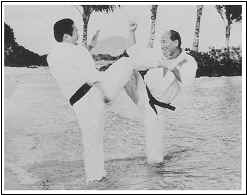
Picture above: (left) Shihan Lowe sparring with Mas Oyama (right)
Throughout his 50 years of involvement in Kyokushin Karate, Shihan Bobby Lowe has periodically lived and trained in Tokyo, Japan, and is the only active and most senior instructor who was personally taught by the late Sosai Masutatsu Oyama. On October 25, 1984, Shihan Lowe was presented his 8th dan rank, the highest in the Kyokushin system, by Master Oyama (10th dan). Shihan Lowe has travelled extensively throughout the world officiating tournaments as chief referee, and is the only instructor to have officiated in all six Kyokushin World Championship Tournaments. Prior to his introduction to the Kyokushin Way, Shihan Lowe experienced various other martial arts and fitness sports. Besides excelling in Kung Fu, Sumo and Boxing, he was awarded black belts in Judo, Kosho-Ryu Kenpo, Aikido, and Jujitsu. In 1957, under the tutelage of Sosai Oyama, he established the Hawaii Branch of Kyokushin Karate, the first school’s dojo to open outside of Japan. Shihan Bobby Lowe has over 57 years of combined martial arts training and is referred to, in Kyokushin circles, as the “instructor’s instructor”. In addition to New Zealand’s two Branch Chiefs Shihan Bob McCallum 6th Dan (Kyokushin veteran of 37 years – started training in 1965) and Sensei Steve Takiwa 4th Dan (former New Zealand full contact tournament champion over numerous years), the tournament was also attended by Canadian Branch Chief Shihan Stuart Corrigal 6th Dan and Sensei Ralph Burd 3rd who runs the Young Lions dojo in Melbourne Australia. I caught up with Shihan’s Lowe, McCallum and Corrigal at the after tournament Sayonara party and had the opportunity of speaking to each on a number of subjects in the following interview.
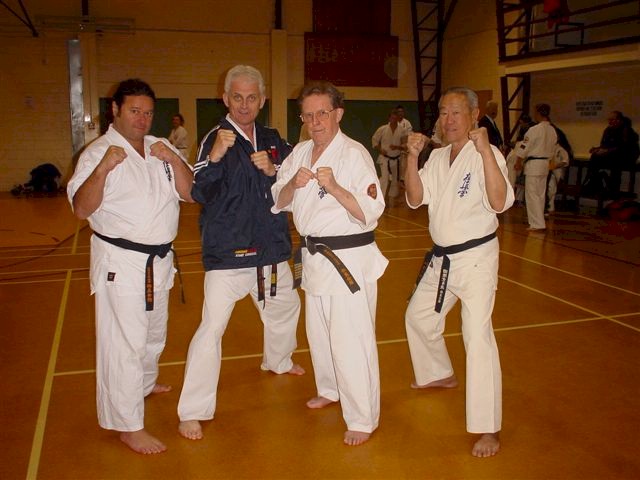
Picture
above: (left to right) Sensei Burd 3rd Dan - Melbourne Branch Chief, Shihan
Corrigal 6th Dan - Canadian Branch Chief, Shihan McCallum 6th Dan - New Zealand
Branch Chief, Shihan Lowe 8th Dab - Hawaii Branch Chief Virgil: Shihan Lowe, can you please review your early days with Kyokushin Shihan
Lowe:
In 1952, Sosai Oyama came over to Hawaii to do an exhibition. At this time, I
was already a black belt in Kempo, my dad was a Kung Fu instructor. I went to
the exhibition that Sosai was performing in Honolulu, my dad went along with me.
What Sosai did was incredible, he bent a US 25c piece with three fingers. I then
saw him perform Pinan sono yon (four) Kata, I was amazed at his power,
gracefulness and strength. My father told me “I think you should follow this
guy” . So I approached him (Sosai) after the exhibition and asked if I could
learn from him. When I went up and introduced myself and he said “why don’t
you come by my hotel tomorrow and well talk and maybe we’ll do a little
training”. That’s how I started my Kyokushin career with Oyama Sosai. At that time it was not known as
Kyokushin, it was Oyama Karate Jitsu, I think in 1955 or there abouts, he named
Kyokushin as his style of karate. Sosai also told me that if I wanted to learn
more that I should come to Japan and train with him for about 1000 days, I
didn’t know at that time, that today’s “Uchi Deshi” (live in student)
program would be built along the lines of what he taught me. I did go and train
with Sosai, but could not stay there that long because my dad got sick. Through
the years that I was in and out of Japan, he told me that “as a beginner after
the first 1000 repetitions you are still a beginner, after 10,000 repetitions
you should master it, but some will learn faster and some will take longer to
learn”. Since then I’ve been following his teachings and theories of life,
and today I still follow his teachings. Virgil: It’s been said on your self-defense video that you were Sosai’s “Spiritual Brother”, what does that mean? Shihan
Lowe:
Actually it’s not a spiritual brother; it’s more that he adopted me as a
brother. Virgil: You obviously shared a very close bond with Sosai, how did your relationship with Sosai impact on your life? Shihan
Lowe:
Prior to meeting Sosai I was always in martial arts or some other contact
sports, but after meeting and training with Sosai, I found that the contact with
Kyokushin karate was much more realistic than in the other styles of martial
arts such as kempo or Kung Fu that I had studied through the years. Boxing has
been an extremely helpful sport for me to have learned. I have incorporated some
of the movements from that boxing experience into the Kyokushin system and today
I am still learning. I never felt that at any time I have mastered such a
movement. Lot’s of times in the course of training with students, I have
learned there are alternatives to our system. Virgil: Why and when did you decide to take up the lifelong study of Goshin Jitsu (self defense)? Shihan
Lowe:
I first went to Japan in 1952, at that time training was called Goshin Jitsu. I
was taught from the very beginning that when you are learning your basics you
should train as if you are really in a fight; every movement has a
purpose. Therefore you must keep in mind when training that every movement has a
bunkai (application). In the old days training was very well
rounded. We had our basics; our Ido Geiko and we had a lot of self defense
training. But all of a sudden because the tournaments were so popular,
everything was geared towards tournament training and the Goshin Jitsu aspect
was kind of left out. In 1989 when in Canada, I was teaching
a class when Sosai walked in. He asked me if I would do some Goshin Jitsu
training, As the Goshin Jitsu training progressed, I got a surprise during one
of the self-defense movements I performed. As soon as I did this movement Sosai
called to me “Bobby, I want to see you in my room!”. I said to myself
“Holly heck, what did I do wrong?”. When
thinking back about it now, to me the movement was a simple error, but to Sosai
it was a major disaster. Anyway, Sosai corrected me and told me to try to bring
back the old system. Sosai said “include Goshin Jitsu as much as possible”.
Since then I have been trying to follow that. Virgil: In your opinion Shihan Lowe, what do you believe was Sosai’s legacy? Shihan
Lowe:
His legacy always was that you should “train, keep training, and train even
more” and that has been the legacy I try to follow. Virgil: Since Sosai’s death, the issue of who should head Kyokushin has been a hotly debated subject around the world and has significantly impacted on Kyokushin bringing about many splits. In your opinion what do you believe Sosai’s wishes were? Shihan
Lowe:
I was sitting in Sosai’s office with Shihan Peter Chong and Sosai out of the
clear blue sky asked me about Shokei Matsui being a leader. I told him that he
would be an excellent choice. I knew all along that he wanted somebody that was
younger who could reign for a longer period of time rather than to just nominate
a person in his later years that could only lead for a short period of time. So,
I said I think that’s an excellent choice, but I did not realize, that would
be the last time I would see Sosai… Virgil: What do you think has changed most about Kyokushin over the years? Shihan
Lowe:
As I mentioned, because of the popularity of the tournaments, the self-defense
aspect of Kyokushin was put aside. But Sosai’s wish was that we bring it back
into training and include it in our system. Every movement that we do has a
meaning. For example in your Uraken Mawashi Uchi you swing and bring the hand
over, the retracting arm is actually escaping from a grab, which is not taught
in many of the other systems. I think Kyokushin is a mixture of some Goju Ryu,
shotokan, Chinese Kempo as well as Korean Kempo. Virgil: What are your thoughts on Kyokushin in New Zealand in consideration of it’s past and it’s position today? Shihan
Lowe:
The last time I was here was probably five years ago, since then it has made
tremendous strides in the quality of the fighting at this tournament. I also
found it much easier to teach self defense during this visit. I hold regular
seminars in Hawaii and a lot of the New Zealand instructors such as Shihan Bob
McCallum have come over and trained with me. They have brought back the training
we have in Hawaii. Shihan McCallum and Sensei Steve Takiwa (IKO1 Branch Chiefs)
have been inserting this into the training in New Zealand. This, in my opinion,
is an excellent move on their part. I believe the fighting and training we saw
at the before and after the National Tournament was much more superior to what I
experienced five years ago. Virgil: Shihan McCallum what are your thoughts on Kyokushin in New Zealand? Shihan
McCallum:
I am sorry to see the splits in the organisation because it was a very strong
organisation, but with Steve Takiwa Sensei, we are “putting the bricks back
together”. At today’s tournament I believe we saw the beginning of a bigger
stronger wall. Many higher-grade people who previously split from our
organisation were present at the tournament and stated what a coup we had made
in having Shihan Lowe and Shihan Corrigal present. Shihan Lowe in my estimation
is a living legend, Shihan Corrigal has revolutionized Kyokushin judging on an
international scale. Having these two friends only benefits New Zealand. In relation to Shihan Lowes comments
regarding Sosai’s Successor, if you spent time in Japan over the years, you
knew who the next head of Kyokushin was going to be; there was no doubt it was
to be Shokei Matsui. It was just a flaw in Sosai’s will that people took
advantage of so they could make a break away. However, with Kancho Shokei Matsui
at the top, we have someone who is young and who is probably one of the best
technicians in the world. No one can take away from Shokei Matsui that he has
won a world tournament, an all Japan tournament and has completed the 100 man
Kumite. These are major credentials in his favor and these things can only be
good for Kyokushin. Virgil: In New Zealand we have IKO1, IKO3, Mas Oyama Kyokushin Karate (Independents), Non affiliated Kyokushin Groups and Dojos, splinter and greakaway groups such as Ashihara, CMA etc, that’s a lot of Kyokushin for a small country. Shihan Corrigal, as the Canadian Branch Chief, what are your thoughts on the New Zealand situation. Shihan
Corrigal: Interesting
you ask me this question because I am very opinionated on this subject. I have
enjoyed a very good relationship with Sosai Oyama, I have also enjoyed a
wonderful relationship with Shihan Lowe. There is no IKO1, IKO2, IKO3.. 5 or 10
or anything else, there is one IKO. Through my training and relationship with
Sosai and Shihan (Lowe) it was very clear to me many years ago what Sosai’s
intent and wishes were for the International Karate Organisation Kyokushinkaikan
(IKO). He (Sosai) named and set out in very clear terms what his legacy would be
and what the future of this organisation would be. There is only one IKO – no
numbers attached. There is an International Karate Organisation Kyokushinkaikan
and that is led by Kancho Shokei Matsui. Shihan
McCallum:
As far as I’m concerned it was plain and clear that Shokei Matsui would be the
next leader, it’s petty jealousy and egotism that has brought about the
splits. Shihan
Corrigal:
Shihan Lowe said it the best one time, “I give these people no further
thought, there is only one Kyokushin organisation”. In my opinion they are
misfits and malcontents. People often say to me “you belong to IKO1?”, I
reply no I do not, I belong to the IKO because there is only one IKO. That was
Sosai’s wish, he told me that himself. Shihan Lowe has been the longest tenure
student of any Kyokushin Karate in the world, you can ask him, and you’ll hear
the same. There has never been any misunderstanding on my part about this. In
this day and age, if we don’t like something it’s easy to find another way,
once you make that choice it gets easier the second and third time to change
again. It’s more difficult to stand by what you believe and back that in the
face of any odds. There are many breakaways; Ashihara, Enshin Karate etc, but
there is only one Kyokushin. Virgil: Where do you believe Kyokushin is going” Shihan
Lowe:
I believe Kyokushin has no limits, we have over 12 million students in over 160
countries and under the leadership of Kancho Shokei Matsui, it will continue to
grow in leaps and bounds. Something I would like to point out in relation to
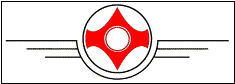
this is the meaning of the Kanku symbol of Kyokushin.
The Kanku reflects the seven continents
and five oceans, which means that Kyokushin is a universal art.
Picture above: Kyokushin Kanku
Symbol Contrary to popular belief, the wide
portions DO NOT symbolize the wrists NOR do the points refer to the mountains.
The Kyokushin Kanku represents the seven continents and five oceans. I do not
know whether internationally many instructors realize this and its significance
to the art. Shihan
McCallum:
Up and onwards, without limits. Shihan
Corrigal:
Again, I’m slightly opinionated on this one as well. Kyokushin is a young,
vibrant, dynamic and progressive style. I’ve been training for over 30 years,
I don’t have a lot of exposure to other styles and I will never speak poorly
of another style. What I will say, is that in my tenure of the past 30 years,
Kyokushin has evolved and changed even from when I started. I think that’s one
of its real strengths and I believe Sosai was really ahead of his time in this
regard in the martial arts world. There are many styles that are stuck with what
their master told them to do. Kyokushin continues to evolve and change and
there’s room for so many things. It’s not just about knockdown fighting, the
leadership we have understands that. The sky’s the limit, we can do anything
we want to do. The uniqueness of Kyokushin is that we have this ability within
our set of boundaries to make it what we want. In Canada I have over 40 dojo’s, and
everybody wants to have input, everybody wants to progress and evolve; for me
that’s really exciting. If we’re always doing the same thing, after a while
we get tired. So why DON’T we have all this drop off? Why DO we have people
like Shihan Lowe who have been training for over 50 years? It’s because
Kyokushin is dynamic and it’s always evolving and changing. In saying this we
(Shihan Lowe, McCallum, Corrigal) can’t do it like the young guys can, but its
our wisdom and knowledge that these young people want and need. I’m sure that
in another 20 years that Kyokushin and the organisation will be somewhat
different from today, and that’s a good thing. Virgil: What advice would you give to a new student starting Kyokushin and an existing Kyokushin practitioner? Shihan
Lowe:
If you’re starting out fresh, train, train and keep training. Existing
students, keep you head low and eyes high. Shihan
McCallum:
Forget the politics and get on with your training. If you concentrate on the
politics, other styles, breakaway groups, your own karate will falter. Focus on
your training. Shihan
Corrigal:
I have to go along with what Shihan Bob (McCallum) says, in this day and age for
students it’s a very immediate world. We seek immediate results, immediate
gratification for everything we do. For the new student, Kyokushin is not about
immediate gratification. Of course we want to improve our fitness, we want to
walk out of the dojo feeling good, but we have to understand that we’re in it
for the long term. And anything that’s important in your life and in this
world is achieved over a longer period. It’s not the instant gratification you
get when you sit at a computer and push a button and get somebody’s spin on
their web page about what Kyokushin is. So for the new students, as Shihan Lowe
says train, train and keep training, the only way you can truly understand what
this means is by training harder and harder, more and more. For the existing and long-time
Kyokushin students, again because of the immediacy of communication, you’ve
got to talk less and train more. That’s the bottom line, forget about the talk
and get on with the training and you will learn what Kyokushin is all about.
Forget the talk! Virgil: Finally, are there any thoughts you would like to like to leave with our readers. Shihan
Lowe:
Keep training, training and forget politics. Shihan
McCallum:
Have good friends, like the people I have around me now, respect them, don’t
back stab them and get on with your training. The old way is still the new way,
pay respect to your Shihan, Sensei and Senpai etc. If we keep that in mind we
won’t trip, we’ll keep moving forward from strength to strength. I have
great faith in this. Shihan
Corrigal:
I’m sitting here 10-12,000 miles away from home, yet I feel like I am home.
Kyokushin is family, and as with many large families there are a number of
people here I don’t know, there are many people I do know, yet we all share a
common bond and that’s a love of Kyokushin. In the end that’s all that
really matters. Virgil: Osu! Shihan’s, thank you for your time.
About
the interviewer: Virgil Troy is Dojo Head of the Napier
Kyokushin Karate Club under Shihan Bob McCallum of the International Karate
Organization, Kyokushinkaikan. Virgil works as a Management and Training
Consultant in the fields of Management, Customer Service and Marketing. Virgil
can be contacted on (06) 834 1996, PO Box 264, Napier or by email at karate@sti.co.nz.
For more information on Kyokushin in New Zealand go to www.sti.co.nz/karate ,
www.kyokushin.org.nz
|
|
Website designed and maintained by Virgil Troy |