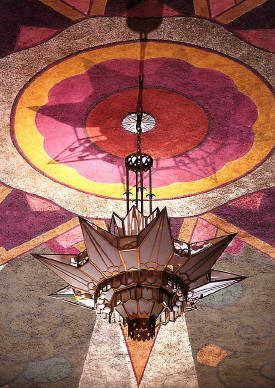
This Magnificent Art Deco
Chandelier, a Centerpiece of the
Original Fox Tucson, Has
Recently Been Restored to
Pristine Condition
by the
Fox Tucson Theatre
Foundation
This Magnificent Art Deco
Chandelier, a Centerpiece of the
Original Fox Tucson, Has
Recently Been Restored to
Pristine Condition
by the
Fox Tucson Theatre
Foundation
The Passing of an Era
The Golden Age of Hollywood was an extraordinary period in many ways. It was an era of great films and of larger-than-life film stars. It was an age of a unique American idealism that found its ideal expression in the medium of film. Correspondingly, it was also the age of the grand Film Palace, lavish movie theatres erected throughout the country to showcase the pictures being mass produced by the studios of the day. Ornate, enormous, and opulent, these film theatres were achievements of architectural art and enduring representations of the tastes and sensibilities of an era of American history that has long faded. Sadly, the passing of time has seen the destruction of most of these theatres and few survive today. As early as the 1950's, these remarkable buildings were regularly torn down, a turn of events so disheartening that even Life magazine was prompted to publish its famous photograph of Gloria Swanson standing among the ruins of the recently demolished, once-great Roxy Theatre. The Film Palace of old was that very rare thing, a meeting of art and intellect and architecture and popular culture; its demise has indeed been a blemish upon modern American attitudes which would so easily allow such beauty to be eradicated from our lives.
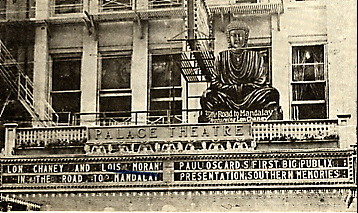
The marquee of one of the better known theatres of the
Golden Age, the Palace Theatre in New York. Taken in 1926,
this photograph shows the theatre as it appeared at the time
it screened The Road to Mandalay, starring
Lon Chaney and Lois Moran. Theatre managers of the day
combined their efforts with those of studio publicists to
create displays and motifs in marquees and lobbies to match
the theme of the film at hand. Here, no expense was
spared in promoting the Oriental locale of the picture.

A Golden Age Revisited
It is good news both to historians of film and of architecture that in recent years there have been concentrated efforts aimed towards restoring some of the great Film Palaces of old that have survived. Disney's magnificent restoration of the El Capitain Theatre on Hollywood Boulevard in Hollywood is a notable example of such restoration projects that have thus far been completed.
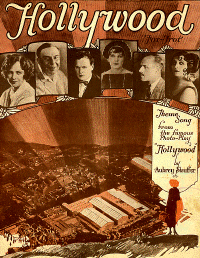
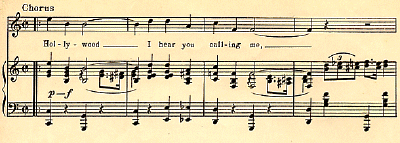
1920's sheet music celebrating
the glory that was
Golden Age Hollywood,
the era of the
Fox Tucson Theatre
In Tucson, Arizona, work is underway on the restoration there of the Fox Theatre, an Art Deco masterpiece that opened in 1930 and closed in 1974. A group of dedicated community leaders and preservationists has set to work upon the daunting task of converting the theatre, little more than a ruin since its closure, into the spectacular showplace it once was. Headed by Herb Stratford, the Board of Directors of the restoration committee, which includes Lois Moran's son Col. Timothy M. Young, is enmeshed is a complex undertaking of enormous financial and artistic challenges. "The old Fox Tucson is part of our collective past," explains Col. Young. "Restoring it to its original beauty is an important part of reclaiming Tucson's history and preserving it for future generations."
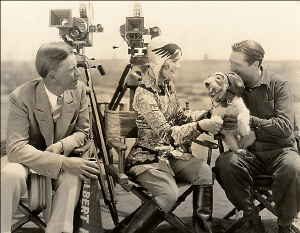
A momento of Old Hollywood, the era of
the Classic Film Palace such as the Fox Tucson:
Director Albert Ray, Lois Moran, Edmund Lowe and Friend,
on the set of the William Fox production,
Publicity Madness,
1927
It is entirely fitting that Col. Young
should be playing a part in the restoration of the Fox Tucson, for the great
film palaces of the past played an important part in his mother's career.
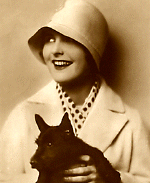 In New York City alone, the film that made her a star in 1925, Stella Dallas,
premiered at the Apollo Theater; her 1926 Lon Chaney film, The Road to
Mandalay, played at the gorgeous Palace Theatre; and God Gave Me 20 Cents,
a 1926 film in which she starred with Lya de Putti, had the honor of being the
first film shown at the spectacular Paramount Theater, one of the most expensive
and lavish film palaces ever erected. Lois' films played at similar
high-profile theatres throughout the country during the course of her career,
including the Fox Tucson.
In New York City alone, the film that made her a star in 1925, Stella Dallas,
premiered at the Apollo Theater; her 1926 Lon Chaney film, The Road to
Mandalay, played at the gorgeous Palace Theatre; and God Gave Me 20 Cents,
a 1926 film in which she starred with Lya de Putti, had the honor of being the
first film shown at the spectacular Paramount Theater, one of the most expensive
and lavish film palaces ever erected. Lois' films played at similar
high-profile theatres throughout the country during the course of her career,
including the Fox Tucson.
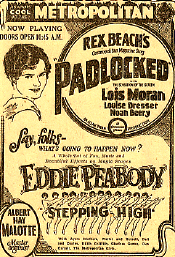
Vintage Movie Palaces
such as the Tucson Fox
placed advertisements in local
newspapers for their upcoming programs.
This is an ad for the Metropolitan Theater's
showing of Padlocked, 1926, a huge
film in its day and one of Lois Moran's
greatest successes
The Fox Tucson Theatre Foundation welcomes your inquiries! Much work has already been accomplished, including the difficult restoration of the theatre's magnificent Art Deco chandelier, but a great deal has yet to be done. For more information, please click on the original Fox Theatre tile, below, to access the Foundation's website.

Please follow this link
for information on the
Fox Tucson Theatre Foundation
Fox Tucson Theatre Foundation
P.O. Box 1008
Tucson, Arizona 85702
Phone (520) 624-1515
Fax (520) 624-5855
Web Site:
www.foxtucsontheatre.org
Email:
foxtucsontheatre@yahoo.com
"Saving the Fox Tucson Theatre
is that rare kind of project that can bring
together a whole community. As a wellspring of
nostalgia and a time capsule from a bygone era,
this project crosses economic and racial lines,
reminding us of a different time when
the world was a smaller place."
-- Herb Stratford,
Executive Director,
Fox Tucson Theatre Foundation
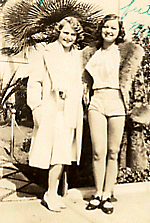
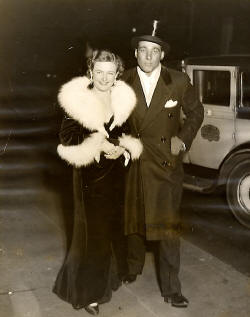
Lois Moran Poses with a Fan,
ca. 1930, at the Zenith of the
Studio System and of the
Film Palaces
Erected to Show Its Films
The 1920's and 1930's:
America Meets the Movies.
Hollywood!
Enter:
The Era of the
Film Palace