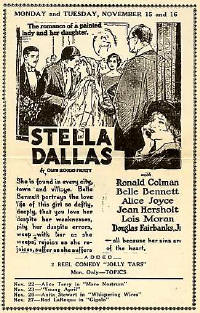
Advertisement for
Stella Dallas,
dating from the time of
its original release
Lois Moran, at 16 years of age,
enacting the
most famous role of her career,
Laurel in
Stella Dallas, 1925
"If any heart fails to throb
to
Stella Dallas,
the trouble is with the heart
and not with the picture" --
Palmer Smith,
the New York Evening World,
1925
The Impressive Vogue of Stella Dallas:
Advertisement for
Stella Dallas,
dating from the time of
its original release
Henry King, the director of Stella Dallas, revealed in Kevin Brownlow's book The Parade's Gone By ... that Lois almost did not get to play Laurel Dallas because of her dancing background. King explained that he was concerned that because Lois was a dancer her legs may have been too muscular for the girl in the film. He recalled that he said to Goldwyn, "Well, Sam, from the neck up she's marvelous. But she has to play a child as well as a woman. What kind of legs does she have?" Goldwyn replied, "You know, Henry, much as I've been around in my life, this is the first time I forgot to look at a girl's legs." King then went to Lois and explained the situation, whereupon she pulled up her skirt and said, "There they are -- how are they?" She passed. (In later years, Lois would comment that she was one of the few actresses who never had to show her legs to get a part, no doubt a true statement if one discounts this early episode.)

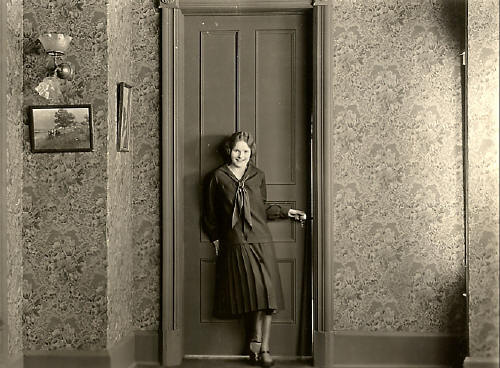
Lois Moran in Stella Dallas
Youthful Optimism, Adult Weariness
Based on the hugely successful novel by Olive Higgins Prouty (one critic referred to the book's popularity as an "impressive vogue"), Stella Dallas proved to be a remarkable success. In The Films of Ronald Colman, Lawrence J. Quirk explains that the film cost one-half million dollars to make and in the next five years grossed four times that amount. The unusually high quality of the cast was, surely, a key element of this triumph. In a compelling performance as Stella, the vulgar but well-intentioned mother who sacrifices so very much for her daughter's happiness, Belle Bennett accomplished some of the finest work of her career; Colman suavely effected the part of Stella's husband, Stephen; and Lois' portrayal of the daughter illuminated scene after scene.
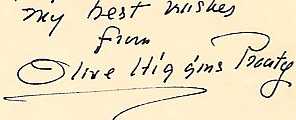
Autograph of Olive Higgins Prouty,
one of the great, albeit underrated, writers
of the first half of the 20th century.
In addition to Stella Dallas,
Prouty authored works such as
Now, Voyager and Home Port.
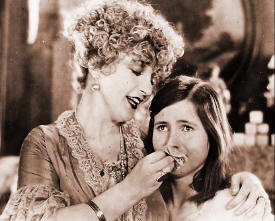 At 16, Lois was just a child actress, but in her best
moments she was able to temper youthful optimism with an adult weariness that
made her quite haunting. There is a sequence, for example, in which
Laurel, upon the occasion of her tenth birthday, is ostracized by her peers and
left stunned and devastated to celebrate alone with her mother. Lois here
enacted a character who in the course of a few minutes transforms from a state
of euphoria to one of enraged despair. The result was dramatically
wrenching, a memorable example of silent-era acting at its most electric; and,
although it would be inaccurate to state that because of scenes such as this
Lois stole the film from Bennett, she did come close to doing so. In fact,
her impact as such that when Grosset & Dunlap published the film edition of the
novel, of the eight stills from the movie it selected to include in the volume,
six depicted Lois while only four showed Bennett.
At 16, Lois was just a child actress, but in her best
moments she was able to temper youthful optimism with an adult weariness that
made her quite haunting. There is a sequence, for example, in which
Laurel, upon the occasion of her tenth birthday, is ostracized by her peers and
left stunned and devastated to celebrate alone with her mother. Lois here
enacted a character who in the course of a few minutes transforms from a state
of euphoria to one of enraged despair. The result was dramatically
wrenching, a memorable example of silent-era acting at its most electric; and,
although it would be inaccurate to state that because of scenes such as this
Lois stole the film from Bennett, she did come close to doing so. In fact,
her impact as such that when Grosset & Dunlap published the film edition of the
novel, of the eight stills from the movie it selected to include in the volume,
six depicted Lois while only four showed Bennett.
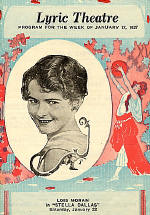
Souvenir Flyer from a
screening of Stella Dallas
at the Lyric Theatre, ca. 1926
"Infinitely the finest picture I have ever seen by a very long way"
Audiences and critics were unusually laudatory of the picture. The original studio herald quoted Cecil B. DeMille as saying, "Stella Dallas is one of the few great screen achievements and will appeal strongly to all classes and intellects." The same herald cited also this statement from John Barrymore: "Stella Dallas is infinitely the finest picture I have ever seen by a very long way." And Palmer Smith went so far as to pen in the New York Evening World, "If any heart fails to throb to Stella Dallas, the trouble is with the heart and not with the picture."

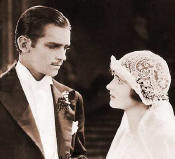
Douglas Fairbanks, Jr.
and Lois Moran:
The Wedding Sequence in
Stella Dallas
Douglas Fairbanks, Jr., who played the young man Laurel marries, described Lois in his memoirs, The Salad Days, as "a young wisp of a girl," but the part made her instantly famous. In its 1926 cover story, Photoplay noted that because of Stella Dallas, Lois "needed only one part to make her a personage," adding that the film helped her to "win her spurs more swiftly" than other young actresses of the day. The magazine went on to remark that hers was "a hard role, played opposite Belle Bennett, an experienced actress, who gave a performance amounting to genius. Yet Lois' playing was almost as distinguished as Miss Bennett's."