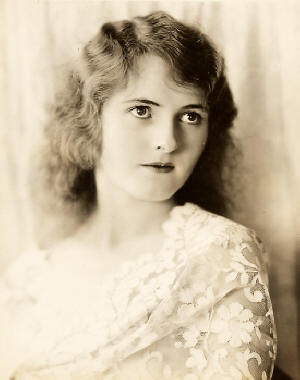
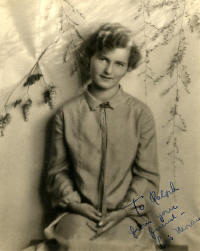
Charming photograph of Lois Moran, ca. 1925
The Early Years
1908-1925
Charming photograph of Lois Moran, ca. 1925
The following subjects are covered in this portion of the Lois Moran Website. Please click on any of the topics to navigate directly to that portion of the text.
"Nothing Is Impossible to a Moran"
To view a separate representation of most of the pictures on this Website, please click on the desired picture.

Lois Moran, New York, 1925,
shortly after her return
to America from Paris
"Nothing Is Impossible to a Moran"
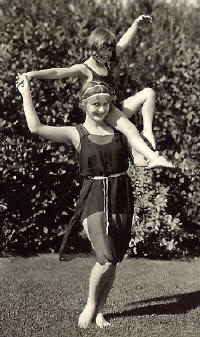 Lois Moran was born Lois Darlington Dowling to parents Gladys and roger on March
1, 1909 in Pittsburgh. Her father died in an automobile accident a year
later. Gladys subsequently married Timothy Moran, who adopted Lois.
Just before he was to go overseas during World War I, when Lois was nine,
Timothy died in influenza. In a 1932 Collier's article, Henry F.
Pringle reported that during her Hollywood years, Lois was inspired by her
stepfather's family motto, "Nothing is impossible to a Moran." (Not
unexpectedly, Betty Moran, Lois' adopted sister, also enjoyed a career as a film
actress.) As a young girl, Lois was much the tomboy and enjoyed being
called by her nickname "Billie."
Lois Moran was born Lois Darlington Dowling to parents Gladys and roger on March
1, 1909 in Pittsburgh. Her father died in an automobile accident a year
later. Gladys subsequently married Timothy Moran, who adopted Lois.
Just before he was to go overseas during World War I, when Lois was nine,
Timothy died in influenza. In a 1932 Collier's article, Henry F.
Pringle reported that during her Hollywood years, Lois was inspired by her
stepfather's family motto, "Nothing is impossible to a Moran." (Not
unexpectedly, Betty Moran, Lois' adopted sister, also enjoyed a career as a film
actress.) As a young girl, Lois was much the tomboy and enjoyed being
called by her nickname "Billie."
Gladys, a descendant of the German poet and dramatist Friedrich von Schiller, discerned that Lois photographed superbly and radiated charisma. Wanting the best for her daughter, and reasoning that Europe was the place to be for the girl to receive a cultured upbringing, she took Lois in 1919 to live in Paris (where they stayed in a hotel which was occupied by Ulysses author James Joyce and which was in proximity to the home of famed expatriate writer Gertrude Stein).
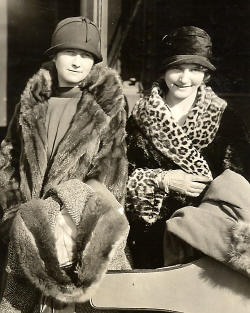
Lois (right) and her mother Gladys, 1925
In a 1931 interview she and Lois gave to Mabel Duke of Picture Play, Gladys explained how she concluded that performing would be the best career for her child. "Lois had no other specific talent that I had observed," she said, "but she was emotionally sensitive, fairly pretty, and free from self-consciousness. And with those three qualities, any girl can learn to be a successful actress." In Paris, Lois danced with the Paris National Opera from the time she was 12 until she was 14 (as will be seen, a fact that almost cost her her first opportunity in Hollywood films). According to a 1929 Picture Show article, her solo dance in Falstaff earned her much adoration from Parisian audiences.
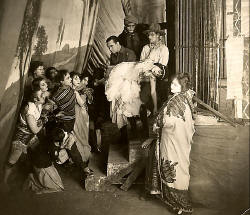
Still photograph from
La Galerie des Monstres,
1924
 As a result of her increasing celebrity, a variety of photographers, including
Man Ray and Fontaine (of Paris), snapped portraits of her, some of which came to
the attention of the French film director Marcel L'Herbier. Recognizing
her potential, he cast her in two of his films, both starring continental
matinee idols: La Galerie Des Monstres (1924, which Jacques
Catelain) and Feu Mathias Pascal (The Living Dead Man) (1925, with
Ivan Mosjoukine). Film scholar Georges Sadoul, in his Dictionary of
Films, wrote of the latter, a visually sumptuous piece, "This is Marcel
L'Herbier's best film," and noted that it is notable for its "documentary-like
use of exteriors (shot in Italy)."
As a result of her increasing celebrity, a variety of photographers, including
Man Ray and Fontaine (of Paris), snapped portraits of her, some of which came to
the attention of the French film director Marcel L'Herbier. Recognizing
her potential, he cast her in two of his films, both starring continental
matinee idols: La Galerie Des Monstres (1924, which Jacques
Catelain) and Feu Mathias Pascal (The Living Dead Man) (1925, with
Ivan Mosjoukine). Film scholar Georges Sadoul, in his Dictionary of
Films, wrote of the latter, a visually sumptuous piece, "This is Marcel
L'Herbier's best film," and noted that it is notable for its "documentary-like
use of exteriors (shot in Italy)."
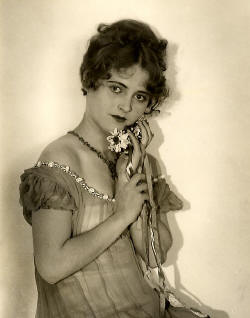
Rare early portrait photograph,
ca. 1924,
of Lois Moran
At Gladys' encouragement, Lois sent photographs of herself to D.W. Griffith and to Samuel Goldwyn. Goldwyn traveled to Europe in 1925 in search of new film talent, met with Lois, and viewed her two French films. Impressed, he wanted to cast her as the lead in Romeo and Juliet with Ronald Colman, but that film never materialized. He was able to offer her the role of Laurel in what would be one of the best silents, Stella Dallas. Lois had stage aspirations, however, and appeared in a trial run in Atlantic City of Marc Connelly's play The Wisdom Tooth, as the wisdom tooth fairy, before Gladys accepted Goldwyn's offer on her behalf.
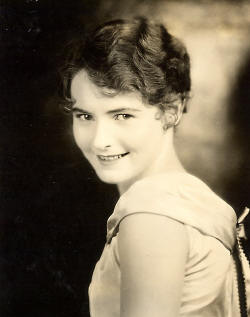
Another early photograph of
Lois Moran