COUNTRY UPDATE |
MALAYSIA |
|
National
Archives of Malaysia |
||||
|
Since its
inauguration in 1957, the National Archives of Malaysia has untiringly
embarked on various acquisition programs in its endeavors to fulfill its
mission, which is to hold in custody and preserve archival materials
pertaining to the nation's history and to disseminate information regarding
their importance to the public. The National Archives Act of 44/1966 provides
for the maintenance of all categories of records, including audio-visual
records. However, due to the lack of storage and preservation facilities, the
acquisition of film and video materials were not actively pursued until 1982.
Prior to that, the audio-visual materials available in the holdings of the
Archives were mostly still photographs and negatives. The shift
to its own premises in 1982 brought about a change in the audio-visual
archiving scenario. The National Archives began actively acquiring archival
materials in the form of films, tape recordings, video cassettes, gramophone
discs, negatives, and CDs with the purpose of building up the national
collection. Currently, the Archives have made arrangements with the National
Film Department and Radio Television Malaysia for the deposit of film, video
and audio materials. Apart from this, a small percentage of films,
particularly documentary films, were acquired from overseas such as Visnews
Library, London as well as NHK, Japan. The
National Archives is currently embarking on an aggressive program to step up
acquisition of the national film heritage. In 1997, the National Archives of
Malaysia was alerted to the fact that Mandarin Laboratory (international),
Hong Kong was holding a collection of master negatives of Malay feature films
produced by local production houses |
|
during the 1960's and 1970's
and sent to Hong Kong for processing. A total of 100 titles of feature films
were identified and notification was made in the Malaysian newspapers of the
intention to transfer custody of the films to the Malaysian Archives. Due to
claims made on the films by some production houses, only 44 titles were
ultimately transferred in September 1998. This was an
encouraging |
|
start to the program to acquire feature films produced by
the private producers. At present,
Malaysia produces about 15 feature films a year and perhaps from 300 to 400 television
dramas and serials a year beside inhouse productions by the television
stations. Unfortunately, most of these Continued on page 10 |
|
|
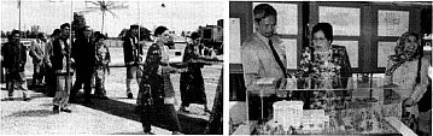
A new
building for the National Archives
Ground-breaking
ceremonies at the National Archives of Malaysia |
|||
|
|
The
National Archives Kedah-Perlis branch was established on March 1, 1979 and is
situated on the ground floor of the Federal Building, Alor Setar, Kedah. It
was originally responsible for preserving all records of federal and state
government departments including statutory bodies in the northern region of
peninsular Malaysia, i.e. Kedah, Perlis and Penang. Penang had it's own
branch on January 1, 1988. The need
for the National Archives Kedah-Perlis branch to have its own building
suitable for the preservation and management of archival materials and
records received the attention of the federal government of Malaysia as well
as the state government of Kedah. The initial planning began in 1986 when the
National Archives bought five acres of land in Kedah proposedly to build the
branch building. |
|
The project was held up due to many unforeseen problems
concerning its site. This
building has six floors with a total floor space of 90,000 sq. feet. It
consists of 10,000 sq. feet for offices and working area; 60,000 sq. feet for
records repository; and 20,000 sq. feet as public area.The repository for
audiovisual records such as films, tape recordings, video cassettes, etc.
will be placed on the second floor occupying 3,060 sq. feet. The
ground-breaking ceremony for the National Archives Kedah-Perlis building was
officially launched by the Kedah Menteri Besar Dato' Seri Hj. Syed Razak bin
Hj. Syed Zain Barakbah on May 15, 2000. The project is expected to be
completed in July 2001. |
|
Page 6 – AV Archives Bulletin |
January-June
2000
|