 Home, Eh
Korea or Bust!
Leaving Alberta
Hangin' in Vancouver
Flying to Korea
English Institutes
Elite Institute
POLY School
Korean Events
World Speedskating
Royal Palace Visits
Seoul Demonstrations
A Day at "Lake Park"
Spring Flower Festival
Japan Cruise
Introduction
Flight to Busan
Superstar Taurus
Fukuoka, Japan
Kagoshima, Japan
Sakurajima Volcano
Captain's Table Dinner
Busan, South Korea
Korea by Rail
People, Places & Food
Interesting People
Fascinating Sights
Delicious Korean Food
Living in Korea
Home Sweet Home
Xenophobia
Korea's Scariest Sight
Other Sights / Sites
More about
Korea
Potpourri
O' Pics
Links to Other Great Sites
Contact Gary
Email Seoul Canadian
Sign
Guestbook
View Guestbook
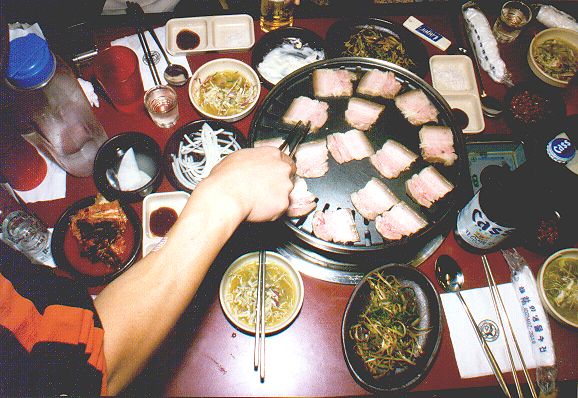 |
People who love large amounts of fruit, vegetables, garlic, beef, pork, poultry, seafood, ultra-hot spices and, of course, rice are in gastronomic heaven when they come to Korea! As the images reveal, Korean meals involve incredible variety plus plenty of exciting visual stimulation. Generally, the food is all served at the same time - with no such thing as successive "courses" - and there are no strict rules about when to eat what.
During my first few months here, I
experienced major difficulty with using chopsticks and, <blush>
was occasionally panic-stricken at the prospect of going hungry.
Thankfully, however, many Korean restaurants do have a few forks 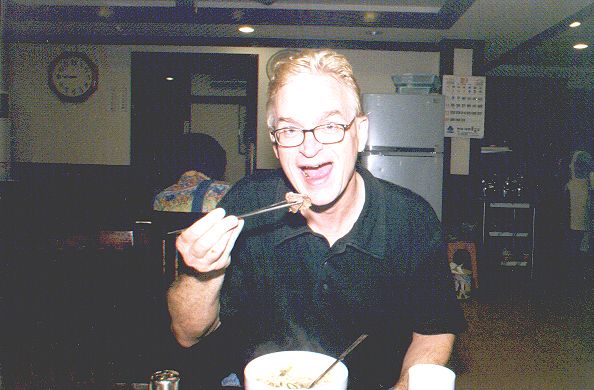 kicking
around and, when the servers see you struggling, they'll often bring you
one. And as you can see on the right, I've finally achieved some level of
mastery in the "eastern science of chopstickology." Once
thing I didn't realize or expect is how much physical strength is actually
required to effectively use chopsticks. Even after living here for almost
a year, I still find myself occasionally having to rest my tired and sore
chopstick fingers during a meal. On the other hand, I've also discovered
that, with certain kinds of foods, chopsticks are much more efficient than
forks!
kicking
around and, when the servers see you struggling, they'll often bring you
one. And as you can see on the right, I've finally achieved some level of
mastery in the "eastern science of chopstickology." Once
thing I didn't realize or expect is how much physical strength is actually
required to effectively use chopsticks. Even after living here for almost
a year, I still find myself occasionally having to rest my tired and sore
chopstick fingers during a meal. On the other hand, I've also discovered
that, with certain kinds of foods, chopsticks are much more efficient than
forks!
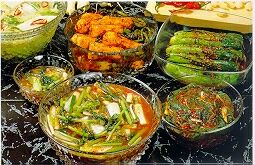 Besides
rice, another staple of the Korean diet is something called "kimchi"
(pronounced KIM chee) This delightful stuff comes in over 100 different
varieties and it's something that is part of almost every meal. The
vegetables most commonly used in its preparation are celery cabbage,
Chinese turnip, and cucumber. The prepared vegetables are sliced, seasoned
with red pepper, onion, and garlic, and fermented in brine in large
earthenware jars. Dried and salted shrimp, anchovy paste, and oysters are
sometimes used as additional seasonings. During fermentation, which takes
approximately one month depending on weather conditions, the kimchi jars
are stored totally or partially underground in cellars or sheds built
expressly for this purpose.
Besides
rice, another staple of the Korean diet is something called "kimchi"
(pronounced KIM chee) This delightful stuff comes in over 100 different
varieties and it's something that is part of almost every meal. The
vegetables most commonly used in its preparation are celery cabbage,
Chinese turnip, and cucumber. The prepared vegetables are sliced, seasoned
with red pepper, onion, and garlic, and fermented in brine in large
earthenware jars. Dried and salted shrimp, anchovy paste, and oysters are
sometimes used as additional seasonings. During fermentation, which takes
approximately one month depending on weather conditions, the kimchi jars
are stored totally or partially underground in cellars or sheds built
expressly for this purpose.
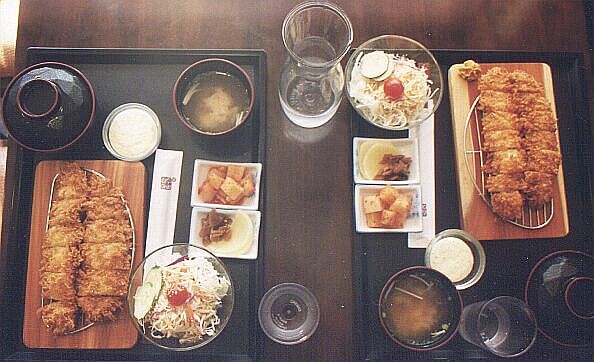 Another
wonderful aspect of life in Korea is the "fusion" of Korean food
with the best foods of other countries. One of my personal favorites of
these fusion meals is the Japanese style pork and fish cutlet dinner. Not
only is it very delicious but, as you can see, it is served in a most
visually appealing manner. By the way, all the side dishes that you see,
including soup, salad, kimchi, and other condiments, are all refillable.
Whenever you run out of something, you just push a button to summon a
server, and they bring more out to you right away--with no limits. This is
typical in all Korean restaurants.
Another
wonderful aspect of life in Korea is the "fusion" of Korean food
with the best foods of other countries. One of my personal favorites of
these fusion meals is the Japanese style pork and fish cutlet dinner. Not
only is it very delicious but, as you can see, it is served in a most
visually appealing manner. By the way, all the side dishes that you see,
including soup, salad, kimchi, and other condiments, are all refillable.
Whenever you run out of something, you just push a button to summon a
server, and they bring more out to you right away--with no limits. This is
typical in all Korean restaurants.
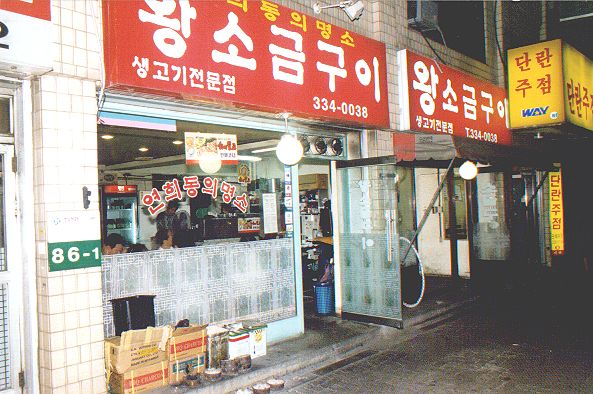
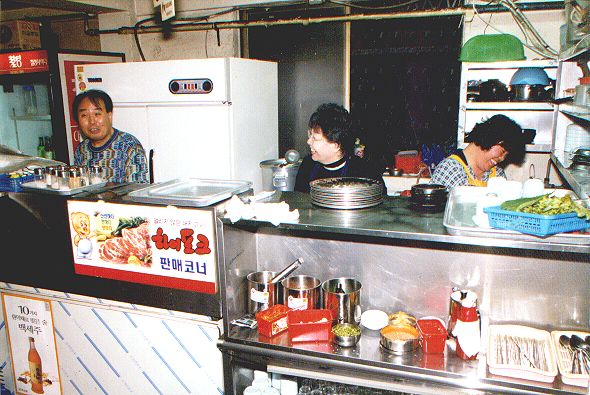
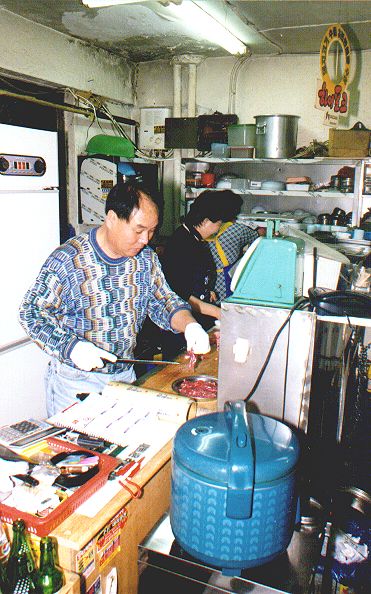
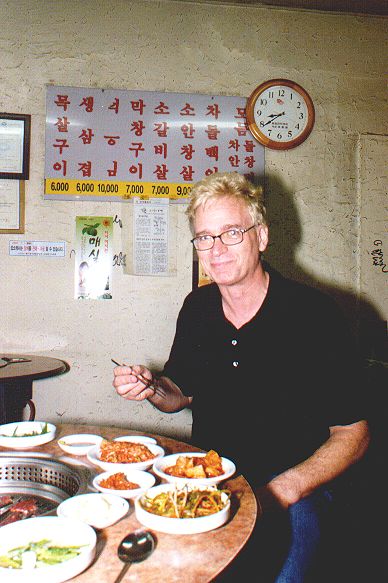
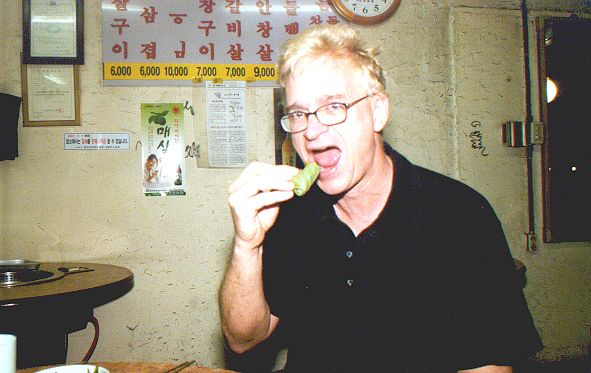
The next series of pics was taken at my favorite restaurant in all of Seoul. I eat here two or three times a week - provided there's room, it's so busy - and I usually have a cut of beef called "anchung" which is barbecued at the table, then dipped in seasoning, sprinkled with some vegetables, and wrapped in lettuce or some other kind of large green leaf. Then, it's just popped into the waiting, salivating mouth and enjoyed very, very much!
|
My favorite restaurant in Seoul! I have no idea what it's called, but I sure know how to get there! |
 |
|
The hard working, very friendly (but shy) staff at this great eatery. |
 |
|
This is the owner,
carefully cutting and weighing the beef. CLICK! to see the full |
 |
| The spread, right after being served, just when the cooking begins! | 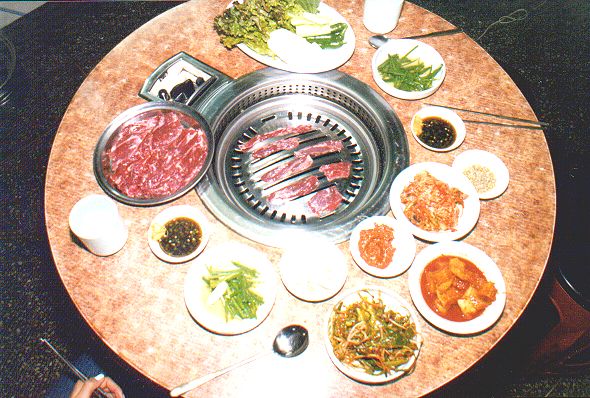 |
| Me, getting ready to
demonstrate the "art" of eating "anchung,"
Korean Style. CLICK! to see the full, uncropped version |
 |
| Once the meat is in the leaf, sprinkle it with whatever you want... | 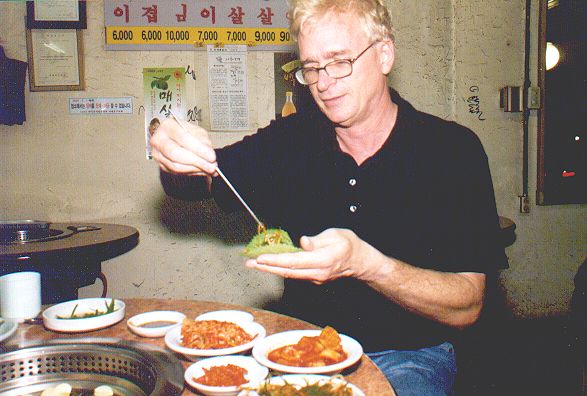 |
| Then wrap it up... ...and pop it in! |
 |