
Welcome
to the
HAIRLESS RAT HEADQUARTERS!
I am a breeder of hairless rats. Yes, hairless. A lot of people don't know about hairless rats, and a lot of people don't know much about hairless rats. I am here to diffuse that ignorance and fill your mug of knowledge to the brim with information, like it or not!
I first saw a hairless rat when I was at a Denver petshop in 1993. They had a bunch of them in this ten gallon aquarium, all huddled together like they always seem to be. I had never seen anything like them. I thought it would be cool to get one, but we were on vacation, and my parents weren't going to bring a rat around with us for the rest of the vacation. So I forgot about it.
When it was creeping closer to Christmas time, I put "hairless rat" on my christmas list, more of a gag than anything, not really expecting to get one. But come Christmas morning, there it was, a female hairless rat. She was a beauty if rats can be beautiful. I had her for a month or two when I thought it would be cool to breed her, so I convinced my dad that we needed a male hairless rat, who convinced my uncle in Denver to buy one for us when we went out there. When we did get out there the rat my uncle had for us was a female! The pet store we talked to tried to get a male, but could only get us a female, so my uncle bought it anyway. When we got back home, we decided that we were just going to have to breed it to a male normal rat, and then breed them back together to get hairless rats, assuming that hairlessness was recessive. The only problem was is that my first hairless female rat got sick, I don't know what of, but I think it was pneumonia. She got sicker and sicker, till she seemed to be skin and bones before she died. The second hairless rat died of a similar disease. We thought that maybe the normal rat might have been carrying a disease, but I don't know. I've had a few die of a similar thing since. The vet said she was beyond help when we took it in, so I just don't know.
Anyway, a few years later, in December of '95, I saw some hairless rats in a pet store in Provo, Utah. So I bought a pair of them, male and female. All the pictures I have of hairless rats are of these two. They never had babies as a pair, but I bought a female normal rat with the intent of breeding the babies back to the father, again assuming that hairlessness was recessive. The female hairless died in May, but the normal female gave birth to a large litter of about 10 or 13, I think. Some of them died, but I had some nice results.
Hairless Rat Genetics
I came to an interesting conclusion. There are at least two forms of hairlessness, maybe more. But it seems to me that one form of the hairless gene is co-dominant. That means that the characteristics of hairlessness and normalness are both exhibited. The result is something like a rex rat, perhaps it's the same thing, I don't know because I've never actually seen a rex rat up close. I know there are other varieties like velour, and that may be the same thing. Anyway, I call this co-dominant gene true hairless. In Kansas City, around the time my female hairless died, I bought a female hairless from a local pet store. She was a darker colored rat, and I believe she was of a variant form of hairlessness. She never had any babies. Infertility or few babies seems to be a characteristic trait of hairless females. I bought a male and a female from a different local pet store. The female was pregnant, which was why I bought her. She gave birth to two babies about two days later. She was in a tank of hairless rats, which you can imagine my surprise when the babies grew hair. She was possibly of a different form of hairlessness than the previous two already mentioned, hers I call semi-hairless. She had a downy layer of fuzz close to her skin, still allowing for a hairless appearance, but smoother to the touch. The male I bought at the same pet store as her was of the variety I call pseudo-hairless. The biggest difference between pseudo-hairless (including semi-hairless) and true hairless, is that pseudo-h is recessive. All the kittens that my pseudo male throws appear absolutely normal.
The differences between my true hairless male and my pseudo hairless male are these: True hairless has nearly no hair on it except for it's extremely curled whiskers. Pseudo hairless has the typically curled whiskers, but on it's arms and legs is a bit of fuzz, as well as on the face.
After I had bred my true hairless male to a normal female, I got an assortment of multi-colored rats, as well as some different varieties of fur. Some of the babies had a sort of rougher fur, which was kind of curly sometimes, some with some soft, velvety fur, some with near normal fur that was slightly different, and a couple normal ones. Which is largely different from the pseudo's all normal litters. Some of these babies lost their hair at a couple of weeks, only to grow it back. The females who lost their hair grew back a nice fuzzy coat, but the males coat grew back a bit rougher. It was kind of hap hazard fur, but not soft. The near normal fur is just plain weird. I don't really know how to describe it, but when bred with a half hairless fuzzy they throw normal or half hairless babies. The fuzzy half hairless rats when bred to each other will produce normal, fuzzy, true hairless, and pseudo/semi hairless babies. A pseudo hairless bred to a fuzzy will produce some normal, some fuzzy, and some pseudo. A true bred to a pseudo will produce some pseudo and some true.
Another area of exploration is the odd-eye gene. Some of my rats exhibit the odd-eye red gene. I don't know what's up with this one. I didn't start out with any odd-eyes. My original female was absolutely normal. (Well, she wasn't absolutely normal. She was actually kind of weird.) Normal in the sense of a normal coat of fur with black eyes. My male hairless was a red eye, but not an odd-eye. So I was surprised when one of their normal appearing kittens was an odd-eye. Some of her offspring are odd-eyes, and some of her siblings offspring are odd-eyes. None of her half-siblings were odd eyes, with the same dad, but a different mom. And they didn't throw any odd-eyes. I recently bred a pseudo-h odd-eye with an odd-eye normal female, and the result is interesting. Some of the babies have red eyes, some are odd-eyes, and some are pink eyes, not to be confused with albinos. It's a variant form of albinism, however.
Read about Ethan's Merle Heads
I think you've been good. How about some pictures?
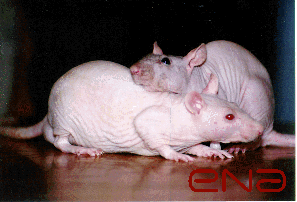
This is Ra and Isis, my first hairless rat pair. All these pictures are of them.
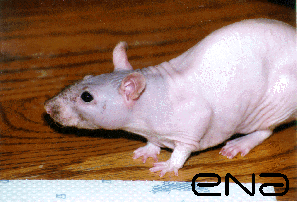
Here's Isis, my female.
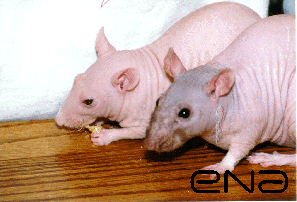
Ra and Isis, respectively.
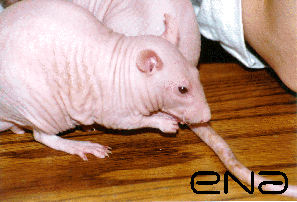
Ra, nibbling on some Corn Chex.
If you would like to add info on hairless rat genetics or if you have hairless rat photos, please send them to me so I can post them.

Comments from Visitors
I found your hairless rat page on the RMCA site. I have 2 hairless rats. There are a couple pictures of them on my page http://www.oocities.org/SunsetStrip/Towers/5998/Rats.html Feel free to use them. A pet store here in Phoenix breeds lots of hairless rats. They usually have at least 20 when I go there. They told me some interesting info about breeding them. Apparently, if you breed a hairless rat, the babies that are black carry the hairless gene. So they use those black ones in their breeding a lot of the time because they are more likely to end up with hairless babies. I have also noticed the differences between the hairless rats. My first one is very hairless with only a few curly hairs and whiskers. The second one like you mentioned, tends to have a little bit of peach fuzz with more around her feet and face. You have some very interesting information. I'm going to add a link to your page. Thanks, Emily
Where Can I get a Hairless Rat?
Hairless rats may be difficult to find, as many of you might have discovered for yourselves. Hairless rats don't usually sell too well in pet stores, as they are an oddity or a curiosity, so they usually don't like to carry them. After receiving some mail as to where individuals can get some of these cute little pets for their very own, I decided to make this helpful bit.
When I started looking for them, I'd find places that were far away that would carry them or other rats, usually reptile places. Reptile people are good contacts for finding rats, as they usually breed them for food as well as hobby. The problem with these places was the fact that they were far away. Now, I'd be glad to ship you a rat, but the problem lies in shipping. Shipping for reptiles is like $30 or $40, but for mammals it's like a hundred bucks from zero to 15 pounds. So it'd be fine if you had a bunch of rats and some people to divide the cost, which may be hard to accomplish. But shipping one rat is gonna cost like a hundred bucks. So shipping is probably out of the question. I'd say try to find a reptile society, there's probably one near you. Or try to to talk to a zookeeper at the (I'm assuming there is one) local zoo. I know a zookeeper who likes feeding hairless rats (as disgusting as that may be) to his arboreal pythons because they're easier to digest. Another thing to do is to try to find a pet store broker, which may be a bit difficult, as I know one only by accident. (She said she can get me jumbo rats that weigh up to five pounds! Is that not amazing?!) The only other thing is to go somewhere where they have rats, which was what I ended up doing. You could try to contact one of the RMCA people and ask if they know anyone who breeds or might have hairless rats in some proximity to you. But I can't guarantee their helpfulness. Oh, and one last thing, if you flew somewhere, I think if you had like a pet carrier you could bring them as carry-on. (And if they die in transit, they'll be carrion. Ok, I'm sorry, bad joke.)
Good luck in your search, I hope you get what you want!
If you have any questions or anything to add, e-mail the toadmaster@oocities.com
This page was created by the ToadMaster, Copyright 1997. Last updated 4/13/1997.
Elements from this page may not be reproduced without the authors permission.
Home | About | Q & A | Art Gallery | Written Word | Rats | Stinky Cheese