 |
 |
||||
 |
 |
 |
 |
 |
 |

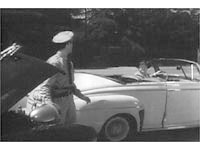
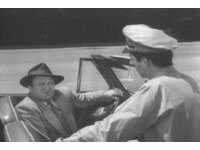
DRIVER: What town is this?
SLIM: Suddenly.
DRIVER: Suddenly what?
SLIM: No, no, that's the name.
DRIVER: That's a funny name for a town.
SLIM: Uh-huh. Hangover from the old days. That's
the way things used to happen here. Suddenly.
DRIVER: I see...
SLIM: Road agents, gamblers, gunfighters.
DRIVER: Well I take it things have changed.
SLIM: Uh-huh. Things happen so slow now, the town
counsel is figuring to change the
 name to "Gradually."
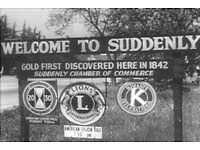
The two men laugh; the driver moves on. The camera pans to a "Welcome to Suddenly" sign as David Raksin's rollicking score announces the opening credits. And so begins screenwriter Richard Sale's anti-pacifist tale of attempted assassination, mainstream values and the violent danger that lurks behind the illusion of safety that used to cling like warm asphalt to the streets of every small American town.
Directed by Lewis Allen and released in the autumn of 1954, Suddenly was the next starring role for Frank Sinatra after his Academy Award-winning performance in From Here to Eternity. In Suddenly, he plays would-be assassin John Baron, a psychotic, small-time hit man yearning to escape his shiftless past. Along with his two accomplices, Bart Wheeler (Christopher Dark) and Benny Conklin (Paul Frees), Baron is hired by parties unknown to kill the President of the United States when he detrains in Suddenly for a little relaxation at a nearby ranch.
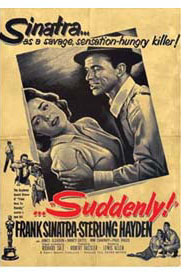 Sinatra's
playing a "savage, sensation-hungry killer" as the original
movie poster proclaims must have seemed risky, but his critically acclaimed
performance paid off and helped solidify his credentials as a dramatic
actor and not just as a lightweight song and dance man.
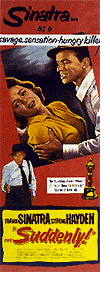
Sinatra's
playing a "savage, sensation-hungry killer" as the original
movie poster proclaims must have seemed risky, but his critically acclaimed
performance paid off and helped solidify his credentials as a dramatic
actor and not just as a lightweight song and dance man.
Sterling Hayden, on the other hand, had nothing like that to prove. As Suddenly Sheriff Tod Shaw, he provides the moral center of the film. His earnest portrayal of the straightforward, uncomplicated Sheriff Shaw wins our sympathy and admiration as someone who sees life clearly and goes after what he wants, even if we might not share his black and white view of the world.
Balanced between these two poles is Ellen Benson (Nancy Gates), a war widow still coming to terms with the loss of her husband. Emotionally unable to move on with her life, she cannot open up to Tod's romantic advances because he represents the world of violence that she's so desperately trying to avoid. Her attempt to shield herself and her young son, Pidge (Chris Kearny), from the cruel realities of the world is portrayed ultimately as a misguided and dangerous female indulgence. This is ironic. In light of subsequent concerns like school shootings, gangsta rap and global terrorism, Ellen's refusal to let her son see violent movies or play with toy guns seems strangely prescient and perfectly understandable.
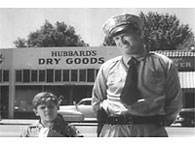
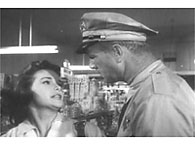
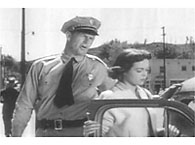
They enter the M&N Market where Ellen, Pidge's mother, is shopping for groceries. Tod and Ellen discuss their ongoing relationship-or lack of one. He tells her he loves her but she puts him off. When she sees Pidge with the toy gun that Tod bought, she angrily tells Pidge to take it off. This is where Tod gives Ellen his NRA recruitment rap that "guns aren't necessarily bad; it depends on who uses 'em." In her defense, she says she's only trying to do what's best. They exit, with Tod dutifully carrying her box of groceries to the car.
Giving it one last shot, he asks her if he can pick her up for church tomorrow (this constitutes a hot date in Suddenly). Again, she refuses to commit herself and Tod turns up the heat by saying he can't keep asking her out and being turned down.
With the emotional relationship established, the scene shifts to the sleepy train station where two clerks, Bebop (Charles Smith of Henry Aldrich fame) and Ed Hawkins (Richard Collier, in the first of his many clerk roles) muse on how it's been a quiet day in Suddenly for the last 50 years. As if on cue, the telegraph wire clicks to life with a message. After reading it, Ed excitedly tells Bebop to go get the Sheriff. Bebop runs all the way to the Sheriff's office, and since Suddenly is a small town, everything's close by (or so it's made to seem). Tod pulls up just after Bebop arrives and they both drive back to the station in Tod's beautiful '54 Nash Statesman accompanied by a wonderfully bouncy David Raksin score that nicely enhances the urgency of the scene.
Back at the station, Bebop wants to know what all the fuss is about, but he's sent away because the telegram is confidential. Once he leaves--muttering Rodney Dangerfield fashion--Ed reads Tod the message of the President's planned arrival:
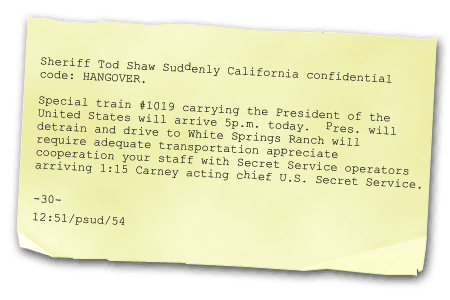
It's now 1:00pm. Tod swings into action. No, he doesn't whip out his gun, he picks up the phone and calls the State Police in nearby Weatherby. He orders five patrol cars, two men per car and one Thompson gun per car, but the efficient State Police Captain already has the show on the road and the cars are on their way. The next task is to arrange a limo for the President so he's off to Kaplan's garage, reminding Ed to keep what he's learned to himself.
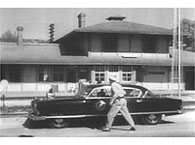
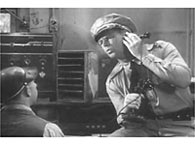
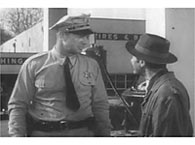
Tod arrives back at the station just in time to meet the 1:15 carrying the Presidential Security Detail -- Agents Wilson (Ken Dibbs), Haggerty (Clark Howat), Schultz (Unknown) and Kelly (Unknown) -- led by Chief Agent Dan Carney (Willis Bouchey). Carney asks Tod if he received the message. In a character-revealing scene, Tod plays dumb until Carney gives him the codeword "Hangover," then Tod still asks to see some identification. If this sounds like a bit of Barney Fife overkill, it doesn't come off that way, although the feds do exchange amused glances over Tod's cautiousness. They return the favor by asking Tod for his credentials. "You're a careful man," Carney tells him.
The agents fan out to secure the stores facing the station. There's one hazard that's particularly troubling: a house on a hill overlooking the station. It turns out that not only is it Ellen's house, which she shares with her father-in-law Peter "Pop" Benson (veteran actor James Gleason at his irascible best), but that Pop used to be Carney's old boss in the Secret Service! Talk about coincidences. Oh well, this is a small town. And if you think it strange that Agent Carney didn't know that Pop lived in Suddenly until now, they make it clear when they meet that they haven't seen each other in a very long time.
 Cut
to the Benson home where Pop hunches over the back of a television set
while Ellen keeps asking him if he's sure he knows what he's doing. Men
love this while they're trying to fix things. Pop's no different, and
good-naturedly chides her for taking it out on him just because she and
Tod had a fight. She retreats to the kitchen where an obviously peeved
Pidge sits at the kitchen table, ignoring her. He's mad because all the
guys call him sissy due to his mother's over protectiveness. Pop takes
up Pidge's case, telling Ellen, "You're a big girl. You've got a problem
you haven't worked out yet. That's no reason Pidge should have your problem."
It's clear this isn't the first time they've gone over this issue and
Ellen once more struggles to make herself understood, unable to rationalize
what good her husband's death accomplished. "Life, liberty, and the pursuit
of happiness sounded real good...," Pop explains, "but they wouldn't have
been worth a plugged nickel if someone hadn't made 'em stick."
Cut
to the Benson home where Pop hunches over the back of a television set
while Ellen keeps asking him if he's sure he knows what he's doing. Men
love this while they're trying to fix things. Pop's no different, and
good-naturedly chides her for taking it out on him just because she and
Tod had a fight. She retreats to the kitchen where an obviously peeved
Pidge sits at the kitchen table, ignoring her. He's mad because all the
guys call him sissy due to his mother's over protectiveness. Pop takes
up Pidge's case, telling Ellen, "You're a big girl. You've got a problem
you haven't worked out yet. That's no reason Pidge should have your problem."
It's clear this isn't the first time they've gone over this issue and
Ellen once more struggles to make herself understood, unable to rationalize
what good her husband's death accomplished. "Life, liberty, and the pursuit
of happiness sounded real good...," Pop explains, "but they wouldn't have
been worth a plugged nickel if someone hadn't made 'em stick."
Pidge excitedly calls Pop to the front window where we see the five state police cars (more of those beautiful old Nashes) racing down the hill from Weatherby to take up position at the train station. Finally, about 20 minutes into the film, John Baron and his henchmen arrive on the scene. They have to stop at an intersection to make way for the speeding patrol cars, impressed by the trooper's punctuality.
At the police station, Tod and Carney go over possible routes the President can take out to the White Springs Ranch. Carney's caution puzzles Tod, who knows every proprietor in town, as well as their children. The chief explains he can't take any chances with the President's safety. Haggerty enters and mentions the house on the hill still isn't secure. With a knowing smile Carney says he's going to check on that personally. Slim bursts in wanting to know "what the Hades is going on?" The town is full of cops. He assumes the national debt is being shipped through Suddenly in gold bars after learning that Mr. Carney is an agent from the Treasury Department. So much for comic relief.
Back at the Benson house, Pop tries out his repairs on the television by plugging it in and holding down a screwdriver in the back. Ellen, displaying hidden talents, warns that electricity is dangerous and that the set packs 5000 volts. Pop tries to defuse Ellen's concern by telling her to "stop being a woman," a great line. This is the first of several setups for a pivotal scene later in the film involving electricity. Pidge turns on the TV and a shower of sparks ensues. Pop is all right but the screwdriver is fried and Pidge asks if 5000 volts is enough to kill you? "Only if you were standing in a puddle of water," Pop explains, "then it would kill you deader than a doornail." After his brush with death, Pop sheepishly agrees to let Ellen call Jud (James Lilburn), the local TV repairman, to come fix the set even though it's time and a half on Saturdays.
The doorbell rings. It's the assassins.
