Asia
|
First Issues Asia |
 |
|
 young Country, ex-USSR republic that became independent in 1991, so
the first cards have been issued recently, by Italian firm Urmet. There
are two values in the set: 25 units showing an old church, and 50 units with the picture of a landscape. young Country, ex-USSR republic that became independent in 1991, so
the first cards have been issued recently, by Italian firm Urmet. There
are two values in the set: 25 units showing an old church, and 50 units with the picture of a landscape. |
|
 |
|
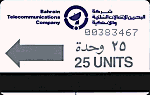
 agstripe cards were
originally manufactured by Autelca on behalf the Bahrain Telecommunications
Company B.S.C. There was a set of 4 definitives with use instructions
in both English and Arabic and black control numbers on the other side.
Quantities printed were: 160,000 for both the 25 and the 50 units; 300,000
for the 100 units, and 80,000 for the 200 units. In 1988 the Autelca cards
were withdrawn and GPT cards, still in use, were introduced. agstripe cards were
originally manufactured by Autelca on behalf the Bahrain Telecommunications
Company B.S.C. There was a set of 4 definitives with use instructions
in both English and Arabic and black control numbers on the other side.
Quantities printed were: 160,000 for both the 25 and the 50 units; 300,000
for the 100 units, and 80,000 for the 200 units. In 1988 the Autelca cards
were withdrawn and GPT cards, still in use, were introduced. |
|
 |
|
 rmet firm supplies payphone system to Bangladesh. The first cards issued were a set of two with the same picture, showing a hand keeping a young plant: values were 25 and 100 units, each one with a printing of 300,000. Six months later, a third value of 50 units was added (350,000 printed), and in 1994 the 100 units was reprinted, buth a new logo on the back side was used. rmet firm supplies payphone system to Bangladesh. The first cards issued were a set of two with the same picture, showing a hand keeping a young plant: values were 25 and 100 units, each one with a printing of 300,000. Six months later, a third value of 50 units was added (350,000 printed), and in 1994 the 100 units was reprinted, buth a new logo on the back side was used. |
|
 |
|
|
agnetic cards supplied by Autelca have been in use since 1994; the first cards have been a set of 4 definitives, B$ 10 (180,000 printed), B$ 20 (150,000), B$ 50 (120,000) and B$ 100 (100,000). At the end of 1994, magnetic cards were withdrawn and an optical system by Landis & Gyr was introduced and is still in use. |
|
 |
|
 wiss-made Autelca magnetic cards are still in use in Hong Kong and the first ones are the so-called red trial series, definitive issues with two different face values: HK$25 (49,000 printed) and HK$100 (14,000). wiss-made Autelca magnetic cards are still in use in Hong Kong and the first ones are the so-called red trial series, definitive issues with two different face values: HK$25 (49,000 printed) and HK$100 (14,000). |
|
 |
|
 ndian phonecards are quite strange and particular, as they are thick plastic cards based on a re-chargeable chip technology, so they are charged several times and for this reason they are not often found used in good conditions. Moreover, these cards have a detachable corner, like the Urmet cards, so a mint card can be distinguished easily from a used one. ndian phonecards are quite strange and particular, as they are thick plastic cards based on a re-chargeable chip technology, so they are charged several times and for this reason they are not often found used in good conditions. Moreover, these cards have a detachable corner, like the Urmet cards, so a mint card can be distinguished easily from a used one. |
|
 |
|
|
srael's 40th anniversary
celebrations in June 1988 saw the presentation of two prototype card-operated
public payphones. The cards, just 300, were supplied blank by Landis
& Gyr of Switzerland and then printed by silk screen in Israel.
Landis & Gyr optical cards are still in use and issued
in several designs and big quantities, but it seems that something is moving towards
chip cards technology. There have been some trials inside certain Israeli Universities since 1996, and this is the first chip card issued by Bezeq. Again, just 300 printed: needless to say, Israeli first issues are among the hardest ones to get! |
|
 |
|
 or a long period, the only phonecard issued and sold in Jordan had been a magstripe card, used for a short trial of a public payphone system. It was sold sealed inside
a paper bag, so if you want to have a look at it, you had to break the bag. The trial wasn't successful, and only in 1998 new cards were issued, this time using chip technology. Since then, lots of cards have been issued by the two phone companies operating in the Country. or a long period, the only phonecard issued and sold in Jordan had been a magstripe card, used for a short trial of a public payphone system. It was sold sealed inside
a paper bag, so if you want to have a look at it, you had to break the bag. The trial wasn't successful, and only in 1998 new cards were issued, this time using chip technology. Since then, lots of cards have been issued by the two phone companies operating in the Country. |
|
 |
|
|
utelca magstripe cards have been supplied firstly in 1986 and are still in use, even if chip card operating phones have been introduced recently for international calls. |
|
 |
|
|
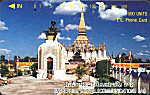
agnetic cards manufactured by japanese Anritsu are supplied to Laos since 1992 and several ones have already been issued. Two cards ($50 and $100) existed previously, originally prepared for Laos, showing particulars from a temple and the wordings on back indicating their use in this Country: they have never used there indeed but supplied to the Australian Cambodian Force. |
|
 |
|
 he first phonecards of this Country, supplied by italian Urmet, were issued in 1995, with two subjects: 100 units, advertising a movie festival, and 200 units, showing a white house. Just 5,000 of each were printed. he first phonecards of this Country, supplied by italian Urmet, were issued in 1995, with two subjects: 100 units, advertising a movie festival, and 200 units, showing a white house. Just 5,000 of each were printed. |
|
 |
|
|
he first
set of 4 magnetic cards were supplied by Autelca of Switzerland, but they were
phased out in 1988. Subsequently magnetic cards supplied by GPT, U.K., were adopted and are still in use. |
|
 |
|
|
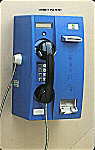
t least three different systems are in use in Pakistan: magnetic, optical, and chip. The first cards to be issued in the Country were magnetic cards supplied by Urmet: there were two cards, both showing the blue phone on one side, and two different colors on back: yellow for the 100 units (375,000 printed) and red for the 200 units (135,000). |
|
 |
|
 ifferent phonecards systems are in use in Philippines, but the first cards have been issued by japanese Tamura so they are thin magnetic type. One year later, GPT system was introduced, and, more recently, chip cards too. ifferent phonecards systems are in use in Philippines, but the first cards have been issued by japanese Tamura so they are thin magnetic type. One year later, GPT system was introduced, and, more recently, chip cards too. |
|
 |
|
 olorful GPT cards which are well known to collectors were introduced in Singapore in 1989, but Tamura cards have been in use since 1985. The first cards were a set of 5 values, $ 2 (160,000 printed), $ 5 (30,000), $ 10 (10,000), $ 20 (10,000), and $ 50 (10,000): they were without notch as typical of cards in that period. Later on, in 1987, larger quantities of cards were reprinted with the same graphics, but they could be easily distinguished by the first ones as this time they are notched. olorful GPT cards which are well known to collectors were introduced in Singapore in 1989, but Tamura cards have been in use since 1985. The first cards were a set of 5 values, $ 2 (160,000 printed), $ 5 (30,000), $ 10 (10,000), $ 20 (10,000), and $ 50 (10,000): they were without notch as typical of cards in that period. Later on, in 1987, larger quantities of cards were reprinted with the same graphics, but they could be easily distinguished by the first ones as this time they are notched. |
|
 |
|
|
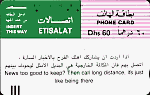
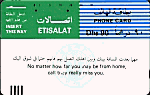
ollowing some successful trials during 1986/87, Tamura cards were adopted and the first public set was issued in 1988: there were four different cards, each one with a different slogan about telephone sevices, but for each slogan there were four different face values too (30, 60, 90, 120 Dhs): that is, the first complete set includes 16 cards! Another "slogan" set was issued later on, in 1989, then some sets of pictorial cards. In 1994, Tamura system was discontinued and Etisalat switched to chip cards system. | ||||
|
|
 allcards@mail.com |
 |