
Mahdia Fatimid Dynasty
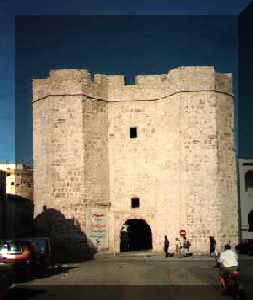 The city of Mahdia
lies south of Monastir.
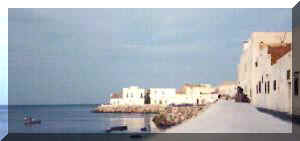
It is located on the rocky promontory of Cape Africa, which gives
the city a unique and most endearing aspect.
The city of Mahdia
lies south of Monastir.
It is located on the rocky promontory of Cape Africa, which gives
the city a unique and most endearing aspect.
Mahdia's history is closely related to that of the Fatimid
dynasty. This very important line of Muslim rulers made it
their capital. The Fatimids, a Shiite dynasty, claimed to be
descendants of Fatimah, the daughter of the prophet Muhammad. The
town was founded in 916 by Caliph Obeid Allah, El Mahdi
("the Saviour" in Shiite religion). He gave the town
its name and in 921 Mahdia was promoted to the rank of capital.
Mahdia protected its founder during the eight-month siege
(944-945) led by the Kharijite troops of Abu Yazid (he was
crucified on the Skifa el Kahla and his skin was to be stuffed
with straw afterwards).
The Zirids
found refuge in Mahdia in 1057 after the Beni Hilals had overran Kairouan.
The Norman armies of Roger II ejected the Zirid rulers in 1148.
Twelve years later, the Normans themselves were in turn driven
out by the Almohads.
In 1390 a Franco-Genoese fleet tried to overtake the port,
without success. In 1549, the pirate Dragut managed to get hold
of Mahdia. After a triple bombardment, Charles the Fifth took
over the town and stayed there from 1550 to 1554.
From that moment on, more and more people started leaving the
town. Its population only started increasing again after the
arrival of the Ottomans.
Local people were joined by Greeks, Andalousians, Albanians and
Anatolians.
Under the French
Protectorate, Mahdia became the prominent port of Tunisia. It
also became an important site for the production of canned food,
due to the fact that the region provided the olive oil from the
Sahel and that salt was exploited there until 1938.
Mahdia got its protection from a double wall : the first was
fortified by 9 towers and the second, which was 175 meters long
and 10,80 meters thick (!), consisted of 2 towers and 4
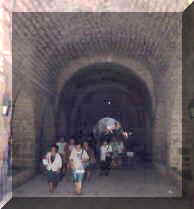
gatehouses, including the Skifa el Kahla. This particular
impressive passageway was designed to be closed with a
wrought-iron gate and several successive portcullises. Each leaf
of this gate, decorated by a bronze lion, weighed 8 tons.
A less impressive wall (2,45 meters thick) surrounded the port.
It was protected by 2 towers, connected by a chain.

Mahdia has managed to preserve all of the charm of its ancient
heart. Today, like in the old days, you can still hear the
shouting of fishermen animating the harbour, especially in the
summertime. The modern pier along the harbour is the venue of the
lively Fridaymarket. In the centre, the silence of the summer
afternoon is only slightly disturbed by the rhythmic noises
produced by weaving-looms : skilful ladies are weaving the
gorgeous wedding dresses that are the pride and glory of the
city.