
Trutnov


|
|
The Environment Trutnov |
|
|
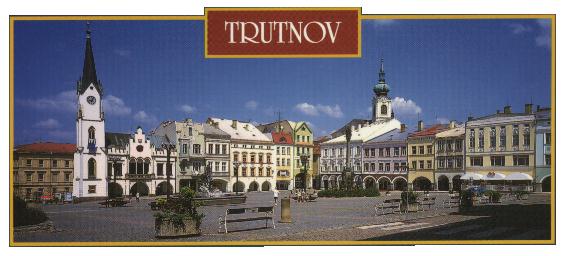
The district town of Trutnov of 33.000 inhabitants is situated in the picturesque valley of the mountain river Upa and on the adjoining hills, in the country at the foot of the Krkonose Mountains which is well forested and closed on horizon by the wall of the Krkonose Ridge with its 1.602 metre Snezka. It spreads 427 metres above the sea level.
How and when did the fabulous dragon (originally it was a crocodile which was, in the legend of the foundation of Trutnov given the frightening appearance of the dragon by the imagination of our ancestors) get to Trutnov? Very probably it was brought here in the time of crusade wars one of the Trutnov feudals or the members of Cross Order, founded in Jerusalem, who, together with the Moravian clan of the the Trutnov country.
The beginning of Trutnov is immediately connected with the Upa River which was of vital importance for the town. Down its valley there led the roads and its waters, brought to the mill race, drove four mills, a paper mill and the first factories and power stations. A long time before the river had also given its name to the Slavonic settlement from 12th century, the predecessor of today's Trutnov. Later it was renamed as "a lovely spot by the meadow" by the colonists coming there under the last of the Premysl Family from the neighbouring Silesia.
The first written documents about the town come from 1260 in a paper of Idik of Svabenice and in paper of the Prague Bishop Jan, where it was even mentioned as the second Upa contrary to the first Upa originating in the place of today's Upper 0ld Town. The name of Trutnov is first given in a document by Wenceslas II. in 130l. Since the end of 14th century Trutnov was the town of the Czech queens, a dowry town.
The town walls whose torso has been preserved especially in the Water Street and the Street on the Race surrounded the inner town from 14th until the middle of 19th century. Now they only saddly evoke the old stone strength and pride of the Medieval town which, throughout its history, was only rarely conquered by enemy.
The centre of the life of Trutnov was the oblong square 98x82 metres with pairs of streets at every corner. These later joined each other in the area of the Lower Gate in the East and the Upper Gate in the West. From the centre of the square the Mountain Street led to the North arched by the Middle Gate at the place of the today's Post-Office.
In 16th century the rarity of the Trutnov Upper Gate were its two beer bells, whose striking used to bring an end the sitting over a glass of beer. Breaking this rule was followed by a fine and a prohibition to visit the pub for, say, a whole year. The Trutnov pubs (the number given for 1900 states there were 76) were fulitfully supplied by the two Trutnov breweries. One of them, from 1582, has still been brewing beer until today.
One of the dominants of the Krakonos Square is the Baroque 11 metre column of the Saint Trinity from 1704 with Czech, German, and Latin inscriptions. (The cryptogram in the Latin text - the capital Latin letters are to be read as Roman numerals - give the year of its construction.) The column, around which we can still find parts of the original pavement of the square with the so called "cats' heads", the stones from the bed of the Upa River, is placed on the spot where the executions once took place.
To the still existing Baroque sights of Trutnov belongs the group of sculptures of St. John of Nepomuk and the Saint Family from the beginning of 18th century, the work of the Pacak brothers, the pupils of the famous Matyas Braun.
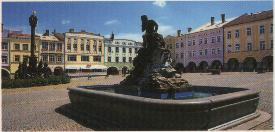
The pride of the square is its fountain from which the ruler of the Krkonose Mountains, Krakonos, has been looking down at the town, which is the gate of his native mountains, since 1892. Before that a Dragon Well with a fabulous monster had been there for 100 years.
The old Town Hall was given its New Gothic appearance after the fire of Trutnov in 186l when the whole of the inner town, except for 18 houses, burnt down. Its original Renaissance looks back in 16th century, the work of the Italian architect Valmadi, is recalled by the sgrafitti decorations, renovated in the 1980's on the side and back parts of the building.
From the point of architecture the Haas Palace is very valuable, standing opposite the Town Hall and coming from the year 1885. It was the original representative residence of a rich factory owner's family. Nowadays it is the seat of the Basic School of Arts.
The Krakonos Square with nicely renovated houses bearing some features of the Baroque, Empire, and Classicism styles brings back the memories of many events from the history of town. In l775 it was simmering with revolting bondsmen, in the revolutionary year of 1848, 160 members of the National Guard gathered there under the leadership of Uffo Horn to set out and help the fighting in Prague. During the Prussian-Austrian War in 1866 the square became the stage of bloody fight. A memorial board with the date of June 27, 1866 on the pavement of the south-western corner of the square marks the place from which the Mayor Roth and l8 citizens were taken hostages and brought to the Prussian fort of Hlohov for their so called treason and accussation of having taken part in the fighting in the town.
Churches also belong to historical sights of Trutnov. The oldest one is the Church of St. Wenceslas in Horni Staré Mesto, which was mentioned in annals as early as 1313. The Renaissance wooden polychrome epitaph from 1606 depicting the numerous family of the king forester Nuss of Trutnov is its most valuable relic of art.
The Church of the Virgin Mary's Birth is a late-Baroque building from 1782, a work of builder Leopold Niederecker who moved to Trutnov from Vienna. The main altar carries the picture of the Virgin Mary's Birth by J. Q. Jahn from 1784.
The Church of St. Peter and Paul in Porici from 1903 is a neo-Gothic building of this century. The evangelistic neo-Gothic church in Upice Street from 1900 was reconstructed in 1980 and changed into the Concert Hall of Bohuslav Martinl'.
The Trutnov cemetery from 1875 hides a lot of the history of the town. Several tombstones brought from the old churchyard and the church can be seen at the Chapel of St. Cross built in neo-Romanesque style. The forged grating of the tombs of Trutnov's early manufacturers carrying bizzare figures and sculptures of dragons, birds, flowers, ornaments, angels, the Virgin Mary and Christ is a remarkable work of art from the cemetery. The poet Uffo Horn and the defender of Trutnov workers Wilhelm Kiesewetter rest here too.
We can also see the memorial to 334 Trunov citizens killed in World War I. by Trutnov sculptor Emil Schwantner, the monument to Czechoslovak soldiers, the tombstone of Jewish women from the concentration camp in Porici, or the monument to the victims of World War II. It was a tragic culmination of the complicated development in the twenties and thirties of this century, and consequently it brought an immense material and moral damage to the citizens of Trutnov too. We try to overwhelm and repair its results in our post-November times.
