Boxhill and Westhumble Station, Surrey
 |
In 'The Culex Experiment', Kevin encounters an insectile menace while en route to meet Megabyte at the local railway station. Arriving at the station in haste, he collapses in a telephone box.
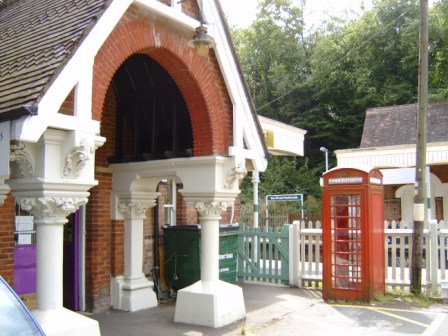
The distinctive architecture identifies Boxhill and Westhumble station in Surrey. For more details, and photograph comparisons, see seperate page on Boxhill and Westhumble Station. (Left) The front entrance to Boxhill and Weshumble station - now a Florists' shop. August 2006
|
|
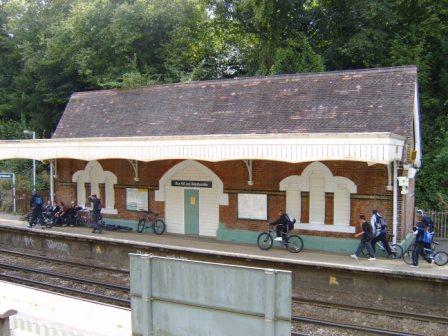
(Right) Boxhill and Westhumble Station - down platform station building seen in August 2006. Boxhill station is notable for being the closest station to Box Hill - one of the Surrey Hills range that includes the OS location Leith Hill. Like Leith Hill, Box Hill is owneed by the National Trust and is a site of special scientific interest due to the presence of rare orchids. The main Boxhill station building was built in 1867, is now a listed building, and has been restored to its full Victorian splendour since the filming of 'The Tomorrow People'. (Map)
|
 |
Busbridge Lakes
The `ghost walk' at Busbridge Lakes in Surrey appeared on screen as the gully and cave to which the possessed villagers led Jade in `The Living Stones'.Busbridge Lakes is a garden and waterfowl haven based around a string of narrow lakes, set in a natural valley near Godalming in Surrey. The natural setting was formed into a park for Busbridge Hall in the mid-seventeenth century by William Elliot, and extensively relandscaped into a pleasure garden by eccentric antiquary and Member of Parliament Philip Cartaret Webb between 1748 and 1770. Together with later additions by Henry Hare Townsend in the nineteenth century, they reshaped the park into a landscape of gothic follies and caves. The `ghost walk' is a narrow rock-lined ravine, with a number of large boulders embedded in the sides and a small hermit's cave opening from it. Originally small niches and alcoves in the gully were adorned with brilliant white sculptures giving the appearance of ghosts in shadow.
The original Busbridge Hall was demolished around 1906 and replaced by a large lake. The current Busbridge Lakes House was created from the former stables. The house and grounds were grade II* listed in 1960. Since 1966, it has been owned by Mr and Mrs Douetil and used for wildfowl breeding. It is open for the public for brief intervals each year, usually centered on bank holidays. The lakes and gardens are not far from Guildford. The nearest railway station is Godalming.
Hascombe, Surrey
| Hascombe village in Surrey was portrayed as Jade's home village of 'Mulberry Wood' in 'Living Stones'. Among the aspects of the village to feature were some distinctive English village cottages, as well as the village pond and the local church which replaced the earlier (most likely Norman) church in the 19th Century.
For more photo comparisons between the site now and in the 1990s see the seperate page on Hascombe.
|

|
|
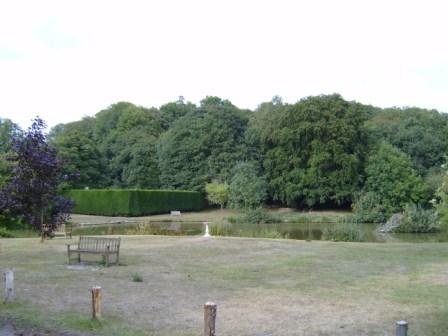
(Photos) Stillwell Cottages and the village pond in Hascombe, Surrey, seen in August 2006.
Hascombe, on the Surrey Greensand and just 10 miles from Leith Hill, has been in continuous occupation since before the Norman invasion, and nearby Hascombe Hill is the site of an Iron Age hillfort. The village had a population of 274 people in the 2001 census, and lies in an Area of Outstanding Natural Beauty. See streetmap.co.uk for a map of this location. |
Heywood Manor
Lady Mulvaney's residence appears in `The Origin Story'. The scenes were filmed at Heywood Manor in Surrey - one of the few locations to appear in both televised incarnations of The Tomorrow People. For full entry see OS pages.Quite where this location is intended to be is far from clear. It is presumably intended to be in America since it is within helicopter and driving distance of Florida, and is also in an American time zone. However, the helicopter in question is UK registered - G-BMIB was in fact registered to an owner in Beaconsfield until 28th May 1993. Also, if the house was intended to be in the US, why is there an appearence by a lookalike of Her Majesty The Queen?